Wednesday, July 13, 2016

Publish No Story Before Its Message Is Right


Color me perplexed. I’m having trouble getting a blog post right. I know what I want to say. I’ve said it a few different ways. A couple are eloquent, well-crafted. But I fear I’m in love with the sound of my own (writer’s) voice, and the message is still not quite right.

So what do I do? Post it anyway? You can tell by the gap between posts that has not happened.

No, I've come to a conclusion that applies to anything I might write — blog posts, emails, short stories or entire memoirs (not to mention novels, cookbooks, or any unpaid project that lacks an urgent deadline). This conclusion may also work for you:

IF YOU DON’T FEEL IT’S READY, 
IF YOU CAN’T QUITE MAKE IT WORK, 
WORK ON SOMETHING ELSE.

How simple is that? Back off. Write something else. Edit something you’ve already written. If you’re still not clear, try
  • discussing the topic with friends.
  • journal or free write about it.
  • read up on the topic
  • asking yourself, “What am I trying to say?”
In general, Give your problem piece space and before long, it will pop into clear focus. And if you write something else in the meantime, you'll at least have something to show for your time.

Photo credit: Ron St. Amant, shared by Creative Commons License

Saturday, July 9, 2016

Progress Report

Much of the design work has been completed over the past few months. The 3D model, drafted in Rhino 3D, is largely complete. Construction techniques, including materials selection, joinery techniques and order of assembly have been largely worked out.


The cockpit design, the deck arches, the tiller linkage, tanks and lockers and many other details have been worked out in detail. We have designed a very strong structure for stepping the mast tabernacles, constructed out of 4x4 hardwood timbers glued and bolted together.


This structure, fastened and glued to the deck, bottom and sides of the hull, will also provide plenty of resistance to torsional loads, side loads when docked and strengthen the foredeck.


We are still working out such minor details as tiller design, hatches, interior cabinetry, wiring and plumbing, and running rigging.


The model has been hydrostatically tested using Orca3D software. (We are very grateful that Orca3D has agreed to sponsor our project, and has donated two seats of their excellent software for our use.) Hydrodynamic tests will have to wait until we build a 1:12 scale model, and conduct towing tests and other types of in-the-water testing.


The good news is: there are no surprises at all. The hydrostatic tests have confirmed the initial calculations: QUIDNON, ballasted as initially designed, is going to be seaworthy and reasonably fast.


Moreover, it will be able to carry considerable freight. Here is a table of draft (with centerboards and rudder blades retracted) vs. load.

Load Draft
0 12.9 inches
10 tons 25.3 inches
20 tons 34.6 inches


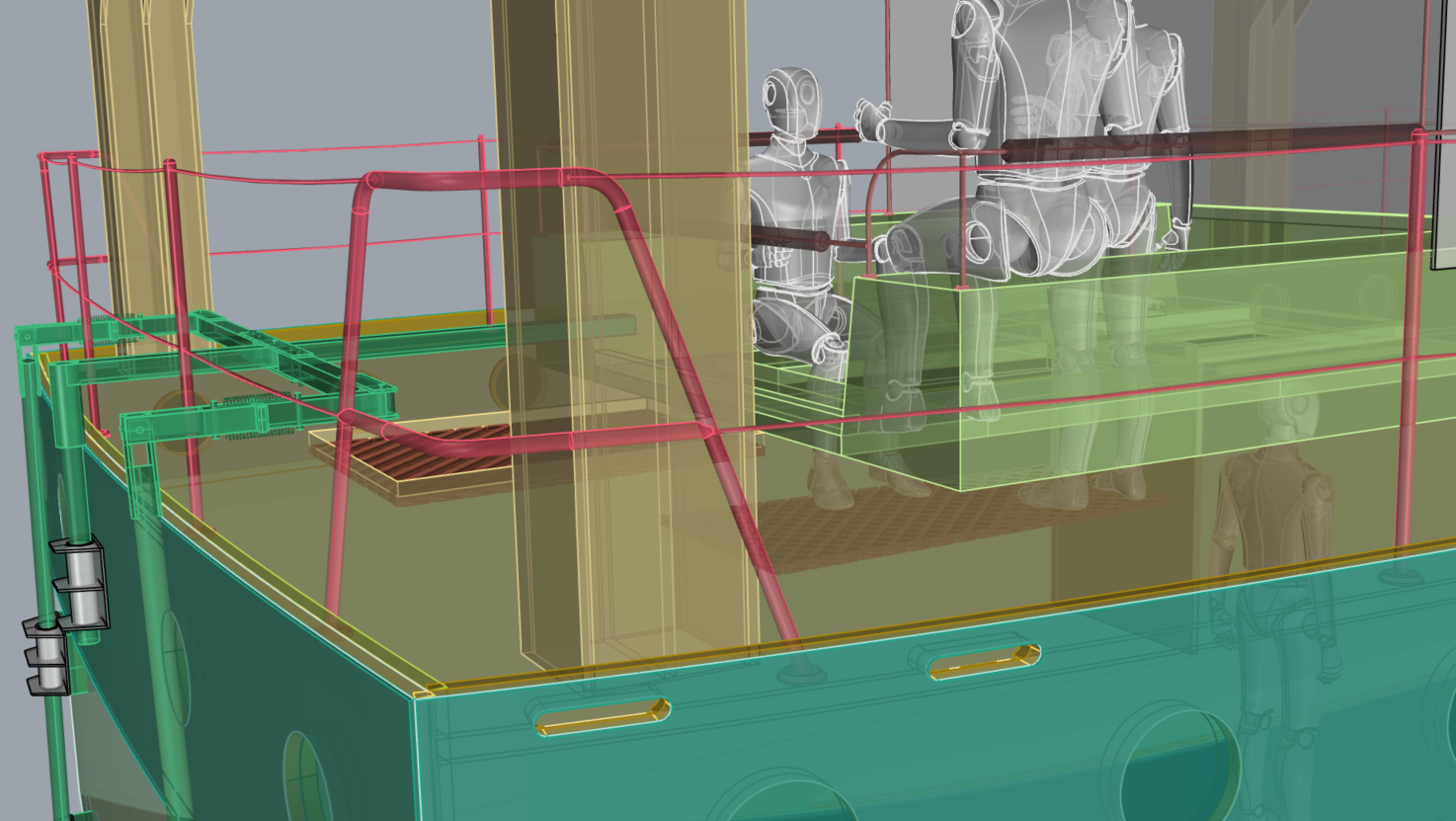
Shown above is the aft amidships section: two 20 lb. propane cylinders in an ABYC-compliant propane locker with an overboard drain, a 100-gallon gasoline tank below it, and a 40 hp outboard engine forward of it in an inboard outboard well.


According to results from Orca3D analysis, fuel consumption and speed will be as expected. As the above chart shows, even when loaded with 20 tons of freight, QUIDNON will do a comfortable 7 knots with a 40hp outboard at half-throttle, burning 2 gallons per hour, for a 350 nm cruising range. Without freight, its cruising range increases to over 600 nm.

It is interesting to note that when QUIDNON isn't loaded, as speed increases from 7 kt, power requirement shoots up. This is because the hull form is a compromise, and at 0 load the transom bogs down faster than when loaded. But this effect will be pronounced mostly when motoring; when sailing the center of force will be further forward, keeping the bow down and presenting a smaller profile to the water.

And so it is safe to conclude that QUIDNON will work very well as a live-aboard boat. You pay for a 36-foot slip and you get around 540 square feet of interior living space, plus just as much space on deck, which is plenty of space for living aboard and for throwing dockside parties. It is fast and economical enough to make a good canal boat, and with a 20-ton cargo capacity it can be used to bring back a year’s worth of harvest from wherever you hunt, gather or grow it back to your winter quarters.

But is it seaworthy?


But, you probably still want to know, Is it seaworthy? To an engineer, this is a fairly annoying question, because there is no technical definition of seaworthiness. And so I will apply my own definition. Seaworthiness is the ability to survive arbitrary conditions at sea. By “arbitrary conditions” I mean something that includes arbitrarily high, almost vertical walls of very angry water, with spindrift blowing from the wave tops at well over 100 miles an hour.

By this standard, few boats are actually seaworthy. We can immediately rule out all catamarans and trimarans: they are more stable floating upside-down than right-side-up, and once a rogue wave flips them over, it’s game over every time.

We can also rule out most yachts, large and small, with tall masts: once the masts hit the water, more often than not they snap off, and, again, it’s game over, every time. So masts have to kept quite stubby. In QUIDNON’s case, the masts measure exactly 36 feet from the mast tabernacle hinges, because they can’t overhang the bow or the transom when the masts are dropped and secured to the deck arches (for canal work, to pass under bridges). And the reason they can’t overhang is because that would increase QUIDNON’s overall length (LOA), incurring increased slip fees at marinas, and we can’t have that.

Secondly, we can rule out all large commercial ships: tankers, cruise ships, dry bulk carriers, container ships, etc. All of them are designed for a maximum wave height, and a big enough wave will capsize them, break them in half, or both. Over a hundred ships are lost every year in just this manner. But “fixing” this problem would be too expensive, and rogue waves are rare enough to keep marine insurers in business.

But we who sail around in small boats do like them to be able to survive almost arbitrary sea conditions. And if you try to design something that is completely seaworthy, by this definition, you end up with a coconut every time. But who wants to sail around in a coconut? (Actually, QUIDNON’s hull shape comes pretty close.)


Hydrostatic analysis shows that QUIDNON is self-righting up to 130º. It is very tender when level, and just walking across the deck is enough to make it list a few degrees. But beyond 10º it puts up a very serious fight. In fact, while sailing, it is probably not possible to make it list more than about 25º, in any sort of useful wind. It continues to put up a very serious fight until about 70º. Thus, any sort of sudden squall will lay it over for a bit, but with no serious consequences (unless you fall overboard, but that's verboten).

At around 90º, it gets ready for Round Two, because at that point the masts are in the water, and they are buoyant because they are filled with foam, weighing in at negative 8.5 lb. per foot of length, with a huge lever arm. Only beyond 130º does QUIDNON develop a propensity to turn turtle and settle.


When inverted, it is only about half as stable as when it is floating right-side-up, and if it lists by more than 50º it will right itself. Thus, if a big enough wave flips it over, leaving it floating at some arbitrary angle, there is only a 27% chance that it will be left floating upside-down. And if a wave big enough to capsize it comes along, there is about a 50% chance that the following wave will be at least half as big, enough to lean it over by at least 65º, and since 65>50, QUIDNON will then right itself. And so the chance of QUIDNON remaining bottoms-up after a rogue wave event is no more than 15%.


This, I would think, is quite seaworthy—for a houseboat. However, we must keep in mind that it is a houseboat, and even though we can take it out on the Big Wobbly with quite a lot of confidence, we should still remember that we are just moving house, not embarking on an extreme survivalist adventure at sea. And so, we should take certain precautions. These are divided into strategy and tactics.

The strategy is to avoid storms by carefully picking weather windows. For longer passages, on which storms are impossible to avoid completely, the strategy is to carefully pick weather windows for getting away from land, and for making landfall. The idea is to be nowhere near anything at all when bad weather hits. Rocks and shoals kill boats; wind and water—not so much. This is the sort of advice you can get from any number of books.

Another part of the strategy is preparing QUIDNON for bad weather, and it is QUIDNON-specific. QUIDNON can sail just fine with unstayed masts, but when making ready for the open ocean a bit of standing rigging makes a lot of sense. A triatic line is connected between the mast-tops, and two running stays are connected to each of the mast-tops and tensioned, the two from the foremast running forward, and the two from the mainmast running back. This set-up is traditional; Tom Colvin had lots of luck with this arrangement. Also, obviously, anything that could possibly shift in a capsize should be secured, both above and below deck.

The tactic is simply to ride out the weather, in the usual sequence: heave to, lie ahull, lie to a drogue, scud off under bare poles. Make a pot of stew, batten down the hatches and hunker down. Again, you can get this sort of advice from any number of books. Unless you are particularly unlucky, seriously bad weather generally passes in 2-3 days, and so with QUIDNON drifting at about 1 knot you’ll need about a 100 nautical mile offing from the nearest hard object to drift safely.

Since this is much more seaworthiness than one has any right to expect from a houseboat, and since it comes at very little additional expense (filling the masts with foam and rigging some running stays is pretty cheap) we will consider this aspect of the design handled.

Wednesday, June 15, 2016

Personal Essay: Pathway to Clarity, Persuasion and Power

What’s the best way to air your personal views? First get clear on what they are, then write a personal essay!

Write an essay? you ask. Me, write an essay? Surely you joke!

I get that. I’ve spent most of my life thinking the same thing. Like most people, I always thought of essays as noxious English class assignments that fed dry toast to brains. 

That was before personal essay and creative nonfiction came of age. Now I recognize essays as both a tool for getting my thoughts clear and orderly, and also a dimension of story — stories explaining what we think and believe and why. Stories exploring Truth. They interlace nicely with stories about experiences. Most stories are hybrids, with elements of both.

Well-written personal essays sizzle with energy and sometimes humor. They make you think. I know this, because I’ve read a pile of them lately. The ones that spurred this post are blog posts by Kristen Lamb.

Two in particular are so powerful I hope they go viral. Both are calls to action, inciting the nation to get a grip and reclaim our sense of balance and humor. While well-meaning and serving an initial purpose, the Political and Emotional Correctness Police have become Nazis, and who isn’t tired of walking on eggshells all the time? I urge you to read them for yourselves:


In her essays Kristen mixes observations on the current state of cultural values with personal reflections on how these values affect them and society at large. She begins her first post by citing an article, “Is America Starting To Target Thought Crime?” That article reports on how Michele Obama anointed graduating high schoolers as thought police for their families. Yikes!  Kristen went on to build on the ramifications of that.

Her second post continues the theme. I don't see how anyone who reads Kristen's posts can avoid personal reflection and become more clear on personal thoughts.

I haven’t queried Kristen about the process she used to compile these essay/posts, but I’d bet a dime to a dollar that she learned something along the way. That she was more clear after writing than before.

How does that work? How can you do that? 

A few years ago I invited Sheila Bender, noted personal essay writer and teacher, and author of highly acclaimed Writing and Publishing Personal Essays,  to write a series of three guest posts, “Finding Starts in Personal Essay Writing.” That wheel still rolls smoothly down the road, so I invite you to take a few minutes to read through them.


Whether you plan to influence the world or not, do give personal essay writing a try. Take something you often ponder and write about your thoughts and feelings about it. That might be as seemingly simple as the challenges of being short, or something like the current Orlando tragedy. See where it goes. Who knows? You may write something as compelling as Kristen. Or you may just be more clear on your views and able to discuss them more effectively with friends and neighbors.

Points to Ponder: What do you want to be more clear about? What keeps you from sitting down to write? Would it help to write about the fears or reasons for reluctance? They may be the key to unlocking your power. 

Monday, May 30, 2016

Things Happen When It’s Time


Things happen when it’s time. The longer I live, the more strongly I believe that. I know this sounds like a cop-out to lots of people, and I don’t mean it in the sense that we shouldn’t set goals and target dates and all that good stuff. But sometimes life intervenes with the best-laid plans, and sometimes we don’t know what we don’t know until … suddenly we do.

My latest example is my car keys. I take them with me when I leave the house, even when I know my husband will be driving. Such was the case last Monday. Tuesday I reached for them to head for a meeting, and they were nowhere to be found. We both turned my purse inside out and searched every nook and cranny in the car. I checked pockets. I folded laundry and reorganized our closet. I cleaned my desk and the catch-all drawer. I retraced our steps the previous day. Those keys had disappeared.

I was stuck! I had nowhere else to look. I lived in limbo for days, dreading the cost of a replacement key.

Six days later, some spirit moved me to look in my purse again. Happy Dance time! The keys were in a side pocket I never use and we’d both overlooked. I found them when they were ready to be found. (Go ahead and laugh — or scoff. I'm not offended.)

In my last post, "Getting Traction," I wrote about being stuck. I was stuck because I was working with the wrong concept and didn’t know it yet. I was, as Ruth Pennebaker puts in her recent book title, a "woman on the edge of a nervous breakthrough." Last week, reading a guest post written by Janet Givens’ dog and riffing with Ian Mathie in the comments pushed me over the edge and that breakthrough occurred. A totally new concept struck me like a bolt of lightning. I’d been writing the wrong book! I was writing more of the same, and it’s time for a radical new approach. Of course!

This was not a fuzzy concept I had to wrestle to the ground. It was delivered complete in all detail. All I have to do is write. Which is what I’ve been doing for several days now. I’m out of the sand and have traction again.  It’s going well.

But it won’t be finished right away. Life is still intervening. As I knew it would, a large editing and manuscript preparation assignment arrived in my inbox today. That job has top priority. Even without the interruption, my project would take a few months. But that’s okay. It will be done when it’s time. If I try to hurry the writing, on this book or any project, I’m likely to miss something crucial, like finding out I’m on the wrong path.

I’m not the only one who’s been stuck on a wrong writing path. I know several others whose projects floundered until they realize they had some hidden issues about content that were unresolved. Once they realized this, things snapped into focus and their stories took a much better shape.They weren't ready to understand the needed shift in focus until it happened. It wasn't time.

By the way, I’m more than a little convinced that the playfulness of Janet’s post, combined with the banter with Ian, was a magic key that unlocked the new concept. We’re never too old to laugh and play.

I’m adding three new items to my checklist for things to do when I’m stuck.
  • Go back and read the map again to make sure I’m on the right path.
  • Take time out to play. Have fun. Get wild and crazy and laugh a lot.
  • Keep sight of the goal and have faith that I will get there. When it’s time.
Points to ponder: What do you do when you feel stuck? What is your favorite, most powerful form of play?

Sunday, May 22, 2016

Getting Traction


Anyone can lose traction on a writing project. Anyone. Maybe a few ancient veterans of the writing world have developed immunity, but the other 99% of us, yes, that includes me, can lose our way (a version of that dreaded malady writer's block).

I’m surprised to find myself in this state right now. In mid-April I attended the Story Circle writing conference held here in Austin every two years and came home wired to write. Unavoidable distractions kept me away from my keyboard for several days and that flame began to wane.

My main, get-it-done-ASAP project was and is a rewrite of The Heart and Craft of Lifestory Writing, which sold out three print runs and has been left to rest in peace (you can still order used copies via Amazon). I did make a strong start on the new version for a couple of weeks.

Then a fantastic series of webinars on hosting online courses intervened. More than a dozen compelling videos were posted, but only for several days, so that soared to the top of my list. Each session or replay lasted nearly two hours not counting time for making notes and checking things out. More distraction. New ideas on courses (I hope you’ll be able to benefit from one of those late this year or early next) and additional ideas for the rewrite gushed forth as I watched. I felt highly creative. But ...

I was not writing!

So here I am today ...
  • Weeding my garden. 
  • Talking to neighbors.
  • Folding piles of laundry. 
  • Making salad for a family celebration. 
  • Answering email. 
  • Cleaning the shower.
  • Writing this long-overdue blog post.
  • Looking longingly at a tall stack of books to be read.
  • Stopping to wrap and freeze yesterday’s chicken parts.
  • Making fresh coffee.
  • Contemplating my mending pile. 
  • Rethinking shelf design for my office. 
  • Feeling lost and overwhelmed!

I can fix this. I can get out of this sand trap and regain traction. Here’s my thumbnail plan for getting my wheels moving down a solid road:
  • Spend ten minutes free writing about why I’m avoiding my project. Yes, I know the reasons, but writing makes thinking visible and seeing it on the page makes it real. Those obstacles become more manageable when I actually see them. (I just checked that off. You see the resulting list).
  • Keep my Work In Progress (WIP) document open when I leave my computer and make sure it’s the only window visible  to minimize distractions.
  • Create a prioritized ToDo list, including at least half an hour of writing every day! I can get a lot done in half an hour — if I know that’s enough.
  • Apply the Swiss Cheese technique to write manageable chunks in those 30 minute windows. I slid into that sand trap when I allowed a much larger project concept to overwhelm me.
  • Make and hang a small poster behind my computer to remind myself to write now, edit later. (Uhm, is this another distraction? More avoidance behavior? Perhaps ...)
  • Make a separate list of random thoughts about all phases of my WIP.
  • Keep a notepad handy for capturing thoughts while I fold laundry, weed, etc.
  • Keep selected people posted about my progress. They'll keep my feet to the fire and help me stay on track. 
None of these are new ideas. All are included in the original book, and I've blogged about each many times. You may know and use several yourself, but sometimes we all need a whack on the side of the head to get back to basics, use what we know, and
WRITE ON! 

I must also mention that other things surfaced in that freewrite involving my Inner Critic and other dark things. But that's another story for another post. Points I included here are enough to hold the others at bay.

Now, I feel so much better for (a) having written this post and (b) having a plan. I’m inching ahead. This book revision has turned into a total rewrite, not just an edit, so it’s different only in content from a lifestory or memoir project. The process is the same. My tips will work for you. Give them a try and let me know how it goes. Send me an email or leave a comment. That will help you stay on track once you get those wheels moving.

Thoughts to ponder: What is keeping you from steaming strongly ahead on your WIP? Or from starting one? Which if the tips above might help you? 

Friday, May 6, 2016

My Brain on Story

Brain on Story
An ongoing, passionate, urge to write is upon me. Primarily I’m engrossed in creating a second edition of The Heart and Craft of Lifestory Writing. I began writing that book ten years ago. All print runs have sold out, and I told the publisher I did not want it to continue as a Print On Demand volume. I feel compelled to freshen it up with new insights rather than perpetuating what seems like a stale version. 

As I finally found the energy to rip into the guts, I found the courage to question everything I said, and I’m ripping it apart with abandon. I’d forgotten how energizing it can be to smash into things with a sledge hammer. Many years ago I literally hammered out tile and sawed out fiberglass in two bathroom renovations. What fun! This book may also be stripped to studs, and it may take way longer than the four to six weeks I’d intended. 

Or maybe not. Story has me by the brain. I’m dreaming about how to express things. Is that sleeping or writing? Mostly the latter. If I don’t get up and get it on the page, I’ll lie awake, afraid I’ll forget. Nothing will do but to hit the keyboard while it’s clear in mind. Keep a notepad by my bed? Great idea, but I don’t sleep alone, so I’d get up anyway to write the note. Then I’m awake. 

In the wee hours this morning my essay, Mayhem at Camp RYLA (download from the Free Stuff tab) came to mind. A couple of weeks ago my son-in-law and daughter and I got into a hammer and tongs discussion about the nature of Truth. I used the example from my essay of the water pistol being misinterpreted as a real gun. Sally Johnson had an extreme response to what she perceived as gun fire. The gun produced as evidence was a water pistol. Nobody knew until later that Sally worked as a bank teller and had been involved less than three months earlier in an armed robbery where a bystander was hit by a stray bullet. The mere glint of sunshine on a gun was enough to trigger a traumatic flashback. That young woman was suffering from PTSD. Nobody knew. Not even her. 

My point at dinner was that to Sally, that object in Mary’s hand was indisputably a pistol full of bullets. That was absolute truth to her, and from her point or view, absolute truth to me. 

“No. There is no way that is true. She may have thought it was true, but the fact is that gun was a water pistol and she was wrong!” Passions were running high, but I stood my ground, realizing that the best I could hope for was for us to agree to disagree. I was tired after three days attending a conference and not on my toes. I may pursue the matter again, because I feel strongly that it’s important for people, especially opinion leaders such as they are, to recognize that Truth comes in fifty shades of white, and I’m not sure that they do. The empirically documentable fact remains that Mary was carrying a water pistol.

But that doesn’t make Sally’s instant perception wrong or untrue. To her, that was a pistol loaded with bullets. Reconciling her instant perception with the reality of the water pistol was almost as traumatic for her as the original assault had been. I wish now I’d stayed in touch with her. Traumatic or not, it seems like a good thing that she recognized the effect of the trauma as soon as she did. 

But what if the junior staff had roared back out of camp and disposed of the evidence like they would have on television? Life is seldom so simple. In that case, we would not have had empirical truth. Sally’s perception would stand. Would that make it more true? I submit that it would. 

Furthermore, each camper saw and experienced the event in a unique way and left with different interpretations. It probably had the most dramatic and lasting impact on Sally and me. As noted in the essay, I was conducting workshops on communication skills at the time, with an emphasis on active listening and the filters involved. I’ve used this event as am example in classes and workshops countless times over the years. 

This morning I woke to see that event as worthy of much deeper exploration, and it may play a large role in the introductory material in the Second Edition. Now I can go back to sleep. Maybe. Stay tuned!

Points to Ponder: How often have you been in a situation where you were sure of something that turned out otherwise? How did this discovery affect you? How did it affect your “story” about what happened? Did you try looking at the situation from other eyes? How could shifting perspectives change a story you’re writing or thinking about writing? Considering alternate points of view can dramatically change a story, even your view of life. 

Wednesday, April 27, 2016

Memoir Writing Lesson from Fiction

Fiction can offer powerful insights for memoir writers. I just began reading a classic historical novel, Divine Average, first published in 1952 by Elith Hamilton Kirkland. Like many novels, it’s written in memoir format, in this case an end-of-life memoir. It’s set in 1838-1858 in “that period of Texas history when ‘cow boy’ was a phrase with a controversial meaning and ‘Texians’ a nationality.

The second paragraph stopped me in my tracks:
I feel compelled at this time by the Spirit of the Holy Mother and the force of God to leave an account of the things that have happened to me and mine. It all lies on my heart like a confession that must be made before I can die in peace . . . a confession not only for myself, but for my husband, Range Templeton, who despises me now after loving me for twenty years, for my daughter Laska, lost to us and to herself, a companion to outlaws in the wilds of Mexico, and for my son, Luke Templeton, so bold of mind and pure in heart.
I know right away that Luvisa Templeton, “a consumptive, soon to die,” is confessing all for peaceful death, which she’s looking forward to “as deliverance.” This compelling reason to write creates a compelling reason to read. What juicy secrets is she about to divulge? What better way to hook my attention?

She immediately goes on to explain her time frame – the twenty years of her marriage to Rage Templeton – and her frustration at never being able to understand him. That sounds like a rich topic.

She then explains that she’s not penning this tome herself. She’s dictating it all to Mr. Bryson, a “very close friend to every member of the Templeton family,” which relationship she’ll explain in due course. Bryson is literate, articulate, better able than she to find the right words for her thoughts and feelings. Bryson has promised to place the completed manuscript “in the proper hands with instructions that it be preserved until such time as it might seem fitting to give it out for reading, in a book perhaps.” She continues:
Is it too much to hope that in some future generation these events may stir the minds and warm the hearts of men and women destined to know more and see further than those of us here now? Perhaps I attach too much importance to the life I have lived and the lives of which my living has played a part. But I yield completely to the compulsion that I must leave such a documentation. 
Like Luvisa, many of us write because we’re compelled to do so. In heeding that compulsion, we’ll do well to follow her fictitious example on several counts:

  • Be clear about why you are writing and
  • Who you are writing for.
  • Be clear about the frame for your story, in her case a twenty year marriage and
  • The story focus or theme, in her case what happened to her and hers. 
  • Have a strong, compelling opening. 
  • Get the tension/conflict going right away, in her case her husband who loved her for twenty years despises her now. Why? How did her daughter come to be in Mexico with outlaws?
  • Seek help when you need it. Luvisa used Mr. Bryson, a sort of ghost writer. You may choose to use an editor, beta readers, reading groups, friends, even family to help you on your way. 
  • Have a strong, compelling opening. 
  • Postpone distribution if you feel it unwise to disclose it all now. 

Points to Ponder: Do you have a story you’re compelled to tell? Can you identify the frame and focus? What help might you need to get it written? 

Preserve a Record of Life As It Was

Believe it or not, this post is not about politics. It’s about change. Regardless of your political position or beliefs, you’d have to be l...