Showing posts with label Accuracy. Show all posts

Friday, November 18, 2016

Write Away Election Stress, part 2

In my previous post I touched on Expressive Writing as a way of dealing with post-election stress. I need to expand on that. Writing for stress relief takes more than one form, and spontaneous writing in real time is best known as journaling.

I can attest from personal experience that journaling my heart out has been hugely helpful in coming to grips with anger, confusion, and other chaotic emotions. I highly recommend it, and if your topic is a tender one that could cause the chaos to spread of others near and dear to you happened to read it, write it into the fireplace, or the shredder, or delete the file.

As great and powerful as journaling is, I’m not aware of any studies showing that it has long-term health benefits. Nor is it reliably useful for calming currently chaotic emotion.
Expressive writing is especially powerful for resolving stressful memories after the fact. This research was pioneered by James Pennebaker and expanded upon in over 200 replications in situations ranging from prison populations to cancer patients and outplaced high tech industry personnel.

In Pennebaker’s original research, people were asked to write about “a trauma, emotional upheaval, or unsettling event that has been influencing your life, spinning obsessively in your mind, and maybe keeping you awake at night” for twenty minutes on each of four consecutive days.

Subsequent studies have found similar results by having people write for as little as five minutes. They have scaled the four days back to one or two. They’ve left it consecutive and spread it out. Research in other directions sheds even more light.

Almost without exception, results showed durable health benefits. In the case of the tech workers, the ones who wrote according to the experimental protocol found new jobs significantly sooner faster than the control group.

So in concert with what I posted last week, I urge you to journal about current fears and frustration. In a few months or more, if it’s still troubling you, switch to the Pennebaker Process. Meanwhile, if journaling current stuff triggers traumatic old memories, do the four day routine with them now.

In fact, most readers here are writing lifestories anyway. Part of the healing value of expressive writing is the way it turns endless rumination loops into coherent story with context and meaning. So take this process one step further and turn the results of those 20 minute sessions into a coherent, meaningful story worthy of passing along.

Write for the health of it!

Image credit: Prawny, posted on https://morguefile.com/creative/Prawny

Wednesday, October 5, 2016

Who Owns Which Memory?

Cousins

I know three sisters who remember life differently, and sometimes things I hear from them drop my jaw, at least mentally. For simplicity here, I’ll call them Annie, Betsy and Connie, in order of age. All are in their mid-eighties.

One day I got an email from Connie with a scanned letter attached. The letter was from her aunt, confirming that this aunt had indeed taken Connie as an infant to her house to care for while Connie’s mother was sick.

“I can’t wait to show this to Annie! She has sworn for years that Aunt Laura never took me home with her, she just took me to a motel!”

Apparently, when Annie saw the letter, she humphed and changed the subject. Obviously this development did not square with her memory of things, and as the older sister, she was supposed to be the authority. 

During a recent visit with Annie and Connie, we got to talking about their grandfather. He let me drive his old car all over the place when I was only eleven. He even lied to the Department of Motor Vehicles so I could get my driver’s license when I was twelve. He told them I was fourteen,” said Annie.

“That’s interesting. He did the same thing for Connie,” I said.

“What?”

“She told me the same story about him taking her to get a license when she was twelve and letting her drive thirty miles to Turkey Town by herself to get something he needed.”

Annie looked at Betsy. “That’s not possible. He didn’t live near us when she was that age.”

Betsy shrugged. She didn’t seem eager to get involved. I changed the subject.

Which sister owns that memory? Did Connie hear Annie tell the story often enough that she started thinking it had been her? Stranger things have happened.

As it turns out, I may be the one with the creative memory. Connie affirmed that it was Annie’s story. “I hardly ever spent time with him when I was young.” Well … whatever. In the overall scheme of things, who cares?

This all goes to show that much of family history is myth, and a changing one at that. One key thing we collectively agree to is that the old man was a scoundrel who bent rules when it suited him and ignored them much of the time.

From the larger perspective, that matters more than which granddaughter got to drive when or where. I’m semi-sorry I sought to clarify the source.

Writing tip: Do some freewriting or journaling about conflicting stories within your family. (This may be best left unshared.)

Wednesday, July 13, 2016

Publish No Story Before Its Message Is Right


Color me perplexed. I’m having trouble getting a blog post right. I know what I want to say. I’ve said it a few different ways. A couple are eloquent, well-crafted. But I fear I’m in love with the sound of my own (writer’s) voice, and the message is still not quite right.

So what do I do? Post it anyway? You can tell by the gap between posts that has not happened.

No, I've come to a conclusion that applies to anything I might write — blog posts, emails, short stories or entire memoirs (not to mention novels, cookbooks, or any unpaid project that lacks an urgent deadline). This conclusion may also work for you:

IF YOU DON’T FEEL IT’S READY, 
IF YOU CAN’T QUITE MAKE IT WORK, 
WORK ON SOMETHING ELSE.

How simple is that? Back off. Write something else. Edit something you’ve already written. If you’re still not clear, try
  • discussing the topic with friends.
  • journal or free write about it.
  • read up on the topic
  • asking yourself, “What am I trying to say?”
In general, Give your problem piece space and before long, it will pop into clear focus. And if you write something else in the meantime, you'll at least have something to show for your time.

Photo credit: Ron St. Amant, shared by Creative Commons License

Monday, October 19, 2015

I’m in Love with Volya Rinpoche


I never expected to fall in love with Volya Rinpoche, a bald, squarely-built Russian monk who dresses in gold-trimmed maroon robes and sandals, has skin the color of acorns, and is a world-renowned spiritual leader and author. Neither did Otto Ringling, the narrator of Breakfast with Buddha, Lunch with Buddha and Dinner with Buddha, a trilogy of mind-bending, possibly life-changing novels by Roland Merulo . But who could resist that heart-melting smile, that endless compassion and infectious laugh? His naïve observations and whiplash fast “wessons?”

But wait. Nothing kinky here.As the story begins, Otto’s whacko, forever hippie sister tricks him into taking a road trip alone with this monk, her latest love interest. As miles and days pass, their relationship grows and Otto decides the Rimpoche is “the real deal.” Between volumes, monk marries sister, plots thicken, and Otto evolves. The novels are poignant in places, hilarious in others, always thought-provoking, and sublimely well-written. Otto’s acute observations on history, geography, philosophy and food are meticulously detailed.

I’ve always encouraged students of lifestory or memoir writing to read widely, to read like a writer, to find authors whose style they admire and immerse themselves in their work. Roland Merullo is my new hero behind the page. These digital volumes are full of pink highlights for exquisite description and gold ones for powerful points.

Although these volumes are clearly fiction, drawn from Merullo’s fertile imagination, they read like memoir. They are among those remarkable titles I occasionally find that convey Truth in concentrated form, more potent than most actual life experience could support. I consider them a prime example of the power of the fiction alternative.

The Buddha books came into my life at the perfect time (who believes in coincidence?). Over the last few months our nearly completed move from Pittsburgh to Austin has become unexpectedly complex and stressful, full of fretting and fear and second-guessing. I was convinced I had neither time nor the concentration to read. In spite of these self-imposed barriers, a book with a Buddha title slipped through the cracks.

I didn’t have time to not read these books. They reminded me of wisdom I’ve accrued over at least forty years, much of which I’ve ignored for the last many. They reminded me that I’ve largely fallen away from soul-enriching practice. They reminded me we can choose our reactions, our thoughts. Along the way, they altered and added perspective. I feel better now, stronger, and ready to forge ahead! Thank you Roland Merullo!

This is not the first time books have restored or enriched my soul and nudged me around corners. Should I include any of these time periods in a memoir, for example this move, it could not be complete without mention of these three books and their influence. I could take things further. Pat Conroy, perhaps best known for his novel, The Great Santini, wrote My Reading Life, a themed memoir devoted to books that have molded and shaped him.

What better time to snuggle down and read than these days of early darkness, of golden leaves and frosty mornings? Find an author you love and read ‘til your eyeballs cave in. Make highlights in ebooks. Put sticky tags in print ones. Collect heart-stopping phrases and notable elements of structure.

Write on: start a list of books that have affected your life and thinking. Write about these in your journal and develop your thoughts into an essay. Add a few of your favorite titles to a comment, as a tribute to the author and a beacon to fellow writers.

Saturday, October 10, 2015

In Defense of Surface Writing

Controversial-Content

In her new book, The Art of Memoir, author Mary Karr repeatedly urges readers to dig deep to discover their true story. As a disclaimer, I’m not digging back into the volume to discuss it. This post is based on what I perceived, understood, and remember, not her specific words. My perception is my reality, my truth. If that varies from literal words in the book, that’s how memory works, and that’s part of my point.

Karr, along with countless others, myself included, have continually made the point that as you begin to edit and refine your initial story and reflect about what really did happen, how else you might look at the past, how else might you tell it, your story changes. In fact, you reconstruct history. Some give the impression that this reconstruction conveys our true essence and is truer than our initial understanding or viewpoint, no matter how long we held it.

As I read Karr’s thoughts on this reconstruction, I was overwhelmed with the certainty that these “deeper truths” are no truer than the ones we’ve lived with, perhaps for decades. Our lives may be richer for reaching them, but they NOT MORE TRUE.

What you remember on the surface is your story, the story that made you who you are. You may derive enormous personal benefit and change your life by digging, archeologist-style, into your past, but that does not diminish the personal validity of your original insights and belief, your original truth.

Early drafts of your story convey a sense of who you have been. When you begin crafting and editing that story, it remains true, but continues to develop. You continue to develop and grow. Deep reflection and insight can shape and reflect who you become. New information can change how we view the past, but it can’t change how we thought and felt before we turned that corner. We are, after all, works in progress, continually evolving as we travel life’s path, and stories change even for those who never write.

Memories do tend to morph over time. Read an old journal if you need examples. Just keep in mind that their initial form is as true and valid as whatever form they eventually take.

I bring this up in the hope that nobody will be deterred from writing or sharing stories for fear they have not dug deeply enough or their story may not be true enough on the first or second draft to be deemed “worthy” of writing or being read. I hope nobody will be deterred from writing at least a few stories from the certainty they’ll never have the time, skill or motivation to polish it to perfection.

Enough of that Inner Critic talk! All stories are worthy of writing and sharing. Furthermore, no matter how well-developed and polished, or how loudly your supporters cheer, not all will appeal to a million people. So whatever your level of skill, motivation and resources, don’t hesitate to write yours.

Do you find this concept startling, that truth can be defined on multiple levels? Do you agree? What are your thoughts and experiences? I welcome and encourage comments on all facets of this topic. Please join the discussion.

Sunday, August 30, 2015

Email As a Journaling Tool

Email-journal-BlazeAs I mentioned in my previous post, I’m journaling the heck out of this relocation experience. I may not be making as much sense of things right now as I’d like – that usually takes more time and distance. But I will have the details as I saw them when things were fresh, raw and new with all the roller coaster dips and climbs as they happen.

During this time when each moment is precious, I often face a choice: email a friend or write in my journal. As soon as I discovered email, I recognized its power as a personal history archive or journal. But who has time to sort through half a million emails to find those key 100? Especially when they’re scattered across half a dozen accounts and … you get the picture.

A couple of months ago, the lights went on. I saw a way to combine three main journaling streams – paper journal, a journal in Word, and email. I can write a long email detailing current stress and success, then copy the relevant part and paste in my Word Journal doc for the current year. That part is a no-brainer. The key to making it work for me right now is to pick up my paper journal and make a one line entry: “Aug. 30, Sunday, see Word Journal.”

I don't use my Word Journal nearly as often as my paper one. My Word one is lovely with virtual pink paper, a string of red hearts atop each page, and a handwriting font in blue ink. Realizing that layout is dependent on having that font installed and Microsoft’s history of changing document storage formats, I know better than to rely on Microsoft for long-term stability. I have 25-year-old Word Perfect files I can still access, but the layout and font info are out the window.

The simplest solution is to save each year's volume in PDF format, with the font embedded. Embedded fonts are the default if you create the PDF document with Word. PDF format is widely regarded as the most stable format for long-term accessibility. I'll also keep my word docs and revisit them every few years to keep them fresh.

Ultimately I may print them. Paper is still the most likely and accessible form for some descendant to find hidden away 85 years from now.

Returning briefly to that paper journal – sometimes I jot quick memory notes on random scraps of paper. I don't recopy those. I tear them out and stick in the relevant spot in my journal.

Write now: start adapting this system to fit your preferences. If you journal only on your computer, form the habit of pasting in relevant snips from email. If you don't have a digital journal, start one. It doesn't have to be fancy like mine. A plain old Word file will do. Just date each entry as you start and leave a couple of extra lines at the end. You can easily go to the end of the document via Ctrl+End. Hopefully a Mac user will leave a comment about how to do this in your version of Word. 

With this simple system you can have many of the benefits of journaling without ever specifically writing a journal entry!

Thursday, July 30, 2015

What Is TRUTH?

Write-TruthNine years ago as I pulled together the material that became The Heart and Craft of Lifestory Writing, I thought I knew the answer to that question, what is truth: It's what really happened, or what you really think. It's basic honesty, plain and simple. Everybody knows that, right?

That's a good starting point, but as I've learned since then, that's both incomplete and misleading. Some of my increased understanding is old news, things I knew that had not integrated into my cluster of life writing neurons. Meanwhile, advances in the study of memory continue to deepen understanding. These discoveries have profound  relevance for life writers. Here's a list of a few evolving insights worth sharing:

Memory is fallible. Contrary to what you probably heard in psychology class, self-help seminars, and various other places, you do not remember every minute detail of every sensation that ever entered your brain. Recent evidence shows that incoming data is filtered, scrubbed and consolidated. Irrelevant material is unlikely to be retained. Furthermore, our brains often mistake vivid mental images for fact, embedding them as memory.


Memory morphs.
Research shows that each time you recall an event or thought, current circumstances and thought become enmeshed in the memory, and the initial memory may become buried in debris over time. Compare this to your story files on disk. You may save your initial draft. Then you edit and save again. You may repeat that process twenty times, perhaps changing only a word or two each time you read. Five years later, if you had a copy of that original draft, you may not recognize it as the same story. But you didn't save the original, so there's now way to know.


Perception is personal and situational.
In 1978 I grew sick of my long, hippie hair. I was enrolled in an off-campus graduate program at Central Washington U at the time, and made the hundred mile drive to the Ellensburg campus every couple of weeks. One day I left early and stopped at a hair salon before a lunch date with my mentor. Although I felt foxy as heck with my sleek new bob, I could barely see beyond a new fringe of bangs invading my view. My next stop was the library. When I stepped up to the checkout desk, I heard a man say, "Oh, my GOD!" A bomb exploded in my self-absorbed brain. Could my hair be that bad? I swung around and saw him gaping at a document.


Truth is relative.
This perspective is based on the one above. In my essay, Mayhem at Camp RYLA, I cite the example of a young woman who worked as a bank teller and was held up at gunpoint a few months earlier. Shots were fired, though not at her. During a simulated crime at Camp RYLA, she saw an object held at arms' length, pointed in her direction. Not only did she tearfully swear under oath at the mock trial that a gun had been pointed at her, but that she'd heard a shot. That belief was so strong and true for her that she went into near meltdown at the revelation the "gun" had been a plastic water pistol.


Truth is situational and sometimes inconsistent.
Victims of abuse often testify to this. "I loved him," they claim, years after they got brave enough to leave. "I really loved him. And I hated him when he beat me. Sometimes I wished he was dead." Those feelings, those truths, can exist side-by-side for decades.


So, you see, although I don't deny the existence of universal truths like the power of love, story truth is fuzzy, fleeting and personal.Write your story the way you see it, the way it's real and true to you. If you find truth changing as you write, consider yourself blessed.


Write now:
Make a list of beliefs about what you hold true. Jot down a few examples of each. Then ask yourself Byron Katie's question, "Is this really, really true?" and "How do I know it's true?" You may be surprised by what you learn.

Sunday, July 19, 2015

Photo Scanning Tips for CreateSpace

Hi-Lo-resMy heart nearly broke when I checked the resolution of a photo in a client’s family history/memoir I was preparing for upload to CreateSpace.com for printing copies for family members. When I copied the document photo and pasted it into IrfanView (my favorite free photo editor for low-end needs), I saw that the resolution was only 72 dpi (dots or pixels per inch). That’s a small fraction of the pixel density CreateSpace requires. This was the case with nearly all the several dozen photos in the book.

I had the gut-wrenching task of explaining to my client that she had a choice: I could resample the existing images to trick CreateSpace into believing they were 300 dpi . . . or she could rescan them.

How I wished that she, like the majority of people scanning old family photos, knew all along about scanning at a minimum resolution of 300 dpi. Here’s why it matters:

CreateSpace will sound an alarm when it analyzes an uploaded document and finds even one image of less than 300 dpi. For good reason. Lo-res images will look even worse in print than they do onscreen when zoomed above 100%. Ignore that warning at your own risk.

The left photo above is scanned at original size at 72 dpi. The image on the right is exactly the same picture, scanned at 300 dpi. Notice the crisp, clear detail in the high-res version compared to the blurry approximation on the left. That’s the sort of result you can expect with any image printed at 72 dpi.

My client wanted her volume to be top quality in every respect, so she opted to rescan as many photos as she still had available. For the rest, we stuck with small sizes and I resampled the existing photos as 300 dpi to stabilize them for printing. That turned off the CreateSpace alarms, but nothing could recreate lost detail. Still, those photos add value to the story and they are better than nothing.

Many of us scanned hundreds of pictures fifteen or twenty years ago when scanner technology was new and file size a concern. A 3” x 4.75” photo scanned at 300 dpi produces a file larger than the 1.44 megabyte capacity of the 3.5” floppy disks we used back then. We scanned at 72, or perhaps 96 dpi. I have a few hundred files like that myself, with the originals clear across the country, as many of hers are now. Those low-res files will work fine for eBooks and online viewing, but they are not print-worthy.

The tips below will help you get the best possible results for your publishing projects. If you decide to have someone else do layout for you, getting the photos right before you hand over the file will keep costs down and save you lots of aggravation.

Terminology

Resolution – the number of dots or pixels per inch. At 72 dpi, a square inch of image will have 72 pixels horizontally x 72 pixels vertically for a total of 5184pixels. At 300 dpi, that will be 300 x 300 for a total of 90,000, allowing for more than 17 times as much detail.

Resample – this word carries a touch of magic. If you change the resolution of an image, software uses samples from the image to calculate how to best condense or expand information to cover the desired amount of space. Increasing resolution spreads existing information thinner and is unable to add more detail.

Tips for preparing photos for publication

Scan at 300 dpi and 100% resolution – or higher. If you have a photo that’s 2” x 3”,  scan it at 600 dpi or higher to give you a high quality image printable at larger sizes so you can enlarge it enough to let people see detail. 600 dpi will allow you to double the size of the original in print. 900 lets  you print up to three times larger. Most old film photos lack the crisp resolution needed to successfully enlarge more than that.

Resample and enhance. If you aren’t able to rescan those old images, resample them to 300 dpi turn off the alarm.

Size in Microsoft Word to fit space on the page, then copy the image and paste into IrfanView or another editor to check resolution. Resample to 300 dpi at the precise size of the image in your manuscript. Replace the “temp” image with the resized one.

This matters because Word does a poor job of resampling, and images resized within the document generally look terrible when printed. This is partly due to changing the resolution as you resize in Word. Resizing is a nuisance, but worth the effort. I’ve tried not doing it and the results were not pretty.

Crop images with a photo editor. You  can do this in Word, and it might be okay, if you start with a 300 dpi image and don’t change anything else about its size. Check the quality of the image in your proof copy of the finished book.  For best results, crop in IrfanView, Photoshop Elements, or something similar and check to make sure the final image is 300 dpi.

Use an image editor to convert color images to grayscale if you plan to print in black and white. You can print from color or use Word’s image editing function to do this, but it’s not your best choice.

I’ll do another post soon on using your scanner interface. For now, scan big and pose questions in comments.

Write now: take a break from writing and scan a photo or two. Insert it in Word and play around with sizing. Download IrfanView and practice resampling. Tip: Resizing is on the Image menu. Ctrl+R will get take you right there. Have fun!

Tuesday, July 7, 2015

Six Things I Learned Going from Memoir to Fiction

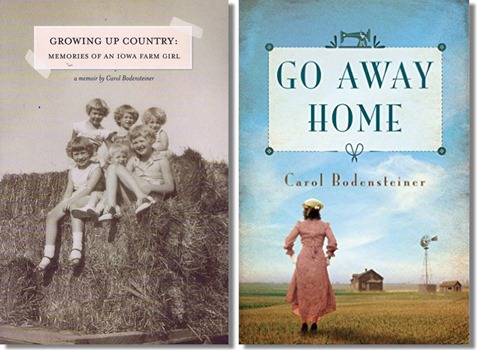
CB-covers

Invited guest post by Carol Bodensteiner

Long time readers may be surprised to find a post about writing fiction on this blog about life writing. While it’s true that my focus is on memoir, lifestory, journaling and other forms that draw upon actual experience to express personal truth, sometimes the freedom of fiction is more effective in conveying truth. Carol Bodensteiner found this to be true. She has successfully written in both genres and her experience moving from memoir to fiction has lessons for all.


I’d been a business writer all my life, so I was used to working with facts. Memoir was a logical first writing step. Growing Up Country: Memories of an Iowa Girl, tells the stories of my childhood growing up on a family farm in the middle of the United States, in the middle of the 20th Century.

When I finally raised my head from writing, publishing, and marketing the memoir, I looked around for what I’d write next. I turned to family-inspired fiction, which I’d never written before.  My novel, Go Away Home, which I indie published in 2014 and was acquired by Lake Union Publishing (an imprint of Amazon Publishing) later that year, is the result of that effort.

The road from memoir to fiction brought many adventures and a lot of learning. Here are six things I learned along the way.

1) A family story can be a great launching pad to fiction.

Go Away Home was inspired by my maternal grandparents. My grandfather died of the Spanish Flu in 1918. Throughout my life, I’ve been intrigued by my connection to this major world event. As someone used to writing from facts, a family story gave me a starting point: A story I cared to write and people and places that were familiar.

Writing the story as fiction was necessary for many reasons. One was that I didn’t have enough facts to write it any other way. Of course I never knew my grandfather and even though my grandmother lived until I was well into my 20s, I never asked her a single question about him or their lives together. And she was not the type to share. So though the story began with family, it is fiction.

2) Don’t get stuck on the facts

Once I got into writing the story, one of the biggest challenges was letting go of the facts. Since the genesis of this story rose from people in my family, and I knew a bit about the people, places, and events, my inclination was to use those facts. But I quickly found that the facts didn’t work for the story I was ultimately telling. They didn’t create a good story arc. There was no drama. On his website, Write the Truth, Robert McKee said, “The weakest possible excuse to include anything in a story is: ‘But it actually happened.’”  Having gone this route, I believe him.

3) Do get stuck on the facts

Since Go Away Home is historical fiction, research was critical to creating the time period accurately. Clothes, transportation, hairstyles, technology, colloquialisms. The list of topics I researched and fact checked was long. Readers of historical fiction really care about the details. Writers must, too.

Research also helped shape the story. One example: Family lore was that my grandmother went to a sewing school. Research revealed that the town in question didn’t have a sewing school, rather that young girls apprenticed with seamstresses as a way to learn an important life skill and to meet a man to marry.  The idea that seamstresses were invited to their clients’ house parties had terrific dramatic potential, so I ran with that.

Another bit of fact to fiction. My grandmother took pictures, but the whole part in the book about the main character’s work for a photographer and her relationship with him is entirely fiction.  Most of the book is that way. Tiny fact. Huge fiction.

4) Planner vs. Pantser

Writers fall into two general camps: Planners and Pantsers. I wrote my way into Go Away Home, discovering the story through countless re-writes – by the seat of my pants. I always knew the end of the story; I didn’t know how we got there. In the first draft, the story started in 1900 and my main character Liddie was 10. In the second draft, the story started in 1915 and Liddie was 19. In the published draft, the story starts in 1913 and Liddie is 16. Believe me – those changes create seismic waves throughout the story.

Having used this highly inefficient “pantser” approach once, I’m reasonably certain that I’m a “plotter” at heart and will be more plan-ful in future writing.

5) Fiction is freeing

While I thought it would be easier to start with some facts because that was what I was used to, the reality was there was great freedom in starting with nothing. As the story developed (pantser), it became clear that connections were missing. I needed a scene to show my main character’s inexperience with men. No problem. I made up a guy. I found it was great fun to let my imagination run. Over and over, I filled holes with scenes that met a plot need.

6) New craft to learn

I learned a lot about creative writing as I crafted my memoir, much of which was also applicable to fiction. Dialogue, scene development, visual characterization – all come into play in both genres. Plotting was a new challenge in fiction writing, as I noted earlier. Developing multi-dimensional fictional characters was another challenge.

I used a number of techniques that contributed to creating the real, individual people living in my novel. I visualized people I know who were somewhat like the characters I had in mind. Writing exercises helped to identify key traits and to express them in fresh ways. I used Enneagram research to flesh out the positive and negative traits of various personality types.

From memoir to fiction, from craft to research, I will always be able to learn something new about writing, and for me, that’s great fun.

Go Away Home is available on Amazon in paperback and ebook formats.

Growing Up Country is available on Amazon in paperback, ebook, and audio book formats.

Carol Bodensteiner – Bio

Carol Bodensteiner is a writer who finds inspiration in the places, people, culture and history of the Midwest. After a successful career in public relations consulting, she turned to creative writing. She blogs about writing, her prairie, gardening, and whatever in life interests her at the moment. She published her memoir Growing Up Country in 2008. Her WWI-era, debut novel Go Away Home was acquired by Lake Union Publishing, an imprint of Amazon Publishing. It launches July 7, 2015.

Carol’s online links
Website/blog 
Twitter
LinkedIn
Facebook

Write now: think of an interesting ancestor or other person who has influenced your life that you know relatively little about. Drawing on Carol’s experience, write a short story about how you imagine this person’s life might have been. Don’t worry about facts. Just let that story rip. Have fun with this!

Monday, June 22, 2015

Clear the Haze from Pictures and Memory

clearing-the-pictureThe pictures above have deep meaning for me, and I think they are likely to strike a chord with most viewers, evoking memories of their own. I want my stories to have that effect. I want readers to see themselves in my words, finding new ways to see old situations and become more fully themselves.

I recently found this left-hand picture from 1973 in a pile I was sorting through. Something in it stirred me, though haziness dimmed my response. I decided to try restoring it.

I scanned it with my Epson V600 scanner using Professional mode on the scanner interface. I used the Color Restoration tool and the Unsharp Mask tool set to high. That produced over 90% of the result you see on the right, but I wanted more. I cloned out spots on the pillow and sharpened the picture a bit more. Then I added a warming yellowish tone to approximate the wall color I recall.

The crisp, haze-free result makes me feel like I’m “back in the picture,” especially when I view it full size and zoom in on details.

I used an ancient version of Photoshop for this, but Paint.net does almost as much as Photoshop and it’s free. Picasa, another popular free choice, is easy to use. Most scanners should have some semblance of the  Epson’s capability. My husband’s 12-year-old Epson can do this, just not as fast.

Once I got a clear view of the photo, I sat with it until I sank into the feeling of having those tots around full time, and gratitude I felt. I thought about how different they were from each other. I looked at our clothing and recalled the joy of sewing. George is on the left. I made his jeans. I made Susan’s to match one I made for myself. I made John’s trendy fake vest shirt. Sewing with knits was big in the seventies. I’m surprised to realize that my shirt and pants both came from stores. Nearly everything in my closet was my own creation.

I remembered the challenge of reupholstering the tattered Goodwill sectional my mom was tired of. Fake animal fur was affordable and trendy. It was a perfect fit for the shag rug in our brand-new home. When we bought new living room furniture, this old stuff went down to the family room. On the right side you see the crewel embroidery project I was working on. That huge picture perfectly matched the carpeting. I put it away years ago. I may rehang it yet.

Oh, the hair – where did it all go? This was my Involved Earth Mother phase: PTO, League of Women Voters, Republican Women, bridge club and more.  I also recalled feeling overwhelmed at times, and wondering just where I fit into the larger scheme of things. Mostly it was a time of settling into house and community and keeping those lively youngsters and their daddy fed, clothed and happy.

I made a list of memories I can use in stories spawned by that picture:

  • Shag rug: hard to live with! Vacuuming flattened it, and I used a garden rake to restore it to fluffiness. Needless to say, I did not do that on a daily basis.
  • Bare feet. I lived in bare feet in the house. I still do in the summer.
  • Making things. I loved crafting enhancements for our home. Repurposing “found objects” was my specialty. I hope to get back to that soon when we move into another new-to-us home.
  • Informality: Our life style was and still is informal. What you see there is no formal pose. It’s typical.

The list goes on, but you get the idea.

My final thought is that stories are like that these pictures. I liken the left one to an early draft. A robust round of editing clears the haze, letting the story shine through. A few more tweaks enhance detail. The final version conveys the sense of the situation so well that readers feel “in the picture,” much as I do with the finished version on the right.

Write now: Find an old picture that’s hazy and indistinct. Play with settings on your scanner and use Paint.net or Picasa to touch it up. Zoom in on details in the finished result and look for stories everywhere.

Wednesday, June 10, 2015

Dreams Do Come True

DreamsDreams do come true – the day dream kind, the wish upon a star kind. I know this because many of mine have. I know they have because I wrote them down. Two examples stand out and show how writing dreams down can benefit life writers.

Moving to Pittsburgh
Around 1983 I began dreaming about moving away from what I considered to be the serious career limits of life in Washington’s Tri-Cities (Richland, Kennewick and Pasco). That was during the hey day of the goal setting movement, at least for me. So I drafted a list of everything I wanted when we moved, even though no move was in sight. That list had over twenty items. Among other things it included

  • Major university.
  • Major corporate headquarters
  • A house with high ceilings
  • A stream in our backyard. (That was pure whimsy, nothing I expected to get.)

I stuck that list somewhere and forgot about it. 

In 1985 my husband accepted a job transfer from the Westinghouse Hanford Nuclear Project to the Westinghouse Nuclear Center in Monroeville, Pennsylvania. I was thrilled to be in a suburb of a real city. Fast forward about three years. I found that list. I was stunned. Every item on it had been fulfilled. True, the high ceiling is only a half-cathedral and the stream only runs after a serious rainstorm, but it is a stream, and it is in the woods in our backyard.

Moving again
in 1993 I wrote a future vision as part of another goal-setting/dream-building exercise. Over the past several years I’ve remembered that exercise often, and looked all over for it, primarily to show my daughter that a dozen years before she met their father, I knew she’d eventually have two daughters. My memory was of writing it by hand in one of the pile of notebooks I began as journals of one sort or another and then abandoned. I’ve found it perplexing that I’ve never been able to find it.

Yesterday I found it. While sorting through various artifacts in my office, thinning things out before packing to move (date as yet undetermined), I found some gorgeous 20-year-old overhead slides I used in workshops and programs on holding effective meetings. Hoping I could find the original file on my computer, I began digging through back-up folders uploaded from old floppies (remember those?). I never did find the slides, but I found something even better:

I found my dream building file, the one I’ve been looking for. Memory was wrong It was never on paper. It’s beautifully done in workbook format. I remember now that I had visions of publishing that workbook, without my personal content.

Reading over the elements of that dream, I buzzed with excitement. I’m living most of that dream right now. Other elements, like the office and house I describe, exactly match what I recently wrote about the house I hope to find in Austin. The dream document said Seattle, but at this point Austin is a better choice. My daughter has built the free-lance writing business I foresaw, and she does have two young daughters. Nearly 25 years after writing that, we will live near each other.

 So what?
Quite aside from any mystical, metaphysical “laws of attraction” aspects of goal-setting, these documents are jewels for lifewriters.

  • They document with laser precision just what we hoped and dreamed for at various points in time.
  • They provide a mirror for reflecting on subsequent events. If we were on target as I have been, we can follow the trail of events that led from then to now. If not, we can explore the insurmountable obstacles, how they affect us, and how they shaped our lives.
  • They provide a focus for stories and memoir.

Sowing and reaping
It’s never too late to start harnessing the power and fascination of dreams. I can’t guarantee they’ll all come true, but I do guarantee you’ll have a fascinating experience as you consider the possibilities. Although it does work to lose them and find them years later, I suggest you start a journal for this specific purpose and keep track of it. That  might be on paper, but a computer file serves well too. Just back it up and file it where you’ll be able to find it again.

Write now: write down a dream of life as you’d like it to be at some point in the future. Give your inner critic a sleeping pill and call in your muse to help you be creative. Be precise and specific about describing details that make it real. Include whimsical elements like that stream. Include emotions and feelings you expect to have. Don’t worry about editing or spelling. Just write it all down. It’s worked for me to file this stuff away and forget about it. Most gurus have you post it on your wall and keep it in sight to keep its power alive. Follow your instincts on this. Years from now, you’ll find it again and have something to remember, write about, and maybe share with your family and the world.

Image credit: Ruben Alexander

Thursday, September 11, 2014

Tips for Dealing with Details

eyeball-bulge

Several pages into a highly recommended memoir, a factual error popped my eyeballs nearly out of my head. Can you find the mistake?

In September 1963, the Cuban and Russian governments placed
          nuclear bombs in Cuba.
In October 1963, the Cuban Missile Crisis ended….
In November 1963, John F. Kennedy was assassinated.
In December 1963, I was born….

The Cuban Crisis was in 1962! Both that event and the JFK assassination are indelibly burned into my memory. The author can’t remember, I thought, but how could something this obvious slip by the editing involved in a traditionally published book? I checked Wikipedia to be absolutely sure, then kept reading. Along the way, I found half a dozen typos, and by the time I finished, I’d found several loose ends in the story along with an apparent contradiction.

But still, I do appreciate the book and its many strengths. The story is powerful and the author’s voice superb. I understand the book’s appeal. The mess saddens me on the author’s behalf.

In one sense I felt vindicated that such casual editing was released by an established publisher when self-published authors are widely slammed for flooding the market with slop. But the point is to write your personal best, not to meet standards.

Whether you are writing a few stories for family or a major opus for the world, these guidelines will help you smooth wrinkles in your stories.

Check your facts. Always validate times, dates or places, if you’re sure you know. Those erroneous dates for the Cuban crisis may be accepted as factual reality by younger readers. Your error about a birthplace or date could throw genealogists into a tizzy years down the road.

Look for loose ends. They may be subtle. For example, this author doesn’t mention how she generated income, but despite a divorce, she spent money like it grows on trees. She says she remarried. To the man she had the amazing relationship with?

Look for conflicts. She reports reflections of someone with her son’s name who met a celebrity she was about to meet. It makes no sense that her young son would have met this person before she did, or that he would relate such a mature impression. Ebooks make searching easy. No other person with that name was mentioned at any other time. Confusing!

Look for missing information. She cites results of certain studies with assurance. The topic is new to me and I’d like to read more. I don’t need footnotes, but I’d love to see an appendix with references and suggested reading.

Rely on beta readers. You aren’t likely to notice loose ends or missing information, because you fill in the blanks from memory as you read. Even family members may gloss over omissions like these. Discerning readers who aren’t privy to the backstory will pick them up in a flash.

Don’t rely too heavily on professional editors. I don’t know what shape this manuscript was in when it arrived on the editor’s desk. Perhaps she did as much as she was able in the time allotted to meet deadline or budget. Maybe loose ends fly under her radar. If you are paying for editing, remember that more time means more money, so have things in the best shape you can before you seek help. Professional or not, nobody is perfect, and any given reader will fail to notice something. Have two or three more people read for further edits and errors after the formal edit is done.

Be gentle with yourself. Readers love this book in spite of its flaws. Write great stories, give them your best shot, and then chill. If you pour your heart into them, readers view mistakes with compassion – if they notice them at all. Many won’t.

Write now: if you don’t already have a writing group or a list of trusted beta readers, find or start a group and begin a search among friends, local or online, who can read pre-release versions and give you reliable feedback.

Monday, September 1, 2014

Accentuate the Positive


Ac-cent-tchu-ate the positive
E-lim-inate the negative
Latch on to the affirmative
Don't mess with Mr. Inbetween.

Who doesn't recognize the value of this sage advice from the 1945 hit sung by Bing Crosby and the Andrews Sisters? But you may not realize the power of this advice for your writing when applied at the micro-level of sentences. I'm not talking here about avoiding negative topics. I'm talking about the value of rephrasing sentences from negative statements to positive.

One of the most compelling examples of this is found in an online article, Kurdish Female Warriors On the Front Lines Fighting ISIS in Iraq and Syria. The lead paragraph states:

A notoriously fierce segment of the Kurdish security forces are striking terror into the hearts of ISIS terrorists – female fighters. The Jihadists have no problem slaughtering defenseless women but they don't like facing armed female warriors in battle – because they don't believe they'll go to heaven if they're killed by one of them.

In actual fact, those Jihadists DO believe they WON’T go to heaven if…

These tips will help you avoid false negatives.

Tell what IS rather than what ISN'T

Instead of writing "It wasn't raining that day," tell the reader, "The rain finally stopped" or "Dry weather that day allowed us to ..." or "My heart soared when I looked out the window that morning and saw patches of blue in the sky."

Do you see what's happening here? That negative statement implies a lot of things, but swinging it around to a positive, affirmative statement avoids a slightly onerous or whiney tone and creates space for discussing advantages and opportunities. Let's look at a few more examples of reversal:

Edward was not tall.Edward was of average height, able to disappear in a crowd.
The meeting was not marred by any discord.Discord was averted and the meeting ran smoothly.
Every time I worked overtime it didn’t show up in my paycheck.None of the times I worked overtime showed up in my paycheck.

Use precision wording

The paragraph about Jihadists is a prime example of imprecise wording. So is “all men are not tall” as cited in an earlier post, Brain Thorns. Examine each negative statement to be sure that is exactly what you intend to say.

View negative statements as opportunities to enhance the message

Rewording the description of Edward gives a better sense of his appearance, and the paycheck statement is awkwardly stated in several regards. The revision shifts the negative aspect to the subject, using a positive verb. The revised sentence flows smoothly, and the meaning is more clear.

Use negative statements sparingly for emphasis

Strongly worded negative statements have tremendous impact. George Washington’s purported statement, “I cannot tell a lie,” would not made history books if he’d said, “I must tell the truth.” How else could you state “The eyes don’t lie” without changing the meaning?

The paycheck statement is inherently negative and must be so for precise meaning. The obvious intent is to emphasize the inequitable situation. Revising yet again to state “Not a single one of the times I worked overtime ever showed up in my paycheck” adds additional emphasis and impact.

So, you see, by paying to detail, you can convey an upbeat, finely tuned, high impact message without sounding like Pollyanna. Consider every sentence and explore ways to ensure precise meaning and smooth flow. Trust me, smoothing sentences gets easier with practice.

Write now: Search several old stories in your collection and look for negative statements that would benefit from flipping or rewording.

Friday, August 1, 2014

Avoiding Editorial Disasters

ScreamWhat I would have to say in the review is "Stop the press and finish the book!”

When I agree to review a book, there’s an unstated contract that my glowing review will help promote the book. If I can’t ethically do that, I won’t write the review. I tell the author “I don’t think you want me to review this book. Here’s why.”

I made the notes below a couple of years ago to clarify my thoughts before emailing the author of a book I did not review.

… focused too tightly on few weeks when marriage finally died. Lacks background information. No sense of bigger picture. Doesn’t quite make sense. Seemed like her family wanted to knock some sense into her. His behavior not acceptable, but not egregious.More back story needed for context and less space documenting her helplessness.

…NO mention of physical affection during trial reconciliation  beyond briefly holding tight to him at beach and a couple of peck-on-the-cheek kisses. “Holding hands” in bed? Bizarre! Story is about the relationship. If they had sex, she should say so and tell how it affected her. If not, say so. Details are irrelevant, but avoidance creates gaping hole.

… She mentions money several times but no details. There is some, apparently hers, but ? His mother knows things he doesn't. Readers know only that we don't know. Ditto for details of her moving out of their shared apartment. Lots and lots of loose ends. Irritating!

The real tragedy is that this book was professionally edited – or at least the author paid someone for that service. Can you imagine anything worse than spending a sizeable hunk of cash on editing that results in this sort of reaction from readers?

Use these guidelines to help you avoid this sort of tragedy:

Seek input from at least half a dozen astute readers. Instead of or before you find a professional editor. Remember that friends and relatives know your story, so they may not see holes that strangers notice right away.

Look beyond your circle of writing friends. Much of my most helpful input has come from people who hate to write. Many book club members have highly developed critical abilities. They can spot plot flaws, awkward wording, inconsistencies and other areas for improvement.

Learn about various types of editors.

  • Developmental or structural editors point out missing back story, loose ends and other flaws such as I mention in those notes above.
  • Line or copy editors revise awkward wording.
  • Proof-readers check for typos and similar errors.

Seek developmental editing help first. Don’t waste time polishing words in a story that needs major revision. I suspect the author I mentioned above used a line editor when she direly needed a developmental or structural one.

Check references. In .03 second, Google will find you tens of thousands of “professional editors”. A far better plan is to seek referrals from people you know or friends of friends. When you find a likely candidate, ask for contact information for authors they’ve worked with. Of course they will only give you names of happy clients. You should know that a startling number of authors are not satisfied with the first editor they work with and end up paying two or three.

Have others read the manuscript again after the professional edit is done. The author I mention above might have found out about those flaws before the book was in print if she’d sought more post-editing input.

YOU own the story. If anyone’s input, professional or otherwise, goes strongly against your grain, ask why they suggest what they do, then you decide. This is your story. Don’t be bullied. And don’t rashly reject input.

Consider your goals and budget. Who are you writing for? What are your sales goals? What can you afford to spend? If you are primarily writing for family and friends, input from people you know may be enough. If you dream larger, look for a qualified pro. But never spend more on book production than you can afford to write off. Don’t quit your day job and don’t spend your retirement fund.

Bottom line: In my opinion (and that’s all this is), a large team of astute readers can give you excellent results and are often enough for a superb story. If you have the money and inclination, professional editors can be worth their weight in gold, and working with one is an educational experience. Use due diligence in selecting one if you decide to go beyond what your circle of readers can help you with. And never rely on any one person’s opinion, no matter how qualified.

Write now: Make a list of people you know who might be willing to read draft copies and give you feedback. Keep this list growing, with the commitment that you will return the favor by reading for others.

Friday, July 18, 2014

Your Friend, the Comma

CommaFriendComma, common. Yes, commas are common, but that doesn’t mean they don’t deserve respect.

Strangely enough, this common little punctuation mark intimidates legions of writers. Others treat it in a cavalier fashion. I admit to being one of the latter. In 1984, I flippantly told Kay DuPont, a national speaker and author of a book on grammar and punctuation that “I punctuate intuitively and put commas where I think I need them.” Was that pity I saw in her glance?

When I saw buckets of red ink the Lighthouse Point Press editors sloshed all over my first book, Do’s, Don’ts and Donuts, I realized I needed to get serious about learning proper comma usage. To my surprise and delight, I discovered that commas are quite friendly.

The main thing to remember is that commas cue readers’ eyes to pause for just a whiff of breath to tide them over to the end of a sentence. They sort information inside the sentence, clustering words into meaningful chunks. The guidelines below cover the main areas of confusion:

Use a comma before conjunctions – words that join two sentences into one

The most common of these words are and, but and or. For example,

“I am starting a new story now, but Nancy is still editing hers.”

Only use the comma if the two parts can stand alone as whole sentences, as they can above. Do not use commas to set off compound subjects or predicates:

“The lawn was green and was freshly mown.”

Use a comma before an introductory group of words

Any time you have a phrase or clause preceding the subject, set it off with a comma.

“If you want people to read your story, you’d better tell them you wrote one.”

“When you fail to use commas well, readers may become confused.”

If your clause is very short, three words or under, and it is clear without the comma, you may omit it. Too many commas create clutter. However, words like “however” should be set off. Good judgment on your part in using commas and selecting proof readers should cover this base.

Use a comma between parts in a series.

Most people are familiar with this rule when simple words are involved. It also applies to phrases and clauses. For example:

“Both the Italian and Mexican flags are comprised of red, green and white stripes.”

“I must clean the kitchen, fold laundry and mow the lawn today.”

“Sally is vacationing in Arizona, Jan is visiting her family in Maine and Ellen is staying home this year.”

You may notice that the final element in each sentence lacks a comma. You may recall learning in English class once upon a time that this is the correct and modern way to punctuate. Yes and no. It is correct, especially for casual usage. More formal usage puts what’s referred to as “the Oxford comma” in that series, as my editors for The Heart and Craft of Lifestory Writing required me to do. Whichever convention you choose, use it consistently within a manuscript, whether that’s a story or a book.

Use pairs of commas to set off interjections

Any time you have a word, phrase or clause that interrupts the flow of a sentence, set it off with a pair of commas.

“Sarah will, of course, be delighted to hear we are having chocolate cake for dessert.”

“The content of a memoir should always, realizing that memory is sometimes fallible, be true.”

Help is at hand

Should you get jammed up and feel insecure about commas and other grammatical things, always remember Google is your friend. Or Yahoo. Or Bing. The web is brimming with helpful sites to guide you to punctuation perfection.

Another tool that may be more confusing than not is Word’s grammar check function. It is good at comma use, and I advise always working through its recommendations as a final proof-reading step. Just remember that it makes lots of miscalls, so use good sense and check other sources if you have any questions.

One more tool that’s helped thousands is the punctuation overview in The Heart and Craft of Lifestory Writing. Click on that title to order your copy now if you don’t already have one.

Write now: use the guidelines above to check comma usage in a couple of stories. Then check your comma skills with a short quiz at GrammarBook.com. Find a paragraph or two that you’re wondering about and paste them into “The World’s Best Grammar Checker” at Grammarly.com.

Thursday, July 3, 2014

Brain Thorns

Thorns“All sentences are not created equal.”

That sentence jams a cactus into my brain, triggering wild buzzing and a whirl of obsessive thoughts.

Even if the story I’m reading is sweet and beautiful as a cactus blossom, when I hear any variation of “All men are not tall”,  my brain revs up like an angry hornet. I know the intention: to contradict the clearly false idea that all men ARE tall. The literal meaning of that sentence is that no men are tall. Obviously that’s as false as the initial statement. The world is full of men of a wide range of heights.

The accurate meaning is “Not all men are tall.” Or, “Men are not all tall.” But hey – I know you could find a better way of stating that within the context of your story.

I saw that opening sentence in a review of  Jenny Davidson’s book, Reading Style: A Life in Sentences. The review quotes that inflammatory sentence from the first chapter of Tankard’s book.

How, you ask, would I edit that sentence?  That’s a fair question. The real message of that sentence is better stated in the second: “Some (sentences) are more interesting, more intricate, more attractive or repellent than others.” I’d omit the first entirely.
But then I’d have to address the fact that neither sentence has anything to do with the rest of the lengthy paragraph. Oh my!

I would not write off a book based on a single sentence, no matter how annoying, but that sentence triggered my "the rest of this better be extraordinary to overcome that transgression” button, and I just showed you that further exploration did not stand the book in good stead. Had that brain thorn not been there, the awkward paragraph probably would have slipped by unseen.

Brain thorns tend to poison a reader’s outlook. Hopefully my rant will prevent you from planting this thorn in your stories, even though I may be the only person on earth vulnerable to its sting. Write what you really mean and your stories will sing.

This is only one example of a multitude of brain thorns. This one is personal and stabs deep. Awkward writing and sloppy checking, like typos, missing commas, or confusing I/me or its/it’s are less distracting to me, but thorns nevertheless.

Are you aware of brain thorns as you read? Join the conversation and tell us about yours in a comment.

Right now: Delight readers by using Grammar Check to remove brain thorns from your writing. Grammar Check is often wrong and can be a distraction if you leave it turned on, but do run it before your final save. Find its location on Word’s Review tab  ribbon and use it to check a few old stories. You may be surprised what you find. Ask trusted friends or your writing group to check for thorns that slip past your eyes and Word’s functions.

Thursday, June 5, 2014

Memoir as Training Wheels

Mary-Gottschalk-AuthorMary Gottschalk has proven her versatility as a writer by crafting a highly acclaimed  memoir, Sailing Down the Moonbeam, followed by a novel, A Fitting Place. Both volumes are gutsy stories, and in this guest post Mary explains how writing the memoir prepared her for the challenge of switching to fiction.

Memoir as Training Wheels

Writerly skills are for naught unless you have something you want to write about.

The story behind my memoir—a mid-life coming-of-age experience after I left a successful career to sail around the world at age 40—had steeped in my brain for two decades before I put pen to paper. Not once, in all those years, did the possibility of writing a novel ever occur to me.

But as the memoir evolved and my writing skills improved, I began to see that “the story” was much bigger than “my story.” Sailing across the Pacific Ocean struck me a metaphor for life: you can’t control your environment, the route is not well marked, and you often end up someplace other than where you set out to go. The core lesson of that voyage was that you learn the most when you step outside your comfort zone.

Suddenly I had a story with almost infinite variations. I itched to explore them. Voilà, my first novel about a woman who never leaves home, but is thrust out of her comfort zone when she is betrayed by those she trusts most. It is my first novel, but it will not be my last.

Learning the Writerly Craft


I often think of my memoir as the literary equivalent of training wheels.

With a memoir, the task is far more manageable than with a novel, where every element—story arc, characters, plot points, scenes, point of view—is in flux until “THE END.” With an infinite number of possible events and characters from which to choose, even an experienced writer can have trouble discerning whether a problem lies in the writing, in the story arc and structure, in the pace, in the mix of characters, or some combination of them all. For an inexperienced writer, sorting it out can seem all but impossible.

By contrast, the outer boundaries of my memoir were established long before the first word hit the page. I knew where the story began and ended, who the players were and what role they played. The plot points and scenes were constrained by reality. My job, as author was to connect the dots, not make them up.

Connecting the dots was certainly not enough to guarantee a good memoir. If you believe, as I do, that a well-written memoir should read like fiction, I needed to have much the same set of writerly skills as a novelist. As a neophyte, I was missing many of them when I started out. In retrospect, one of the great advantages of starting out with a memoir was that when things weren’t going right, there were fewer things to be fixed.

As a memoirist, I couldn’t change the trajectory of events, so I had to focus on doing a better job of building tension and establishing cause and effect within the existing storyline. I learned, by trial and error, to recognize which events moved the story forward. I discovered how it felt when my story began to unfold organically. I learned that ruthlessly cutting out events that serve no plot purpose could heighten the emotional truth of the story, with little damage to factual accuracy.

Similarly, I couldn’t create new scenes or new characters out of whole cloth. All I could do was focus on re-writing those that were flat, on learning how to make them come alive, on using them more effectively to carry the plot forward. My focus was on mastering the art of showing vs. telling, on finding the right balance between dialogue and narrative. I learned that what I didn’t say often had as much dramatic potential as what I did say.

Throughout the often painful process of repairing crippled parts of the story, it was easier to push forward, knowing that I had a clear idea of what I wanted the story to look like when it was complete. By the time I began my novel, I had developed solid skills in constructing a story arc, both for the book as a whole and for each chapter along the way. I knew how to use dialogue and develop my characters through judicious use of scenes. I still had a lot to learn, but completing the memoir gave me the confidence to attack one problem at a time, to avoid being overwhelmed by the enormity of the task.

The memoir served as my training wheels. Without it, there never could have been a novel.

Bio


Mary has made a career out of changing careers. After finishing graduate school, she spent nearly thirty years in the financial markets, first in New York, then in New Zealand and Australia, eventually returning to the U.S.

Along the way, she dropped out several times. In the mid-80's, at age 40, Mary and her husband Tom embarked on the three-year sailing voyage that is the subject of her memoir, Sailing Down the Moonbeam. When the voyage ended, she returned to her career in finance, but dropped out again to provide financial and strategic planning services to the nonprofit community. In her latest incarnation, she is a full time writer. Her first novel, A Fitting Place, was released May 1, 2014.

Find A Fitting Place on Amazon and iBooks.

Social Media Links

http://marycgottschalk.comhttp://twitter.com/marycgottschalk
http://www.facebook.com/mary.gottschalk.9
http://www.facebook.com/MaryGottschalkWriter
http://www.linkedin.com/in/marygottschalk/
https://plus.google.com/u/0/105973496280247274228/posts

Monday, April 7, 2014

Memoir with Recipes

Although few things bond people like food and sharing recipes, I didn’t intend to include recipes in my mini-memoir, Adventures of a Chilehead, for several reasons:

1) Some of the stories are set in restaurants and I couldn’t include recipes for those.
2) Recipes for things like frijoles, chile con carne and enchiladas are easily found on the web.
3) When I cook, I use recipes as mere suggestions and cook by the seat of my pants based mostly on what’s in the kitchen at any given time. How do you write recipes for that?
4) Some ingredients, like chile powder, are unreliable in strength.

The finished book bears the subtitle “A Mini-Memoir with Recipes.” Obviously I changed my mind, primarily because most people who read early versions of the manuscript told me they wanted recipes. Since I value their input, I accepted their inspiration and set about writing creative recipes for food the way I make it. The way I make it varies from one time to the next so in addition to the standard list of ingredients and preparation steps, I had to include variations.

That resulted in long, involved instructions that explain a process rather than serving as a formula, but once I got started, thinking through all the factors involved turned out to be fun. In fact, it gave me a reason to make those dishes a time or two to be sure I had not missed anything, so we had lots of yummy dinners.

I explained things like where to buy good chile powder (perhaps online). Chile quality and potency is fickle, so I had to explain how to test the heat level of a new batch, and how to adjust recipes to individual tolerance levels. The recipe for homemade corn tortillas is over three pages long and gives guidelines for when it’s not worth making them as well as what brand of masa you’ll do well to avoid, and how to use grocery bags to simplify rolling or pressing them flat.

Most memoirs that include recipes put a single recipe at the end of each chapter. For example, Ruth Reichl’s Tender at the Bone and Judith Newton’s Tasting Home follow this pattern. Since some of my stories take place in restaurants or feature hot pepper sauce, and some stories spin off three or four recipes, it didn’t make sense to put them with the chapters. Besides, the length of the recipes would interrupt the flow of the stories.

Once I got rolling with the first few, I was having so much fun that I added many more favorites. Over half the recipes in the final list are not mentioned in the memoir section.

I’ve received a pile of emails from happy readers who have tried recipes with good success, and my family is delighted to have those recipes they grew up with documented for all time.

You don’t have to write an entire memoir, mini or full-length, to write about recipes. Next time you share a recipe, take the time to tell the history of the recipe, including some favorite memories, to go with it. Sharing its story builds the sort of bond I write about in the last chapter of Chilehead when I tell of feeling a link with centuries of women who have prepared chile for their families.

Write now: select one of your favorite recipes, perhaps one that has been handed down in your family, and write a story about how you came to have the recipe and memorable occasions when it has been served by you or others.

Monday, March 24, 2014

Which Memory is Real?

Memory1Everyone knows how memory dims and darkens with time. Yesterday I began writing about a memory from the summer after first grade when I felt “outside the circle.” I'd written  about this incident before, but decided to begin fresh. After five paragraphs I could see no further benefit in continuing the rewrite and tracked down a version from five years ago, intending to graft in some of that material.

When I read the earlier story, my jaw dropped. The theme was the same, the other main character was the same, but circumstances were quite different. Yesterday's  story begins as I approach a cluster of kids that included Carol (the girl across the street) and half a dozen neighborhood boys. In the earlier version, Carol was jumping rope alone in front of her house.

Which is real? Has my memory changed that much in five years? Which version should I use?

As I closely examine the versions, slight differences begin to emerge. In the jump rope version, Carol does invite me to play, in an off-handed way. I do mention that Tom, the boy our age who lives in the other end of her duplex, won’t play with me. In yesterday's memory and story, I arrive as Tom finishes telling a dirty joke. I hear only the ensuing laughter. An older boy tells me I shouldn’t have been listening (I wasn’t!), and all the boys run off, leaving me to play with Carol.

In both cases I felt awkward and uncertain. Both my mother and I had only our younger sisters to play with before we began school, and we both lacked social savvy. I was desperate to learn. The jump rope story works well to emphasize that awkwardness. The second story works better for emphasizing my discomfort with groups, my feeling of being on the fraying fringe of things.

I’ve concluded that two memories are involved and that both memories are real – as real as any memory can be. As I further refine my theme, I believe the choice of which story to use will become apparent. Or I may use both in a longer version.

The important point for now is that both memories are tattered and faded, dark fragments of the moment. The “actual facts” of what “really” happened are only faintly discernible. The “truth” of the encounters lies in emotional memory.  That’s where the story is. Knowing the specific date, time of day, color of Carol’s hair, or names of the boys serves no purpose. I don’t care about those myself!

I shall include only details directly relevant to the story such as:

  • The comforting feel of summer sun on my shoulders and espresso-brown hair.
  • The view from my vantage point in front of my house, eighteen stair steps above the street and two hundred feet away.
  • Feeling sad, alone and "different" as I watched.
  • Feeling confused and clueless about how to join Carol or the group.
  • Feeling awed by the beautifully decorated bedroom she had to herself.

Details like this form the reality of memories. My challenge is to develop brightly lit scenes that crisply convey this sense of loneliness and longing — the core truth of both memories and countless later incidents.

Write now: Without looking back, rewrite an emotional memory you wrote about at least a year ago (preferably much longer) in a story or journal. Don't look back before you write, but compare versions when you're done. Make note of differences and dig for those golden key emotions underlying the memory. Follow their trail through the years.

Photo credit: Dan Sakamoto

Monday, October 14, 2013

Fact or Fiction

Fact2Fiction

Last week I had a bizarre experience that had me almost dancing down the street with secret glee. I wanted to write about it. I HAD to write about it. I had chill time in my schedule that day, so I stopped at a library and got most of a first draft on the page.

I decided at the outset that this story was too complex and personal to write as memoir, so I did the conversion to third-person point of view at the start. Aside from that, I stayed close to the reality of what happened. At t`hat point, I was the only active character in the story, and much of it was reflection and flashbacks.

I shared the result with a non-writer friend, mentioning that I knew the ending was lame. She made an off-handed suggestion for strengthening the ending. Oh, my! Her idea was like tossing a match into a pile of dry leaves. A 15,340 word story has grown to nearly 5000, and it's just getting started.

As I've continued writing, the main character has disengaged from “me” and taken on a life and mind of her own. The other characters are able to articulate her (my) thoughts that would be difficult to express and boring to read in memoir. Seven pages of reflection could put nearly anyone to sleep.

I’ve adopted the attitude of “Accuracy be damned, and all sorts of new ideas are tumbling forth. As I ponder what one or the other character will say next, breakthrough insights are coming to me that I probably would not have seen if I stayed in memoir, and especially if I didn't write at all. Besides, it’s fun.

These characters range from sassy to serious, nervous to nonchalant – all aspects of my reactions that I can split off and give their own voice. They can represent a wide range of emotion. They are giving me as many “cameras” as I need to create a holistic overview of this particular event.

One aspect of fiction is shared with memoir – as I said at the outset, this experience was rather personal, and it’s becoming way more so as the story develops. I ‘m writing right now for a readership of one, and may decide to keep it that way.

My bottom line discovery is that the power of memoir for personal exploration may be enhanced and expanded by turning to fiction– whether for publication, analysis, or pure fun. Furthermore, the longer I work on this story, the more real it becomes. Another few hours and I’ll be convinced it really did happen, just this way. This could have interesting implications for understanding memory and power to change your life.

Who has had a similar experience? Have you fictionalized a life story? Why? How did it work for you? Leave a comment and share your thought.

Write now: chose a story idea that you’ve been meaning to write about and write it as fiction. Tell is like you wish it had been. Add a few characters and let your various points of view reason things out. Let other people do things for you to reflect one. Have fun as you write and follow the story where it leads you. You may make some surprising discoveries.

Preserve a Record of Life As It Was

Believe it or not, this post is not about politics. It’s about change. Regardless of your political position or beliefs, you’d have to be l...