Showing posts with label Documentation. Show all posts

Saturday, January 28, 2017

Preserve a Record of Life As It Was

News-collageBelieve it or not, this post is not about politics. It’s about change. Regardless of your political position or beliefs, you’d have to be living in a deep jungle to be  unaware how fast things are changing. It’s too soon to say if life will be better for Americans in general or if some form of Armageddon is at hand as current headlines seem to suggest. Heavens above, collecting those headlines today for the collage you see above was an anxiety-laden task!

For better or worse, I’m betting on the end of life as we’ve known it. It’s already drastically changed from what I knew as a child.

In any case, it’s time to preserve memories of the past. WRITE ABOUT LIFE AS YOU HAVE KNOWN IT. You can’t count on history books to tell it like it was for you. History is always written through filters, and those filters change over time, subject to prevailing culture. If lifestyles in the future are an improvement, let your progeny know how much better it is.

On the other hand, if, as some fear, tyranny is at hand, preserve a picture of freedom. Keep its memory alive.

I am convinced that it’s important for families to create personal archives, and to keep print copies as well as backups in pdf format on DVD disks or thumb drives. What if the internet came tumbling down? What if libraries full of books were burned? What if …?

No, I do not anticipate a Doomsday scenario, but … what if?

In addition to preserving your memories of the past and what life was like, share your reflections about it. I’m not writing about politics and my personal beliefs here, but I am writing piles of journal entries and essays that aren’t public, but will be available for family. I want my grandchildren to know what I believe, what I feel, what actions I’m taking.

Writing prompts for preserving a picture of life in the past

  • How much freedom did you have as a child? Did you freely roam the neighborhood? Ride your bike across town when you were 10 or 12? Play hide-and-seek with the neighborhood gang after dark in the summer?
  • What did you do to pass the time before computers and electronic games? Did your family play cards or other games together? Do crafts?
  • What was it like to cook real food from scratch without frozen entrees?
  • Did you go to church? What were/are your beliefs?
  • What political party did your parents support (if any)?
  • Were you ever involved in any protests or demonstrations? Which ones? How and what did you do?
  • Did you or your dad ever change the oil in the family car or fix a flat tire on t he road, or do other maintenance?
  • What was medical care like? Were you ever in the hospital? How much did it cost when your children were born?
  • How have your views changed over the years?
  • What are your views on the corner our country seems to be turning right now? What was your position on the 2016 election? Keep a log of your thoughts as things unfold.

This mini-list should get your wheels turning.

Don’t put this off another minutes. Write fast. Write off the top of your head. You may edit it later, but get it on paper, write now!

Saturday, January 14, 2017

Finding Time to Write

Melting-time

“I’ve been so busy the last couple of weeks I just didn’t have time to write anything, but I promise I’ll have something next time.” I’ve attended hundreds of writing group sessions, and I almost always hear some version of this explanation. In fact, I admit that rather than writing something new, I’ve recycled old stories more than a couple of times myself.

Who doesn’t find it a challenge to carve out writing time, at least now and then?

If this is a chronic problem for you, here’s a time tested idea: keep a time log for a week. I know. How can you find more time by spending precious minutes a day doing an OCD thing like that? Here’s the deal. You can’t control an unknown quantity and this is a specialized instance of the concept that writing makes thinking visible. If you know how you typically spend your time, you can find ways to carve out an extra hour or two. If you really want to.

The chart below is a relic I recently found while sorting through files from my previous life in corporate training.  I used it in time management modules. It may not bear much resemblance to your life, but you’ll see how this works.

Time to writeIn this example, work takes 50 hours out of the person’s 168 hour week. Perhaps this includes commuting time, maybe not. It may include answering emails at home in the evening, or lunch hour with friends. 50 hours is 50 hours, leaving 118 hours for other activities. 

That 56 hours for sleep allows for 8 hours a night. A healthy choice. Maintenance stuff may be cooking and cleaning, paying bills, sorting laundry … whatever. Work and sleep together consume all but 62 hours.

TV/Internet time may be low. Maybe it includes email and Facebook. The Internet addition is new right now. I did not refer to that 25 years ago. Few people had access to the Internet at that point, and we watched a lot more TV. The old version had no mention of writing either.

You may notice no time is allotted for recreation, childcare, or anything fun. Who would want to live this person’s life?

A list like the one above may help you may find a way to carve a couple of hours a week out of work time by eating lunch at your desk while you write for half an hour a day or asking family members for more help with chores.

Chances are good that you find that while you’re at your computer intending to write, you drift off following whimsical links. If this is the case, help is at hand. Allow yourself one more web search for  “apps to disable the internet on a computer.” You’ll find all sorts of apps, from Plain Old Writing apps that fill your screen and block distractions to tips on configuring your firewall to block Facebook, Twitter, or whatever for several hours a day.

Or, you may confirm a hunch that the distractions are avoidance behavior. That’s another kettle of fish for another post.

Bottom line, you’ll never know where your time goes if you  don’t keep track. You’ll have only yourself to thank. Celebrate your success when you complete the week.

Something to try: find a small notebook you can keep in your pocket. Keep track of your time for a single day. Keep trying until you master this challenge. Then go for a week. Sort out your results in a table similar to what you see, and make decisions about possible changes. Have fun and write about your experience later.


Sunday, December 4, 2016

Punch Up Your Stories with Active Verbs

Kapow!

How exciting is it to read a story full of “it was” or “there were” phrases? Yes, you’ve heard it before – phrases like these are a variation of passive voice, and they put readers to sleep. Let’s explore alternatives.

As an example of the difference it can make to switch out dull, boring verbs with punchier active ones, Randall McKee agreed to let me use part of a documentary type story he recently read to our newly formed lifestory writing group. Randall read the “after” version, but confirmed that his first draft was indeed full of the dull form. Since he continued to save improvements over his initial draft, I took the liberty of reverse engineering the passage, especially the verbs, back to what they might have been. The clip below was excerpted from his opening paragraph:

… Blake's Barber Shop was next to the Brownfield Hotel on North 6th Street just off Broadway. Outside the shop was a traditional red, white and blue banded barber pole. A hat tree was next to the door. It was full of silver-belly Stetsons, neatly creased fedoras and soiled blue-striped railroad engineer's caps, head coverings for gentlemen from all walks of life. There was dark paneling halfway up the wall from a white tiled floor. Behind the barbers was a long wooden breakfront. Its shelf was piled with clippers, shaving mugs, brushes, bottles of hair tonic, aftershave and jars of Barbacide with scissors, straight razors and combs soaking in it. The breakfront had a mirror along it that looked like it doubled the number of items on the shelf. …

Now compare with the final version he read to the group:

… Blake's Barber Shop was next to the Brownfield Hotel on North 6th Street, just off Broadway. Outside the shop a traditional red, white and blue banded barber pole beckoned menfolk to enter. A hat tree stood next to the door, a harbor for silver-belly Stetsons, neatly creased fedoras and soiled blue-striped railroad engineer's caps, head coverings for gentlemen from all walks of life. Dark paneling rose halfway up the wall from a white tiled floor. Behind the barbers stood a long wooden breakfront, its shelf piled with clippers, shaving mugs, brushes, bottles of hair tonic, aftershave and jars of Barbacide in which scissors, straight razors and combs soaked. A mirror stretched the breakfront length. Its reflection appeared to double the number of items on the shelf. …

Notice how the second version is laced with action verbs: beckoned, stood, rose up,  piled, soaked, stretched, appeared to double. Doesn’t that second version just jump off the page compared to the first?

You aren’t likely to get that second result on your first draft, at least not right away. Randall explained that he wrote the first draft quickly to get it down on the page. Then he worked on polishing that first pass. “I looked at each sentence to consider how I might make it better.” I think you’ll agree that he did.

Use these tips to find and replace your ho-hum verbs:

1) Read through a story with a highlighter in hand. Mark each instance you use any form of a pronoun together with a form of the verb to be. Some variations include “it is,” “there were,” and “they were.” Please note: not all forms of being verbs are banned – just clichéd phrases with pronouns.

2) Ponder each sentence to determine what’s happening in it. What’s the message?

3) Exercise your creativity to find a suitable action verb to replace the “being” verb.

You may find this a challenge at first, and I guarantee they’ll invade your first drafts. My first draft of the previous sentence, “This may be … ,” got tossed. This is a vague pronoun and “may be” is a conditional form of to be. As you gain experience, you’ll find these being phrases popping out at you everywhere. Alternate phrasings will come more easily to mind.

Who knows? You may form the habit of thinking in active phrases, punching up conversations and becoming a more compelling story teller.

Friday, November 25, 2016

Amy Cohen Discusses The Fountain at the Crossroads

Earlier this year I published A Humble Story Lives On, a post based on the work of Amy Cohen, a distant cousin of my husband’s. Amy has been busy over the last several months lovingly publishing a posthumous memoir written by Ernest Lion, another shirt-tail relative who survived the Holocaust at Auschwitz.

Amy asked for my guidance in preparing the manuscript for publication, and I became intrigued with her project as well as the story. In this post Amy explains how she came across the story and why she decided to publish it. I find it especially intriguing that a story written late in life with no known plans for publication could be found and brought to the world by a stranger. It just goes to show that you never know where your words may end up.

SL: Amy, how did you discover The Fountain at the Crossroads?

AC: I was researching the family of one of my Schoenthal cousins—Rosalie Schoenthal. She was one of only two siblings of my great-grandfather who did not immigrate to the US from Germany in the late 19th century. She married Willie Heymann. All but two of their many children left Germany and escaped the Holocaust. The two daughters who stayed in Germany were killed by the Nazis. In trying to learn more about the lives and deaths of these cousins, I found out that one of Rosalie’s granddaughters, Liesel Mosbach, had married Ernst (later Ernest) Lion. Although Liesel was killed at Auschwitz, her husband Ernest survived. One online source included a link to a memoir written by Ernest Lion.

I clicked on the link and printed out the 200+ page manuscript. I read it in one sitting over the course of a day, tears streaming down my face, unable to put it down until I reached the last page.

SL: What did finding the story mean to you?

AC: Although the fact that Ernest was a relative initially drew me to his book, I quickly realized that his story is the story of more than six million people. It’s the story of how the Germans tried to strip them of their humanity and lives. But Ernest, like countless survivors, refused to surrender his humanity or dignity. The narrative brings you into his experiences and also his mind, allowing the reader to understand the reality of life at Auschwitz and perhaps even more importantly what it was like to survive during and after that experience.

This book reveals both the darkest and best of human nature. Ernest’s ability to persist, to escape, to build a new life in a new country, to find love and purpose is inspiring and deeply moving.

SL: How did you decide to publish it?

AC: After reading the book, I felt strongly that it needed to be read by others. But aside from a few links to the rough manuscript, there was no way for people to find this 200 page manuscript. And with no chapters and crude formatting, it was difficult to read.

So I decided to see if I could get permission to edit and publish the manuscript to make it more readable and publicly accessible.

SL: What challenges did you face?

First, I had to find out who had the rights to the book. I knew Ernest was deceased and that he had a son, but I had no way to contact him. Ernest had acknowledged a number of people in the book, including Randall Wells and Suzanne Thompson, his writing instructors at Coastal Carolina University. Through the university, I got in touch with them and got contact information for Ernest’s son Tom. I soon learned that Tom was the sole heir to Ernest’s estate and thus owned the book’s copyright.

Tom liked the idea of making his father’s book more accessible, so I began editing the manuscript. Wanting to preserve Ernest’s voice and leave content intact, I did nothing but add chapter headings, fix typos here and there, and reorganize one section so the chronology flowed more smoothly.
The second greatest challenge was figuring out how to publish it. That’s where you came in, Sharon, with advice on how to create a professional looking format. Your important suggestion that I use CreateSpace made the process of getting the book on Amazon in both print and Kindle format relatively easy.

SL: What are your hopes for this volume? 

AC: I hope that a multitude will read the book. We set the price low to keep it affordable. Our hope is that readers will gain a deeper understanding of the Holocaust and human nature.
I am hoping that schools and libraries will put the books on their shelves. I am hoping that the book will be reviewed in places where it will draw the attention of history buffs. We need help spreading the word.


Fountain at the Crossroad is available on Amazon in both print and Kindle versions. You can find them here. Whatever small profits may accrue will be donated to the United States Holocaust Memorial and Museum in memory of Ernest Lion.

For an extensive array of family history stories collected and written by Amy Cohen, visit her Brotmanblog: A Family Journey.

Tuesday, July 7, 2015

Six Things I Learned Going from Memoir to Fiction

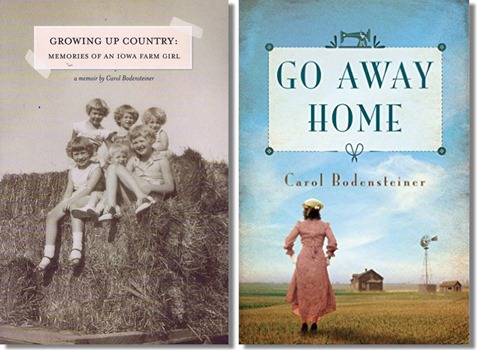
CB-covers

Invited guest post by Carol Bodensteiner

Long time readers may be surprised to find a post about writing fiction on this blog about life writing. While it’s true that my focus is on memoir, lifestory, journaling and other forms that draw upon actual experience to express personal truth, sometimes the freedom of fiction is more effective in conveying truth. Carol Bodensteiner found this to be true. She has successfully written in both genres and her experience moving from memoir to fiction has lessons for all.


I’d been a business writer all my life, so I was used to working with facts. Memoir was a logical first writing step. Growing Up Country: Memories of an Iowa Girl, tells the stories of my childhood growing up on a family farm in the middle of the United States, in the middle of the 20th Century.

When I finally raised my head from writing, publishing, and marketing the memoir, I looked around for what I’d write next. I turned to family-inspired fiction, which I’d never written before.  My novel, Go Away Home, which I indie published in 2014 and was acquired by Lake Union Publishing (an imprint of Amazon Publishing) later that year, is the result of that effort.

The road from memoir to fiction brought many adventures and a lot of learning. Here are six things I learned along the way.

1) A family story can be a great launching pad to fiction.

Go Away Home was inspired by my maternal grandparents. My grandfather died of the Spanish Flu in 1918. Throughout my life, I’ve been intrigued by my connection to this major world event. As someone used to writing from facts, a family story gave me a starting point: A story I cared to write and people and places that were familiar.

Writing the story as fiction was necessary for many reasons. One was that I didn’t have enough facts to write it any other way. Of course I never knew my grandfather and even though my grandmother lived until I was well into my 20s, I never asked her a single question about him or their lives together. And she was not the type to share. So though the story began with family, it is fiction.

2) Don’t get stuck on the facts

Once I got into writing the story, one of the biggest challenges was letting go of the facts. Since the genesis of this story rose from people in my family, and I knew a bit about the people, places, and events, my inclination was to use those facts. But I quickly found that the facts didn’t work for the story I was ultimately telling. They didn’t create a good story arc. There was no drama. On his website, Write the Truth, Robert McKee said, “The weakest possible excuse to include anything in a story is: ‘But it actually happened.’”  Having gone this route, I believe him.

3) Do get stuck on the facts

Since Go Away Home is historical fiction, research was critical to creating the time period accurately. Clothes, transportation, hairstyles, technology, colloquialisms. The list of topics I researched and fact checked was long. Readers of historical fiction really care about the details. Writers must, too.

Research also helped shape the story. One example: Family lore was that my grandmother went to a sewing school. Research revealed that the town in question didn’t have a sewing school, rather that young girls apprenticed with seamstresses as a way to learn an important life skill and to meet a man to marry.  The idea that seamstresses were invited to their clients’ house parties had terrific dramatic potential, so I ran with that.

Another bit of fact to fiction. My grandmother took pictures, but the whole part in the book about the main character’s work for a photographer and her relationship with him is entirely fiction.  Most of the book is that way. Tiny fact. Huge fiction.

4) Planner vs. Pantser

Writers fall into two general camps: Planners and Pantsers. I wrote my way into Go Away Home, discovering the story through countless re-writes – by the seat of my pants. I always knew the end of the story; I didn’t know how we got there. In the first draft, the story started in 1900 and my main character Liddie was 10. In the second draft, the story started in 1915 and Liddie was 19. In the published draft, the story starts in 1913 and Liddie is 16. Believe me – those changes create seismic waves throughout the story.

Having used this highly inefficient “pantser” approach once, I’m reasonably certain that I’m a “plotter” at heart and will be more plan-ful in future writing.

5) Fiction is freeing

While I thought it would be easier to start with some facts because that was what I was used to, the reality was there was great freedom in starting with nothing. As the story developed (pantser), it became clear that connections were missing. I needed a scene to show my main character’s inexperience with men. No problem. I made up a guy. I found it was great fun to let my imagination run. Over and over, I filled holes with scenes that met a plot need.

6) New craft to learn

I learned a lot about creative writing as I crafted my memoir, much of which was also applicable to fiction. Dialogue, scene development, visual characterization – all come into play in both genres. Plotting was a new challenge in fiction writing, as I noted earlier. Developing multi-dimensional fictional characters was another challenge.

I used a number of techniques that contributed to creating the real, individual people living in my novel. I visualized people I know who were somewhat like the characters I had in mind. Writing exercises helped to identify key traits and to express them in fresh ways. I used Enneagram research to flesh out the positive and negative traits of various personality types.

From memoir to fiction, from craft to research, I will always be able to learn something new about writing, and for me, that’s great fun.

Go Away Home is available on Amazon in paperback and ebook formats.

Growing Up Country is available on Amazon in paperback, ebook, and audio book formats.

Carol Bodensteiner – Bio

Carol Bodensteiner is a writer who finds inspiration in the places, people, culture and history of the Midwest. After a successful career in public relations consulting, she turned to creative writing. She blogs about writing, her prairie, gardening, and whatever in life interests her at the moment. She published her memoir Growing Up Country in 2008. Her WWI-era, debut novel Go Away Home was acquired by Lake Union Publishing, an imprint of Amazon Publishing. It launches July 7, 2015.

Carol’s online links
Website/blog 
Twitter
LinkedIn
Facebook

Write now: think of an interesting ancestor or other person who has influenced your life that you know relatively little about. Drawing on Carol’s experience, write a short story about how you imagine this person’s life might have been. Don’t worry about facts. Just let that story rip. Have fun with this!

Saturday, March 7, 2015

Hidden Treasures

Sympathy-cardI just discovered a  hidden treasure trove. I’m glad I didn’t give into the urge to purge. I almost tossed old sympathy letters unread. What relevance, I wondered, could I possibly find in condolence letters written to my now-deceased mother-in-law nearly fifty years ago when her husband died? What a surprise to find that I’m learning so much from reading between the lines.

I hardly knew my father-in-law, Ezra Lippincott. We never lived near them and had only been married six years when he died. Quite likely he found his son’s young wife as baffling as I found him. We never connected. My mother-in-law Blanche often spoke of memories involving him, but they usually included other people and things they did, and I still had little sense of what Ezzie was like.

Now I’m reading these letters, beautiful tributes from friends, colleagues and customers. “A remarkable human being.” “He was always there when anyone needed help.” “We’ll miss him terribly.” Some shared memories that I’ve never heard before. From these word scraps my dim, fuzzy picture, formed mainly from pictures and bare-bones stories, is fleshing out just a bit. He’s becoming more real.

As I read and consider, I’m reminded of three things of relevance for all of us who write:

People are naturally curious.

They want to know details. When we record the past in story form, we try our best to cover the basics and give a complete account. We may not know all the facts. We may run out of time and not finish the story. If this happens, don’t fret. Do the best you can. Someday someone may read whatever you were able to write and connect the dots, as I’m doing now. Their picture will sharpen from clues you do give.

People read between the lines.

Right now I’m filling in blanks in my image of Ezzie. I’m also reading between the lines to imagine how Blanche may have felt as she read these shimmering tributes. I did not know her well either at that time, and neither of us was good at expressing emotion. I had only a foggy notion what she was really going through, and I was too busy chasing my toddlers to give it much thought. Suddenly her loss seems poignantly real, and I grieve for that loss as I read.

Treasure artifacts.

I’m sorting because we’re preparing to sell our house and move from Pittsburgh to Austin. My intention is to lighten the load. But now that I’ve read these notes, I see that they are pieces of heart. Not only do they give a clearer picture of Ezzie, but they document the way people communicated back then – with pen and ink. They wrote and mailed deeply heart-felt messages. Only a few sent cards. I may scan the the messages in, but I’ll still save the originals. Some later generation can decide whether to continue keeping or toss.

For now, I’ll just finger my newly found treasures. Maybe later I’ll use some of these scraps in a story or few.

Write now: if you have old letters or photos, look through them. See what dots connect or how you read between lines to notice things more clearly today than you did in earlier times. Write a story about what you fine.

Thursday, January 29, 2015

Boring or Brilliant?

BoredThe cliché of watching someone else’s home movies has always been “It’s always just a saddening bore.” What’s surprising is that the farther we find ourselves removed in time and place, the more these old films have the capacity to move us, to entertain us, or simply to remind us of life as it once was.

From My Private Italy, Steve McCurdy

Ask around and you’re bound to hear this sentiment about boredom expressed with regard to reading life stories written by “ordinary” people, especially strangers. You even hear it expressed by people about their own stories: “My life is so ordinary. Nobody would be interested enough to read it.”

Hold the phone! Notice that McCurdy goes on to state that with time and distance things change. He went on to explain that old home videos have become hot properties now selling to strangers for premium prices on eBay. Various organizations are building archives for documentary purposes.

The same thing can happen with life stories. Some memories or stories, especially though without compelling drama or even a plot, may seem boring today, but brilliant fifty years from now. Ideally you will find a way to add drama and interest to any story, but don’t be deterred if all you can do is describe how you did things.

In fifty years, people are likely to be fascinated with how things were done “back in the olden days." For example, children today may be blown away to read simple descriptions of how kids amused themselves in the 1950s with no computers, video games, or cell phones, limited TV, and freedom to roam. Accounts of using a standard manual typewriter may sound as arcane as whittling quill pens out of goose feathers. Given the current pace of change, by 2050, what seems cutting edge today may have been supplanted by something far more advanced and they’ll wonder how we got along.

So, you see, even stories that are primarily documentary and lacking drama are worth writing, if only for the fun of remembering and creating a legacy of family history. Let McCurdy’s observations guide your purpose and path as you plan how to approach this adventure, or where to go next if you’ve already begun. Who knows? Your descendants could make a mint selling the collection of stories you couldn’t get anyone to read today.

Write now: Write a simple documentary story about some area of your daily life that has changed dramatically over time, for example how you helped hang laundry on the clothesline before you or your family had a clothes dryer, or how your family spent Sunday evenings playing canasta in the days before TV. Include details of how you did things and add reflections on differences between then and now if you wish.

Image credit: Jose Izquierdo, Creative Commons license

Saturday, January 10, 2015

Jumpstart a Personal Timeline

Dates,-lgJanuary is a great time to begin or update a personal timeline. If you are serious about lifestories or memoir, a timeline is invaluable for recalling story-worthy events and keeping your thread untangled. I have good news: a free download to simplify the process of starting or enhancing yours. Read on.

On February 24, 2006, I published “The Value of a Personal Timeline” as my  ninth post on this blog I began that month. The material in that post has stood the test of time. It explains the basics of why you need one and how to get started. Rather than repeat what I said in that post, I refer you back to it.

I wrote the post while still working on the original draft of The Heart and Craft of Lifestory Writing, and had not completed the section on timelines. In the finished book, I include considerable detail about the technical aspects of creating and customizing a timeline. This graphic shows how something as simple as changing the font gives a dry document a more human feel.

H&C Timeline

You could make your own table from scratch, as I describe in the earlier post. But there’s an easier way. I just finished updating two basic Personal Timeline templates. Both are published in the Word 2003 .doc format and work equally well in later versions of Word or other programs that accept .doc files.

One is for filling out on your computer; the other has larger table cells to print and fill out on paper. Both come with the year column already numbered from 1910 through this year, and the numbering will continue as you add years in the future. I include instructions for deleting unwanted years at the top, and other helpful tips.

To download, click on the Free Stuff tab at the top of the page and scroll down to the timelines. No registration is required, and no hidden nasties lurk within. Consider them my gift to you to celebrate a new year. Enjoy!

Write now: read the earlier post, then download that timeline (and anything else that appeals to you) and get busy filling it out. If you don’t already have a copy of The Heart and Craft of Lifestory Writing, order one now to find more detail on timelines and other tips.

Tuesday, July 23, 2013

Bride Price: Cannibals, Witch Doctor and Hope

Bride Price, by Ian MathieIan Mathie, author of Bride Price and three (soon to be four) other African Memoirs, is the only person I know who has personally witnessed cannibalism. He put this horrifying event in context as I interviewed him across five time zones and one ocean recently. You can watch the video on YouTube or in the frame below and read the book to find out whether he actually ate any of that man.  

Each of Mathie’s memoirs is unique in structure as well as content, but besides the fact they are all set in African countries, they all share one other feature. While Mathie is definitely telling the story in the context of his own experience, he is telling the stories of people he grew to know, respect and admire. He documents cultures and a way of life that’s all but disappeared in the ensuing thirty years, and his stories are a tribute and reminder that wisdom, love and compassion transcend time, place and culture.


I’m reminded of the works of Margaret Mead I read in cultural anthropology classes way back when. Like Mead, Mathie was a participant observer, by circumstance rather than intention. Though he was in the villages as a water engineer to help build safe water supplies, he kept copious notes and sketches in many languages about the people and his experiences. Like Meade’s, his books should be on the reading list in all schools. The world would be a better place if more diplomats made use of his insight.
 
I read a sweet short story last week that told of the author’s experience ordering breakfast at MacDonald’s. On the surface, what could be more ordinary and less-noteworthy than that? I found the story remarkable. I smelled frying bacon and heard it sizzle in the background. I heard children laughing. And I heard people grumble and complain when the the biscuit supply ran out. I also felt the warmth of a chance encounter and the joy of a day gone right.

Her deft depiction of human nature touched me deeply. Without a word to this effect, she challenged readers to adopt an attitude of gratitude. All this in about 700 words. That little story brightened my day. It’s a gem. In fifty years, it will shine even more brightly as a reminder of life back in 2013.

She and Mathie both focus on others, sharing life through their eyes as a way of expressing love for the people they know and see, and their own joy in life, while indirectly challenging us to choose the way we view life and respond to it.

Documentary stories such as the two I cite expand our vision and awareness. I appreciate both, and strongly encourage you to watch the video, then read Bride Price!
Learn more about Ian Mathie and his books on his website. All four books are available in both print and eBook format. Kindle format is on Amazon, and other formats on Smashwords.

Write Now: Write a story about an ordinary day, whether that’s today or once upon a time. Include your thoughts about the situation and people involved. Let future generations know what life was like from the inside and how it affected you.

Friday, June 7, 2013

Chili or Chile? Check It Out

Chile-ristraAdventures of a Chilihead is the title I chose ages ago for what I intended to be a story album or themed collection of short stories about my experiences eating hot chili peppers and other blow-your-head-off food. As usual, getting the book pulled together is an adventure itself as it morphed from loose stories to mini-memoir, and part of that adventure includes resolving a quandary about the proper spelling of the main subject.

More years ago than I can remember, my father sorted me out on the proper spelling of chile. “Chile is a country in South America. We eat chili!” He grew up in New Mexico, staying there until he was a grandfather. He’s a reliable trivia consultant and can always back up his opinions, so as far as I was concerned, that settled it. I consistently used the correct spelling in my manuscript.

Or so I thought. I follow a couple of Facebook groups populated with people who grew up in Los Alamos. On a whim, I posted a request for comments testifying to their love of chili. Results were completely unexpected. A few posted short comments about their love of chili, their favorite varieties and so forth, but far more made sure I know the New Mexican way to spell CHILE!

The word was originally adapted by the Spanish explorers from Mexico’s native Nahuatl term, “xilli” o(alternately spelled “chilli”). The Spaniards adapted it as chile, which was subsequently rendered chili in American English. The Brits, whether by design or fluke, stuck to the Nahuatl spelling, chilli. Although most of the United States accepts chili as the proper spelling, many southwesterners assert that the word is of Spanish origin, hence the Spanish spelling should be retained.

New Mexicans are especially assertive about this, and on November 3, 1983, Senator Pete Domenici, R-NM, had a statement read into the Congressional Record 129 (149) entitled “The correct way to spell chile.” However, I know of no resolution introduced or legislation passed, so the question continues to loom.

Not relying strictly on a well-informed, but possibly biased, sample, or grandstanding Congressional hoopla, I turned to my own definitive resource, a decades old publications from the New Mexico State Agricultural Extension Service. The title says it all: CHILE.

You may wonder why I’m taking such pains to detail all this. Why I don’t just quietly make the change? Because of the cover. I’d like to be true to my roots, but I also want an instantly recognizable title. So, I’m asking you to help me decide. Please look at the two images below and leave a comment to tell me if you see any reason to stick with Chilihead rather than changing to Chilehead.

Chilehead

Chilihead

Stay tuned for more of the writing adventure.

Write now: make a list of colloquial terms specific to the area where you live or grew up. Select a couple of related ones to include in a story, and consider how to make them clear to your readers while remaining true to your roots and voice. Do any necessary research to support your usage. Involve others who share those roots.

Friday, March 1, 2013

Back to Basics, Part 1

ABCsAfter whizzing past this blog’s seven year mark three weeks ago, I’ve realized how much ground we’ve covered. It’s time to review of some basics, and terminology is a great place to start.

I’m often asked to define and explain the  differences among six terms in common usage for describing written accounts of personal history. This overview should answer any questions.

Autobiography — a chronological account documenting events of your life from birth through the present. Given the amount of material that is generally covered, these works tend to emphasize basic facts with relatively little reflection and insight.

Memoir — a narrative account of a specific, bounded aspect of your life. You can write many memoirs to emphasize different facets. Typical examples of memoir content include military service, career experience, surviving a hurricane, illness or various sorts of abuse, or perhaps your experiences with quilting, cooking or a favorite sport. Formal memoir is an integrated story using fiction techniques such as an ongoing plot (story line, story arc), scenes, dialog and more. Like autobiography, memoirs are typically book length and divided into chapters. Unlike autobiography, they incorporate insights, emotions, and other elements to emphasize a message in the included material and bring it to life for readers.

Life Story (lifestory) — short, self-contained stories about specific events and experiences. These stories focus on things you did or things that happened to you. They may be combined into anthologies or “story albums” for sharing with others, and they may be incorporated as scenes in memoir or autobiography. Language and structure of life stories may be more or less formal and polished, depending on your levels of interest and skill. These stories are a great way to ease into life writing.

Personal Essay — stories about your beliefs, values and opinions. In their purest form, personal essays focus on thoughts and feelings, life stories on actions and experiences. In reality, the line between them blurs, and the most compelling stories have elements of both. Distinctions between them are meaningless.

Journaling — spontaneous accounts of anything that comes to mind: events, thoughts, hopes, fears, the weather, rants and more. Journal writing is helpful for sorting things out and making sense of life, and purely spontaneous journaling has documented health benefits. You can write journals like letters to the future, intended as a legacy, but may lose some health benefits in the process.

Freewriting — similar to journaling, but usually destined for the wastebasket or fireplace. During sessions of freewriting, you write spontaneously, without thought of form, spelling, or other elements of shared writing. It’s useful for getting ideas onto paper where you can see them and further refine them for sharing with others or just making sense of them for yourself.

Based on levels of complexity, freewriting and journaling are the simplest forms, intended only for personal review, not sharing with others. They serve well to gather your thoughts before writing more material for others to read. Life stories and personal essays are the next rung on the ladder, presenting your thoughts and ideas in and orderly, logical flow. Autobiography and memoir are the most involved, drawing on elements of both lifestories and memoir.

Please understand you need not make a choice. Each form is a tool, and you can use all of them. Many people begin with life stories, then integrate those into an anthology and/or autobiography. After writing the overview, they may drill down to explore certain areas more deeply in a series of memoirs. But if all you do is write a few simple stories, that is a noble accomplishment.

Write now: Ponder these various forms of writing and explore ways each may help you achieve your life writing project goals.

Monday, January 21, 2013

Documentary Memoir

MathieBooksWhen I first began writing lifestories and teaching workshops to help others do the same, my emphasis was on preserving family memories and creating a legacy of personal and family history for future generations. That picture gradually enlarged to include documenting your way of life in what will soon be times gone by.

In spite of a growing emphasis on transformational, healing and confessional memoir, historical documentation still serves a valid and important purpose, one that should not get lost in the scramble to bare more psychological skin. Well-written documentary memoir can be both fascinating and thrilling.

British author Ian Mathie is remarkably skilled at this. I read each of his four  engrossing volumes of memoir straight through. I was unable to tear my eyes from the page as I read about his experiences during the 1970s in various parts of northern Africa where he worked as a water engineer for an unspecified British Foreign Service agency. Rather than commuting from cities, he preferred to live in remote villages among the people while teaching them to dig reliable wells with natural filtering systems to provide a sustainable, safe water supply. He began schools with native teachers to spread these skills to other areas.

At times he was in the jungle. Other times he was in one desert or another, and occasionally he did live in cities. He encountered witch doctors, tribal chiefs, and ordinary villagers. He was invited to dinner by four different presidents, including Mobutu. He drove all over in Land Rovers, rode trains and camels, and often relied on his small Cessna. He was a genius at working the system.

But these are not books about “The Further Adventures of Ian Mathie.” Despite the fact that his life was indeed filled with constant adventure, the emphasis in his stories is on the people he encountered, the people he came to care so deeply for, his friends for life — which unfortunately wasn't long. Most of those people and cultures were victims of one revolution or another.

The books document lifestyles of people who had highly evolved cultures, ideally adapted to an environment which was already endangered when he lived among them. My understanding and respect for the wisdom of prewestern, native cultures soared, and I expect enthralled anthropology students will be citing Mathie’s accounts in piles of research papers for decades.

Few of us have stories as inherently exotic and powerful as Mathie’s, but even ordinary life can be described in compelling ways and may seem exotic to your offspring  in fifty or one hundred years. Imagine how fascinating it would be to read the details of your great-great-grandparents’ lives more than 100 years ago. Even if all mine did was haul in the harvest and milk the cows, I’d love to know how they went about it.

Each of Mathie’s volumes has a different structure, so each has a lesson to teach on how to write as a bonus beyond the amazing content. All four of his volumes are available in print on Amazon. The first, Bride Price, is now also available in all eBook formats as well as text documents on Smashwords, and the other titles will soon follow.

Write now: write a description of your day today (or a recent one of your choosing). Rather than simply listing things calendar style, describe how you did them. Pretend you are writing for someone from 200 years ago and explain what a dishwasher is and how it works. What sort of blankets are on your bed. What does your house look like? What did you do at work if you went there? Fill them in, and tell how you felt about each activity. You may find your days are more interesting than you’d realized!

Preserve a Record of Life As It Was

Believe it or not, this post is not about politics. It’s about change. Regardless of your political position or beliefs, you’d have to be l...