Showing posts with label Emotion. Show all posts

Friday, November 11, 2016

Write Away Election Stress

FingerPointAs much as we’d like to forget it all, it’s hard. Who can forget the finger pointing, the name calling, the conversations you tried not to have before November 8? We hoped it would end the next day, but we knew, most of us knew anyway, that it wouldn’t.

Here we are now, stressed, burned out and perhaps more divided than ever. Half the country is rejoicing that they managed to Trump the so-called self-righteous, socialistic feminists represented by That Woman. “Change is finally possible,” they crow. “We can get back to true values, to democracy as it was intended to be.” And on it goes.

On the flip side are those who were either Hillary’s True Believers as well as many who may not have preferred That Woman, but they claim a trained seal would be better than that devious, inexperienced, misogynistic bully. The sudden triumph of Trump seemed unimaginable and that half of the country is in deep mourning, highly traumatized.

“How can they believe all that stuff?”

“How can they just throw out all the progress we’ve made?”

And on it goes.

We’ll see how things unfold in the future, but for the present, our collective national life stress index is off the map.

The medical community has been warning us about the negative health effects of stress for over fifty years. We know it leads to cardiovascular problems, lowered immunity, depression, and a host of other ills. So what's a person to do?Lists of stress management techniques abound. A search for "stress management" turned up 16 million links. WebMD has two pages of tips, and many more of links and articles.

Fortunately, one of the simplest ways to offset the stressful effects of trauma is to pick up pen and paper and write about your thoughts, feelings, fears and perceptions. Original research showed that writing for as little as twenty minutes about troubling topics may boost your immune system and lead to numerous health benefits reversing the ravages of stress. Research has repeatedly shown enhanced cardio-vascular function, lower blood pressure, reduced asthma and arthritis symptoms, decreased need for pain medication in many instances, and more. Emotional health benefits such as relief from depression, better sleep, and enhanced sense of well-being are also common.

More recent studies have shown measurable results from writing for five or ten minutes a day, or even writing once for a few minutes. It’s undeniably clear that expressive writing is good for your health! Expressive writing is not a panacea intended to replace medical care, but it often serves as an effective adjunct, enhancing effects of any treatment you may undergo. It's affordable for anyone, and can be done anywhere.

In our current situation, you can make it even more effective by expanding your writing to include attempts to understand the perspective of those on the other side of the electoral divide. Think and write as deeply about their fears, hopes and concerns as you do your own. You may find you have more in common than you imagined. You may discover deeper compassion for others as well as your self and begin to rebuild community that may have suffered over the last several months.

Please leave a comment about ways you are using writing to recover from election stress, along with any other tips you may have.

Friday, September 16, 2016

Start Your Story with a Hook

HookIf you spend time worrying about the best way to start a story, you may never write it. Your first challenge is to get it on the page in any form at all. But before you release it to readers, give your opening some thought so you sink a hook firmly into readers’ brains and guts.

I offer these Before and After opening excerpts of a story titled Missing Neighbor that’s based on a personal experience.

Before

You would not believe the adventure I had with my friend Ellie. We were scheduled to take her to the airport at ten. I texted her around nine-thirty, and she didn't reply. I tried calling a few minutes later. She didn't answer, but I assumed she was on the phone with her daughter. Her voice mail was full. Hmm. Shall I go over there now just to check? No ... she's a big girl ... I muted my ESP.

At ten I rang the bell. No answer. I rang again. And again. I pounded on the door. She's expecting us now. What the heck? I decided to call her husband, who flew east four days ago. Maybe he’d heard something.

“Bring me my phone!” I hollered to Ed, who was standing by our car watching.

Suddenly it occurred to me to try the door. She does often leave it unlocked when she's expecting people. Huh! It opened! I went in. The house was dark. And silent. I saw no evidence of life. Very creepy!

“Ellie? Ellie!” I made my way toward the back of the long everything room, noticing the door on the sun porch was closed. At the end, I saw her bedroom door was closed. What will I find if I open it? Is she sick Or worse? What if she's ... dead? I feel like I’m living the opening chapter of a thriller novel! ….

After

Something is dreadfully wrong! This thought roils through my head after I punch the doorbell five more times and pound on the door and get no response. I see no light behind the frosted door glass. She has to be up. Her plane leaves in two hours. What am I going to do?

“Bring me my phone!” I holler across the yard to Ed, who stands waiting at our car. I’ll call Chuck. Maybe he’s heard from her. No matter that Chuck is already in Boston, her destination today.

My eye lands on the doorknob. Of course! She often leaves it unlocked when she’s expecting someone. I press the lever and the door swings open into their huge, dark, empty everything room. Aside from a fan whispering on the ceiling, I hear no sound except my pounding heart.

“Ellie? Ellie!” My skin crawls as I creep slowly toward the end of the room. “Ellie! Are you here?” I call out over and over, but hear no response. My heart beats even louder.

Ellie can be ditzy, but this is way out of character. She’s been planning this trip for months, and I’ve been booked for the airport run from the start. Yesterday she was excited about the weekend wedding she’s heading for. I should have followed my hunch and come over thirty minutes ago when she didn’t answer my text or her phone. But hey, she was probably talking to her daughter. She doesn’t interrupt those calls. She’s a big girl. I’m not her mommy. I’d muted my ESP.

The door to the sunroom is closed. I reach the hall to her room. It’s also closed. Maybe she’s in the shower. But what if she’s sick? What if she’s gone? What if she’s … dead? I feel like I’m living the opening chapter of a thriller novel!”

“Ellie? Are you up?”

I hold my breath as I approach the door, reaching for the knob ….

~ ~ ~

You may not be surprised to learn that the Before version began life as an email, which is a great way to discover and develop a story draft. In fact, it’s just fine to send it as an email. Whether you send it or not, you may want to copy it out and develop it further. I decided to hold onto mine before sending it off and exercise a little creativity.

I realized that the creepy, horrified feeling I had as I crept through her house was the perfect beginning for a compelling mystery novel. Taking all the advice I’ve read from both fiction authors and experts like Lisa Cron in Wired for Story, I cut right to the emotion-filled point where my stomach began churning and let it build from there, looping briefly back to tell who Ellie is.

Are you curious about what I found? Was Ellie hurt or … dead? Mission accomplished.

Writing tip: write a new story or pull out an old one and find the juicy part. Rewrite the story starting with that.

Sunday, August 30, 2015

Email As a Journaling Tool

Email-journal-BlazeAs I mentioned in my previous post, I’m journaling the heck out of this relocation experience. I may not be making as much sense of things right now as I’d like – that usually takes more time and distance. But I will have the details as I saw them when things were fresh, raw and new with all the roller coaster dips and climbs as they happen.

During this time when each moment is precious, I often face a choice: email a friend or write in my journal. As soon as I discovered email, I recognized its power as a personal history archive or journal. But who has time to sort through half a million emails to find those key 100? Especially when they’re scattered across half a dozen accounts and … you get the picture.

A couple of months ago, the lights went on. I saw a way to combine three main journaling streams – paper journal, a journal in Word, and email. I can write a long email detailing current stress and success, then copy the relevant part and paste in my Word Journal doc for the current year. That part is a no-brainer. The key to making it work for me right now is to pick up my paper journal and make a one line entry: “Aug. 30, Sunday, see Word Journal.”

I don't use my Word Journal nearly as often as my paper one. My Word one is lovely with virtual pink paper, a string of red hearts atop each page, and a handwriting font in blue ink. Realizing that layout is dependent on having that font installed and Microsoft’s history of changing document storage formats, I know better than to rely on Microsoft for long-term stability. I have 25-year-old Word Perfect files I can still access, but the layout and font info are out the window.

The simplest solution is to save each year's volume in PDF format, with the font embedded. Embedded fonts are the default if you create the PDF document with Word. PDF format is widely regarded as the most stable format for long-term accessibility. I'll also keep my word docs and revisit them every few years to keep them fresh.

Ultimately I may print them. Paper is still the most likely and accessible form for some descendant to find hidden away 85 years from now.

Returning briefly to that paper journal – sometimes I jot quick memory notes on random scraps of paper. I don't recopy those. I tear them out and stick in the relevant spot in my journal.

Write now: start adapting this system to fit your preferences. If you journal only on your computer, form the habit of pasting in relevant snips from email. If you don't have a digital journal, start one. It doesn't have to be fancy like mine. A plain old Word file will do. Just date each entry as you start and leave a couple of extra lines at the end. You can easily go to the end of the document via Ctrl+End. Hopefully a Mac user will leave a comment about how to do this in your version of Word. 

With this simple system you can have many of the benefits of journaling without ever specifically writing a journal entry!

Saturday, August 15, 2015

Tip for Surviving Change

Movers

This could be a picture of our belongings heading west to Texas on a South  Hills Movers truck, presumably before the end of the  year.  Moving is complicated and stressful. When I added things up on the classic Holmes and Rahe stress scale, I found that I’m not far from the boiling point of 300.

  • I have a seemingly impossible To-Do list to get the house ready to list with a realtor by our target date.
  • I’m having to pull away from my cherished writing groups and classes and other friends.
  • I’m already missing the home I’ve loved for thirty years.
  • My mate of 52 years baffles and enrages me at times (and keeps me laughing at others).
  • And ye gods, the thought of finding the right house in Austin and getting the deal done in a timely manner and all the work of settling in … YIKES!

Of course there’s so much to look forward to:

  • More time with granddaughters and extended family there.
  • Connections with new friends (Austin is a friendly place).
  • A chance to reboot writing groups down there – or not.
  • A lovely new home to settle into.
  • Fresh chile and tortillas easily available.
  • Amazing food stores.
  • The impeccable service of South Hills Movers.
  • Finding things I’d forgotten I have.

Making a list is daunting. At this point, pressure and unknowns far outweigh the obvious rewards. It seeems like I keep falling off my raft as I go through this white water stretch on the river of life.

So what’s a person to do when it’s time to start packing, hold a garage sale, fill out a couple of reams of forms to list and buy a house, schedule inspections, fix a few more things … ?

JOURNAL!

I say I don’t have time to write. But I make time to journal. Journaling is like taking vitamins. It’s good for your health. Even ten minutes is good. I need to rest my back anyway. I journal to keep track of what’s going on. I include lessons learned: tips for cleaning, mistakes to avoid, messes I found and more. I journal about frustrations when I’m convinced that yesterday  we agreed to do X, and today he informs me that’s not even close… it all goes in the journal, along with dreams of how things will be when we get there and gratitude for the kindnesses of people here.

I would not be surprised to find that journal turning into a memoir of this move. But not soon. I need time to process. And right now I must climb back on that raft and load a few boxes. I’ll keep you posted now and then, but not often.

Write now: Write about a stressful time in your life and how you survived. Share a few tips in comments.

Wednesday, June 10, 2015

Dreams Do Come True

DreamsDreams do come true – the day dream kind, the wish upon a star kind. I know this because many of mine have. I know they have because I wrote them down. Two examples stand out and show how writing dreams down can benefit life writers.

Moving to Pittsburgh
Around 1983 I began dreaming about moving away from what I considered to be the serious career limits of life in Washington’s Tri-Cities (Richland, Kennewick and Pasco). That was during the hey day of the goal setting movement, at least for me. So I drafted a list of everything I wanted when we moved, even though no move was in sight. That list had over twenty items. Among other things it included

  • Major university.
  • Major corporate headquarters
  • A house with high ceilings
  • A stream in our backyard. (That was pure whimsy, nothing I expected to get.)

I stuck that list somewhere and forgot about it. 

In 1985 my husband accepted a job transfer from the Westinghouse Hanford Nuclear Project to the Westinghouse Nuclear Center in Monroeville, Pennsylvania. I was thrilled to be in a suburb of a real city. Fast forward about three years. I found that list. I was stunned. Every item on it had been fulfilled. True, the high ceiling is only a half-cathedral and the stream only runs after a serious rainstorm, but it is a stream, and it is in the woods in our backyard.

Moving again
in 1993 I wrote a future vision as part of another goal-setting/dream-building exercise. Over the past several years I’ve remembered that exercise often, and looked all over for it, primarily to show my daughter that a dozen years before she met their father, I knew she’d eventually have two daughters. My memory was of writing it by hand in one of the pile of notebooks I began as journals of one sort or another and then abandoned. I’ve found it perplexing that I’ve never been able to find it.

Yesterday I found it. While sorting through various artifacts in my office, thinning things out before packing to move (date as yet undetermined), I found some gorgeous 20-year-old overhead slides I used in workshops and programs on holding effective meetings. Hoping I could find the original file on my computer, I began digging through back-up folders uploaded from old floppies (remember those?). I never did find the slides, but I found something even better:

I found my dream building file, the one I’ve been looking for. Memory was wrong It was never on paper. It’s beautifully done in workbook format. I remember now that I had visions of publishing that workbook, without my personal content.

Reading over the elements of that dream, I buzzed with excitement. I’m living most of that dream right now. Other elements, like the office and house I describe, exactly match what I recently wrote about the house I hope to find in Austin. The dream document said Seattle, but at this point Austin is a better choice. My daughter has built the free-lance writing business I foresaw, and she does have two young daughters. Nearly 25 years after writing that, we will live near each other.

 So what?
Quite aside from any mystical, metaphysical “laws of attraction” aspects of goal-setting, these documents are jewels for lifewriters.

  • They document with laser precision just what we hoped and dreamed for at various points in time.
  • They provide a mirror for reflecting on subsequent events. If we were on target as I have been, we can follow the trail of events that led from then to now. If not, we can explore the insurmountable obstacles, how they affect us, and how they shaped our lives.
  • They provide a focus for stories and memoir.

Sowing and reaping
It’s never too late to start harnessing the power and fascination of dreams. I can’t guarantee they’ll all come true, but I do guarantee you’ll have a fascinating experience as you consider the possibilities. Although it does work to lose them and find them years later, I suggest you start a journal for this specific purpose and keep track of it. That  might be on paper, but a computer file serves well too. Just back it up and file it where you’ll be able to find it again.

Write now: write down a dream of life as you’d like it to be at some point in the future. Give your inner critic a sleeping pill and call in your muse to help you be creative. Be precise and specific about describing details that make it real. Include whimsical elements like that stream. Include emotions and feelings you expect to have. Don’t worry about editing or spelling. Just write it all down. It’s worked for me to file this stuff away and forget about it. Most gurus have you post it on your wall and keep it in sight to keep its power alive. Follow your instincts on this. Years from now, you’ll find it again and have something to remember, write about, and maybe share with your family and the world.

Image credit: Ruben Alexander

Thursday, May 21, 2015

Monkeys, Jackasses and Wispy Mist

monkeyIn her blog post, “Jackasses & Monkeys – Inner demons of writing,” Carol Bodensteiner reveals that her inner writing demons take the form of monkeys. She expresses relief on learning that others, such as Kimberly  Brock, have similar problems. In my opinion, Kimberly’s challenge is worse. She is beset by Jackasses.

Carol invited readers to share their experiences. I also have demons, as I believe we all do. Like Carol, I battle monkeys, described by Zen masters as Monkey Mind. My monkeys are different from Carol’s. Mine swing through the trees at random, taking my thoughts along with them, rendering me incapable of staying focused. They dangle distractions, and they're a hindrance all the time, not just while writing.

Look this up NOW! Right NOW! one shouts while I'm unloading the dishwasher or chopping celery for salad. When the monkey shouts, I enter a state of paralyzing need to obey. I crave the closure of filling that gap. Sometimes I return to chopping celery, but laundry may remain unfolded for days, a blog post unfinished for ... maybe ever.

Jackasses? I’ve known a few of those, but they don’t live in my head. For me the voices Kimberly attributes to jackasses are more subtle and indirect. Much harder to quantify. Mine are formless entities. They whisper from wisps of mist. "It's not good enough. It's shallow," they whisper. But wait. I reread my work and it is shallow. It isn’t ready for print. Those critical voices protect me. They drive me to more research on craft, to yet another round of edits. My whispering wisps protect me. I cherish them.

Tips for silencing monkeys, jackasses and wispy mist

  1. Talk to them – ask them for their advice. If they tell you to work on your craft, they speak true. Heed them. If they tell you you’ll never succeed, you’ll never be good enough … tell them firmly to zip their lips and stuff them into their crates.
  2. Talk to others – like Carol Bodensteiner, you may find it a huge relief to compare notes with fellow writers and learn that they battle the same demons. Compare notes on coping strategies.
  3. Write stories about them – especially stories that poke fun at them. Write yourself as the shero of your own story (or hero, as the case may be). Have fun with these stories. Be silly, be bold, be outrageous. Smash and bash away.
  4. Feed them cookies and make friends – because they can be helpful, as mine have turned out to be. Just don’t eat the cookies yourself. It is not true that writing success is directly proportional to body mass.
  5. Call their bluffs – by succeeding in spite of them and yourself. Just write. And edit. And get lots of feedback. And then publish or share your work with legions of others. Those critters will get the message.

Write now: write a story about your inner demons. What form do they take? What do they sound like? How have you dealt with them? If you haven’t yet neutralized or harnessed their power, imagine that you have and write about that. Post your story in a comment or email me a copy. I’d love to read it.

Monday, March 16, 2015

How and Why to Write about JOY

Talking-about-problemsThis advice to talk about our joys struck home with me when I saw it the other day. Not surprisingly, I immediately thought how it applies to writing – specifically to life writing – and how happy stories spread joy.

In The Heart and Craft of Lifewriting, I discuss the way many people tend to shy away from discussing success and joy.

“I don’t want to sound like I’m bragging,” some people say. “I don’t people to envy me,” or “I don’t want them to think I think I’m better than they are,” or “I don’t want to make people sad because they missed out.”

These are valid concerns. Compassion for the feelings of others is important. But let’s look at the flip side, at what is lost if you soft-peddle success and happiness:

You are only writing part of your truth. If you are writing for posterity, or for the world at large right now, your success is part of who you are. Surely it’s something you’re proud of. Let them know.

Happiness keeps your story authentic. People who know you’ve achieved something, financial or business success, a happy marriage, or some other positive state will know something’s missing if you downplay the sunshine in your story. It tends to come across as false humility and lack of trust. This is, of course, assuming you were happy. Not all stories are, though we do hope for a glimmer of happiness by the end. Add it where you can.

Reading about how you achieved success, happiness and joy inspires others. We hear and read about gloom, doom and suffering constantly in the media. We need to hear good news. It gives us hope!

People can learn from your example. Explaining in more detail or less how you managed to achieve your fortunate condition may provide a clue for others to follow your example.

Writing about happy things is good for YOU! A quick web search will verify that simple lists in gratitude journals help dispel or fend off depression (in at least some cases) and generally improve your state of mind. They help you stay positive and foster creativity. You don’t even have to share the contents or turn them into story to get these benefits.

Have I convinced you to write some joy? Hopefully into your story? Follow these guidelines:

Include shadows with the sunshine. Everything brilliant emerges from some sort of struggle or stretch. Tell of the tribulations and challenges you encountered along the way. Report feelings of fear, doubt, or dismay. Don’t leave out your concern about not wanting to brag.

Be honest about jubiliation. Who would believe you weren’t popping champagne corks, real or figurative, when you got that big promotion?

Give credit where credit is due. Nobody scales Mt. Everest without a team of Sherpas. Give your Sherpas credit.

Use humor. Poke fun at yourself. This doesn’t mean putting yourself down, but keep both heart and fingers light.

My latest book, Adventures of a  Chilehead, is the story of my life-long love affair with hot chile. It’s full of humor and joy, and I had a ball writing it. The capsaicin in chile releases endorphins. Writing about those happy memories released more. So remember some joy, write yourself happy, and share that good stuff with the world.

Write now: write about a happy experience you shared with at least one other person and write that story in an email or letter. Send it to that person. You’ll both feel happy you did.

Thursday, January 22, 2015

Writing About Friends

FriendsSooner or later most of us want to write stories about people who are or were special to us. These stories may be free-standing tributes, or you may include friends as characters in memoir stories. Some such stories work better than others. In fact, as much as I hate to say this, some can be downright boring, the exact opposite of what we intend. The boring stories are generally limited to an account of things you did together, which makes the story more about your experience than the friend.

While it’s perfectly fine to write about shared experiences, it takes more to define a relationship. Use these tips to write glowing tributes that will help readers love your friends as much as you do.

Give examples of what makes the person special to you.
If you say only that “Joan was a wonderful friend,” we have no idea what that means. Tell us what Joan did that set her apart, how she went above and beyond. Did she have a special sense of humor that always lifted your spirits? Was she one of those people who always shows up with chicken soup when someone is sick?

Season with feelings.
Embed reports of how you feel about this person, what emotions he or she evokes. Use specific actions or conversations to give context to these reports.

Add some action.
Yes, this is another way of saying, “Show, don’t tell.”

Include some quirks.
Make your friend real with quirks that set her apart. Does she laugh too loud? Compulsively rearrange a dishwasher after someone else loads it? Is his desk a disaster?

Dramatize with dialogue.
Dialogue is one area of writing where clichés and jargon are welcome, in moderation. Let the way your friend speaks add color to your portrait.

Seek input from others.
When you write about people dear to you, you become immersed in a holographic memory of events, experiences, and the reality of that person. You may not realize that you’ve left out key details like what the person looks like and similar things.

Make preliminary notes.
While it often works well to simply start writing, for a special tribute planning can help. Use a pen and paper to jot down a few thoughts as you pause to ponder

  • What does this person mean to you?
  • How does she make you feel?
  • What does she do to make you feel this way?
  • What is sets this person apart and makes him special, in general and to you in particular.
  • What do you want the reader to understand about this person?

Crystalize your answers into terse statements. For example for “How does she make you feel?” you may write, “treasured, valued, understood.” When you draft your final story, include the thoughts you’ve uncovered this way to make your story glow with heart-warming energy.

Write now: write a short tribute to a special friend or someone who has been helpful and inspiring to you. Use the points above to flesh it out. Then send a copy to your friend.

Image credit: Stu Seeger. Cropped image shared under Creative Commons license.

Thursday, August 7, 2014

Author Interview: Kathleen Pooler

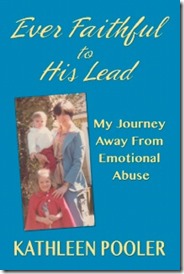
Pooler Final CoverToday I’m privileged to have Kathleen Pooler stop by to answer some questions about her newly published memoir, Ever Faithful to His Lead. In any memoir, the author today tells the story of the author back then, and sorting through the jumble of memories and pain to find a meaningful story thread can be a daunting task. Kathy has done a terrific job of finding that thread and turning it into a story that should touch nearly everyone’s life. If you haven’t personally experienced the sort of trauma she did, odds are strong that you know others who have. Let’s hear some back story for this book that lets the wise Kathleen of today put her former confusion into perspective.

Leave a comment below to enter a drawing to receive a free eBook version of Ever Faithful to His Lead.

SL: Why did you write Ever Faithful to His Lead: My Journey Away From Emotional Abuse?

KP: I started out writing a different story about a cancer diagnosis and watching a beloved son spiral downward into substance abuse. I didn’t find this story until I had written three years worth of vignettes while taking a memoir writing workshop. As I kept writing, the story that needed to be told revealed itself to me. When a developmental editor told me I had two memoirs, I realized I could not write the story of my simultaneous battle with a cancer diagnosis and a young son’s descent into substance abuse until I wrote about getting into and out of two abusive marriages. It took on a life of its own and I became connected to its purpose—to share hope with others. It is possible to climb out of the abyss of poor decisions and go on to live life on your own terms.

SL: How do you describe the theme of your memoir?

KP: I was driven by the question: “How does a young woman from a loving Catholic family make so many wise choices about career, yet so many poor choices about love that she ends up escaping in broad daylight with her two children from her second husband for fear of physical abuse?” It was time to answer the question that had been asked of me my entire life by those who loved me.

SL: In the book, you say “a loving family, a solid career and a strong faith cannot rescue her until she decides to rescue herself.” What lies behind that statement?

KP: One of the lessons I learned as I wrote this book is that I already had everything I needed within. I only needed to claim and honor my inner strength. . It sounds so simple, but it took a dozen years for me to realize I had to do this myself. If I can help one person connect with their own inner strength and leave an abusive relationship sooner rather than later — or better yet, not even get involved in one to begin with, then my mission in writing this book will be fulfilled.        

SL: What will readers will learn from Ever Faithful to His Lead?

KP: Three things come to mind:

  1. One does not have to sustain broken bones or bruises to be abused. Emotional abuse is harmful and the impact on the children of mothers who are in abusive relationships is far-reaching and damaging.
  2. Abuse impacts all socioeconomic groups. Despite having earned my master’s in nursing and growing up in a loving family, I was drawn to two emotionally abusive spouses.
  3. Denial and magical thinking can keep one from recognizing abusive behavior and taking action. Emotional abuse can lead to physical abuse. According to the National Coalition for Awareness of Domestic Violence, “One in every four women will experience domestic violence in her lifetime; 1.3 million women are victims of physical assault by an intimate partner each year. Most cases of domestic violence are never reported to police.” These are staggering statistics of epidemic proportion.

Domestic violence results in physical injury, psychological trauma and sometimes death. The consequences of domestic violence can cross generations and truly last a lifetime.

10% of the proceeds of the sale of Ever Faithful to His Lead will go toward the National Coalition for the Awareness of Domestic Violence.

SL: People reading books like yours often struggle with guilt and shame. What's your best advice on how they can deal with that?

KP: First, be awareness and acknowledgement that you are indeed in an abusive situation—denial can play a big role, as it did for me—and need to get out. Then, develop a support system and an escape plan. Have your bags packed. This can only happen when you admit you’ve made a mistake and need to act on your fears. You need to love yourself enough to want something better for yourself. Listen to, honor and embrace your inner voice.

SL: Where can we buy the book?

KP: Print and Kindle versions are on Amazon and print on Barnes & Noble. Digital versions are available on Smashwords for any eBook reader.

SL: Thank you Kathy for an enlightening discussion of your process.

KathyPoolerBrighterKathleen Pooler is an author and a retired Family Nurse Practitioner whose memoir, Ever Faithful to His Lead: My Journey Away From Emotional Abuse, and her work-in-progress sequel, Hope Matters: A Memoir are about how the power of hope through her faith in God helped her to transform, heal and transcend a long string of obstacles and disappointments:  domestic abuse, divorce, single parenting, loving and letting go of an alcoholic son, cancer and heart failure. She emerged to live a life of joy and contentment. She believes that hope matters and that we are all strengthened and enlightened when we share our stories.

She lives with her husband Wayne in eastern New York, and  blogs weekly at her Memoir Writer’s Journey blog: http://krpooler.com

Visit Kathleen online: (click site name for link)
Twitter: @kathypooler
LinkedIn: Kathleen Pooler
Google+: Kathleen Pooler
Goodreads
Facebook
          Personal page: Kathy Pooler
          Author page: Kathleen Pooler/Memoir Writer’s Journey
Pintrest

One of her stories “The Stone on the Shore” is published in the anthology: The Woman I’ve Become: 37 Women Share Their Journeys From Toxic Relationships to Self-Empowerment by Pat LaPointe, 2012.

Another story: “Choices and Chances” is published in the My Gutsy Story Anthology by Sonia Marsh, September, 2013.

Write now: leave a comment to enter the drawing for a free eBook version of Ever Faithful to His Lead. The winner will be notified on August 14.

Thursday, July 3, 2014

Brain Thorns

Thorns“All sentences are not created equal.”

That sentence jams a cactus into my brain, triggering wild buzzing and a whirl of obsessive thoughts.

Even if the story I’m reading is sweet and beautiful as a cactus blossom, when I hear any variation of “All men are not tall”,  my brain revs up like an angry hornet. I know the intention: to contradict the clearly false idea that all men ARE tall. The literal meaning of that sentence is that no men are tall. Obviously that’s as false as the initial statement. The world is full of men of a wide range of heights.

The accurate meaning is “Not all men are tall.” Or, “Men are not all tall.” But hey – I know you could find a better way of stating that within the context of your story.

I saw that opening sentence in a review of  Jenny Davidson’s book, Reading Style: A Life in Sentences. The review quotes that inflammatory sentence from the first chapter of Tankard’s book.

How, you ask, would I edit that sentence?  That’s a fair question. The real message of that sentence is better stated in the second: “Some (sentences) are more interesting, more intricate, more attractive or repellent than others.” I’d omit the first entirely.
But then I’d have to address the fact that neither sentence has anything to do with the rest of the lengthy paragraph. Oh my!

I would not write off a book based on a single sentence, no matter how annoying, but that sentence triggered my "the rest of this better be extraordinary to overcome that transgression” button, and I just showed you that further exploration did not stand the book in good stead. Had that brain thorn not been there, the awkward paragraph probably would have slipped by unseen.

Brain thorns tend to poison a reader’s outlook. Hopefully my rant will prevent you from planting this thorn in your stories, even though I may be the only person on earth vulnerable to its sting. Write what you really mean and your stories will sing.

This is only one example of a multitude of brain thorns. This one is personal and stabs deep. Awkward writing and sloppy checking, like typos, missing commas, or confusing I/me or its/it’s are less distracting to me, but thorns nevertheless.

Are you aware of brain thorns as you read? Join the conversation and tell us about yours in a comment.

Right now: Delight readers by using Grammar Check to remove brain thorns from your writing. Grammar Check is often wrong and can be a distraction if you leave it turned on, but do run it before your final save. Find its location on Word’s Review tab  ribbon and use it to check a few old stories. You may be surprised what you find. Ask trusted friends or your writing group to check for thorns that slip past your eyes and Word’s functions.

Tuesday, April 22, 2014

Flash Memoir–A Versatile Tool

LipsMany memories are tiny, so tiny they fit in a short paragraph. So tiny you may not think them stories at all. But don’t brush them away. They have stayed with you for a reason, and a much larger chunk of memory is usually attached to that alluring tag, one with deep richness that can develop into a lengthy tale, perhaps even a full-length memoir. Those fragments are worth exploring.

Journaling and writing practice are traditional ways of digging more deeply into the roots of memory. Flash memoir is yet another. In flash memoir, variously defined as stories under 500, 800 or 1000 words, you are challenged to develop a story concisely, framing it with crisp precision.

Writing flash memoir has more benefits, but first, an example. The following  474 word story grew from a micro-memory of mine:


First Kiss

He wraps his arms around me. I raise my head and his lips brush lightly against mine.
          Does this count as a kiss? My thought lasts longer than the kiss does. I smile bravely up at my tall date, hoping stars dance in my eyes. After all, I’ve been waiting my entire life for this moment, my first kiss from a boyfriend.     
          Is he a boyfriend? I’m not sure.
          His smile seems unsure. His arms fall as he steps back.
          “Uhm, well, goodnight…” He turns and walks down the steps and back to his truck that smells of hay and manure and damp cowboy boots. I open the door and go in.
          I feel empty, disappointed. This is not what I’ve dreamed of. I don’t feel any tingles with him. He’s tall, has a nice smile, but this six-foot-four, baby-faced cowboy seems bland as butter. Does he feel more passion for me than I do for him? We don’t hang around or have classes together. We only know each other from square-dancing. I think he needed a date tonight. So did I.
   
A month passes and we go square-dancing again. He picks me up early and takes me to his house and introduces me to his parents. His mother slouches on the couch with a book and cigarette. No makeup adorns her craggy face. Does she ever comb her stringy hair? It looks like she cuts it herself in the dark. This hag is married to a division head?
          Said division head sits in another corner of the room with the newspaper. He glances up and nods. Both smile when they hear that I just won second prize in the state Make-It-Yourself-With-Wool contest.
          “That’s nice,” says his mother, her beady eyes peering through wire-frame coke bottle glasses.
          We leave. Mission accomplished, I guess. What was this all about? Is he trying to make points with his parents? Why?
          During intermission, instead of gabbing with kids in our square, we wander outside. He puts his arm around my shoulders, maybe to keep us both warm in the evening chill. He talks about his horse. This is more like it. Will he kiss me for real? There may still be hope.
          He doesn’t.
          When he takes me home his lips brush mine twice. This time I don’t care.
   
Fifty years pass and we meet at a class reunion. He’s lean, weathered just right, still wearing cowboy boots. His smile lights up the room, twinkles flashing in crinkly eyes. This man evolved from that boy? Wow! He wraps his arms around me, right there in front of his dumpling queen wife, who watches with tiny sad eyes sunk deeply into her face. A lifetime of what-ifs swirls in my heart as our bodies cling together for six sizzling seconds.  
          I do not lift my face.


I worked for hours on these few words and discovered additional benefits from this compressed form:

    • It forced me to focus like a laser on the story topic and message.
    • It forced me to examine every word and prune anything that did not add value.
    • Ditto with details.
    • It forced me to craft precise, imaginative descriptions.

    As I pruned and clipped and crafted, a trove of related memories gushed to the surface, ready to be recorded for use in other stories or an expansion of this one. “Start small, grow big.” As I delved, I got deeply in touch with my insecure young self, realizing how much I didn’t yet know (and he probably didn’t either!). All that angst, that longing, came flooding back.

        This was beyond the usual concern with truth and general memoir considerations

        I urge you to have fun with flash memoir and use it to hone your editing skills. For an ongoing discussion of this sub-genre, tons more tips, and a list of places to post stories, visit Christine Houser’s FlashMemoirs website.

        By the way, I did not do all this editing in a vacuum. I shared the story with a group who pointed out rough spots I had not noticed. Never underestimate the power of a group for fine tuning stories.

        Write now: think of a micro-memory and draft a flash memoir of at least 100 words, but not more than 1000. Practice focus in every respect – content, wording, and description. 

        Monday, April 14, 2014

        Thoughts on the Writing Process

        bunny-hopToday’s post is part of a group effort. Last week in a guest post on Linda Austin's blog, Moonbridgebooks.com, I was invited by Mary Gottschalk, author of the memoir, Sailing Down the Moonbeam and a forthcoming novel to join a collective discussion on personal aspects of the writing processes. I found the questions useful in clarifying my thoughts on this matter and urge all writers to do likewise.

        1) What am I working on?

        I’m dabbling in flash memoir. I’ve spent the last few months intensively studying techniques for evoking emotion in readers, and one key concept that snapped sharply into focus is the need for laser precision in determining what details to include in any story. Flash memoir is a perfect vehicle for practicing focus. Soon I plan to write more about my experience as a square peg in a round hole world.

        2) How does my work differ from others of its genre?

        My most recent published project, Adventures of a Chilehead, differs in one significant way: it’s a mini-memoir, far shorter than most published memoirs, and it includes a slew of recipes that explain process rather than relying on set formulas. I kept the memoir part purposely short because I wanted to focus exclusively on my life-long love affair with hot chile, showing its origins and the evolution of this evolving relationship. I did not want to dilute that focus by including “padding” material. I said what there was to say and called it a book.

        I write more instructional material than memoir, distinguished by combining a bit of humor and conversational tone with clearly defined, step-by-step instructions with more information on technology than others include.

        3) Why do I write what I do?

        I write memoir primarily for family and friends. I write these stories as a legacy of personal history, to entertain my  readers, and to clarify my thoughts about the past and what it means.

        I write instructional material because learning is more rewarding when shared with others. My main metaphor for  life is that of a wilderness explorer who later leads others on a tour. Few things are as rewarding to me as helping others become stronger writers.

        4) How does my wiring process work?

        Different ways on different days! In the first chapter of The Heart and Craft of Lifestory Writing I emphasize the importance of finding your own best work style for writing. In her fantastically helpful book, The Plot Whisperer, Martha Alderson uses the terms "plotters and pantsers." Plotters plan everything out before writing. Pantsers write intuitively, "by the seat of their pants."

        I'm primarily a pantser, forming a rough idea what I have to say, dumping my thoughts onto paper and organizing them later. Sometimes I'll begin jotting key concepts on paper, but always turn to the keyboard before finishing half my list. Writing by hand works well to unjam my thoughts, but need keyboard speed to let them run free.

        Once I get that draft on the page, I edit like a fiend, questioning every word. Typical questions I ask myself include:

        • How can I streamline this?
        • How else can I describe or say this?
        • Does this detail add to the story or do I just love it?
        • What else does the reader need to know?
        • Is this the best place to say that/

        If I plan to publish it, the story (or book) goes out to beta readers. After I get their input, I start editing again. Usually life intervenes and two or three months pass before I get to final publication. By then the material is cold enough it seems new again, and I do another round of tough edits. Last week I shared a flash memoir with an online writing group. I kept track of the number of times I resaved the pdf version: 43 at last count. The story has 482 words. That's pretty typical

        Write now: take some time and answer these four questions for yourself. You may be surprised what you learn. If you have a blog and decide to post your responses on it, please link back.

        Monday, March 24, 2014

        Which Memory is Real?

        Memory1Everyone knows how memory dims and darkens with time. Yesterday I began writing about a memory from the summer after first grade when I felt “outside the circle.” I'd written  about this incident before, but decided to begin fresh. After five paragraphs I could see no further benefit in continuing the rewrite and tracked down a version from five years ago, intending to graft in some of that material.

        When I read the earlier story, my jaw dropped. The theme was the same, the other main character was the same, but circumstances were quite different. Yesterday's  story begins as I approach a cluster of kids that included Carol (the girl across the street) and half a dozen neighborhood boys. In the earlier version, Carol was jumping rope alone in front of her house.

        Which is real? Has my memory changed that much in five years? Which version should I use?

        As I closely examine the versions, slight differences begin to emerge. In the jump rope version, Carol does invite me to play, in an off-handed way. I do mention that Tom, the boy our age who lives in the other end of her duplex, won’t play with me. In yesterday's memory and story, I arrive as Tom finishes telling a dirty joke. I hear only the ensuing laughter. An older boy tells me I shouldn’t have been listening (I wasn’t!), and all the boys run off, leaving me to play with Carol.

        In both cases I felt awkward and uncertain. Both my mother and I had only our younger sisters to play with before we began school, and we both lacked social savvy. I was desperate to learn. The jump rope story works well to emphasize that awkwardness. The second story works better for emphasizing my discomfort with groups, my feeling of being on the fraying fringe of things.

        I’ve concluded that two memories are involved and that both memories are real – as real as any memory can be. As I further refine my theme, I believe the choice of which story to use will become apparent. Or I may use both in a longer version.

        The important point for now is that both memories are tattered and faded, dark fragments of the moment. The “actual facts” of what “really” happened are only faintly discernible. The “truth” of the encounters lies in emotional memory.  That’s where the story is. Knowing the specific date, time of day, color of Carol’s hair, or names of the boys serves no purpose. I don’t care about those myself!

        I shall include only details directly relevant to the story such as:

        • The comforting feel of summer sun on my shoulders and espresso-brown hair.
        • The view from my vantage point in front of my house, eighteen stair steps above the street and two hundred feet away.
        • Feeling sad, alone and "different" as I watched.
        • Feeling confused and clueless about how to join Carol or the group.
        • Feeling awed by the beautifully decorated bedroom she had to herself.

        Details like this form the reality of memories. My challenge is to develop brightly lit scenes that crisply convey this sense of loneliness and longing — the core truth of both memories and countless later incidents.

        Write now: Without looking back, rewrite an emotional memory you wrote about at least a year ago (preferably much longer) in a story or journal. Don't look back before you write, but compare versions when you're done. Make note of differences and dig for those golden key emotions underlying the memory. Follow their trail through the years.

        Photo credit: Dan Sakamoto

        Sunday, March 16, 2014

        Eternal Optimists Piss Me Off

        RoseColoredGlassesAt the risk of sounding judgmental (how human would that be?) I’ve got to admit that when I continually hear nothing but rosy accounts from the same person, I grow suspicious, even angry at times.

        For example, an elderly woman I knew many years ago never had anything but the kindest, nicest things to say about people, even about people I found monstrously arrogant or rude. She was always smiling and cheerful, even in her nineties when I knew she had aches, pains, and countless physical problems and not everyone treated her well. By her account, people were always delightful, and her cheerfulness never ended.

        Get real, Gertie, I thought. Admit it. Some of the cherries in that bowl are rotten.

        Another example is an acquaintance who seemed authentically forthright and open. Until serious illness set in. At first, rosy Caring Bridge accounts of awesome friends and caregivers, minimal side effects, and even the blessing of illness seemed brave and spunky. Later, when no post ever mentioned the least affliction of the spirit, I became suspicious. These sound like press releases from the Ministry of Positive Thinking and Eternal Gratitude. What's it really like? What are we not hearing?

        Snarky bitch am I not? But those reports increasingly reeked of dishonesty. I became increasingly convinced I was not reading the whole story. I felt disrespected and misled. While happy to hear good reports, I wanted to read about the challenges of remaining positive in spite of the odds, in the face of obstacles. I wanted survival lessons "just in case."

        Now, lest you decide I’m totally lacking in compassion, please understand that I realized both these people presumably held back for good reasons. The old lady belonged to an ethnic minority and learned from her first breath not to make waves. My annoyance with her was fleeting. The ill acquaintance was probably hanging on by fingernails, frantically stomping all negative thought, hoping thereby to promote healing for self — and also for the world. This person is like that. Genuinely compassionate and caring, expecting the best of others and determined to set a great example by walking the talk

        But it pissed me off. Reports — STORIES, that is — that lack conflict, lack a bit of appropriate, expected pain, suffering and angst don't ring true. Authenticity holds my attention, especially authentic transcendence. You can't transcend what you don't experience and unless you give a fuller picture we don't know but what you had a fortunately light case of whatever, sort of like being passed over by a blizzard after dire forecasts.

        I'm not perfect. I obsess, fend off fear, dread and demons of doubt and despair like anyone else. I bite back now and then. So the last thing I want to read or hear about is someone so good, so saintly, that they don't have these carnal thoughts or problems. That makes them unattainably better than me. I must cut them down to size or feel diminished myself. Unfortunately, cutting them down to size makes me feel rotten, not encouraged.

        So here's the irony for lifestory and memoir writers:

        If we record only the light sides of ourselves, our noble accomplishments — the sides we want to be remembered for and examples we want to provide, we come across as plastic stereotypes who set an unattainable standards. Through perceived insincerity, we run a great risk of pissing off readers.

        To claim admiring respect spin around in front of the camera, for at least a quick rotation, and prove that you are/were human. It doesn't have to be much — only what's required to flesh out the story. A few lines of inner reflection may be enough, if they support the story to help readers understand your point and person.

        Only vampires and liars lack shadows.

        Write now: pull out an overly bright story and add a few lines of shadowed reflection for depth and credibility. Readers will love you for it.

        Friday, December 6, 2013

        Mr. Muse Cranks Up Creative Juices


        HermI met Herchel Newman, aka Herm, about a dozen years ago in the original Lifestory Group on Yahoo when we were both new to the genre. I’m always blown away by his richly authentic stories. Whatever the topic, gentle humor or compelling drama, I’m mesmerized from the first word. We’ve stayed in touch after that YahooGroup went poof, meeting in person one time, and we’ve both continued to write.

        Not long ago he emailed me some thoughts about his muse, the source of inspiration for his writing, both memoir and make-believe. He  graciously agreed to share those thoughts here on this blog. Hopefully Mr. Muse will guide you to tap more deeply into your creative forces.

        There’s a guy who lives inside my head. I call him Mr. Muse. Besides God and myself, I’m pretty sure he knows me better than anyone else. He is the contemplative as well as the whimsical part of me. He comes and goes as he pleases. It doesn’t matter if I’m asleep or awake. Sometimes he gives me rhyme and reason for things I’m having a hard time understanding. Other times he’ll show me something that makes me laugh out loud. That causes my wife to wonder about me sometimes. I admit to being quite fond of him even though at times he’ll begin a story or piece of poetry and decide to take a nap before he gets to the end. And sometimes–like now–I call for him and he’s no where to be found.

        Mr. Muse, for the most part, is a class act. For instance, recently he showed up while I was doing some free writing–you know, just to see some words going on my computer screen. He started telling a story, I would say from the inside out. Kind of like starting a novel in Chapter 4. Here’s the kicker. He was talking–get this–in character just as if he was Bogart.

        Listen to Humphrey Bogart’s voice: “She took a table caddy-corner to the left and front of mine. Her red dress fit as well as the name Coke-A-Cola on a tall bottle. I didn’t mean to stare. It’s just there wasn’t anything else that could compete for my attention. She crossed her legs at the ankles like it was a romantic dance move. I never understood how shoes could be considered sexy until I noticed hers at the end of those cinnamon brown legs. Her brown hair cascaded just past her shoulders with silken waves the Mississip would envy. Her perfume invaded my space and deliberately sat like an invited guest. My wedding band began to vibrate like it was my cell phone. (Of course Bogart never had one) I joked to myself, ‘She needs to be ugly or I need another table.’

        “She turned her head to the side, granting me a profile view. No, she wasn’t ugly. A diamond held a ruby dangling from the lobe of her ear. The corner of her mouth and that of her eye were gracefully lined to perfection. I’d no sooner formulated the questions in my mind: Who is this lovely lady and why is she dining alone on a Friday in a place like this? when I noticed a tear forming at the corner of her eye. Perhaps my answers were in that salty drop. She moved as if she might look my way. I turned my attention to the window view.”

        I don’t know who or what Muse is to you, but here’s one other thing I’ll share with you about my Mr. Muse. He is a companion of my conscience. If I attempt to turn away from my conscience, he’s resourceful enough to get my attention.

        Excuse me. Here he comes now.

        Notice how Herm’s muse is fickle. What he didn’t mention here, but I know he knows, just as I know it with my muse Sarabelle, is that when a muse speaks, you’d better not only listen but write down what you hear! You probably won’t get a second chance. Notice also how Mr. Muse guided him to magnificent description details and the “voice” of Bogart. That’s hard to do when writing “cold.”  Mr. Muse puts Herm in a state of flow.

        Write now: Try some free writing, as Herm did. That’s the best way to get in touch with your muse, however you may define this source of inspiration. See where s/he leads you. And don’t forget to write down any ideas your muse whispers in your ear at odd times and places.

        Herchel Newman A.K.A. Herm, has been a seasoned storyteller all his adult life. He added photography to his skill and operated a successful wedding photography business for many years. He has stories published in three titles of Chicken Soup for the Soul – one a cover highlight. He loves family and romancing Sweet Lonnie, his wife of forty-four years. Also a motorcycle enthusiast, he says every day has an adventure to write about. Click here to read his spellbinding story, Escape from Hell, excerpted from Chicken Soup for the Soul: 101 Miracles. He is a valued member of the Life Writers Forum.

        Thursday, November 14, 2013

        Living to Write the Tale

        dreamlife

        A novel concept came across my radar lately in the form of a guest post request – the idea of planning to live a life worth writing about. Although I saluted the basic idea, my initial reaction was that such a post belongs in inspirational blogs, and does not fit the focus of this life writing blog. At first glance, it seems to contradict what I’ve said many times, that any life is worth writing about. I also failed to see the connection between establishing visions and goals and writing about life.

        The second time I received a proposal about this, something clicked. The idea of taking charge of your life, however many days or years you have left is nothing new. I recognized that people like Elizabeth Gilbert did just that in her best-selling memoir, Eat Pray Love. She planned the sort of adventures she wanted to experience and write about and negotiated a book contract before she bought her plane ticket. A few purists felt that was contrived and perhaps a tad beyond the pale for memoir. But the vast majority applauded her spunk.

        What was new this second time was realizing that life writing has powerful tools for making that planning effective, and they’ll work for any age.

        These tools work because writing makes thinking visible. Once you see something on the page, whatever form it’s in, it’s easier to understand and manage. Use these tools to explore your hopes and dreams and develop ways to bring them about.

        1) Journal: Use your journal to write about hopes and dreams.

        • Make a bucket list of 100 things you want to do, visit, see, or experience before you die.
        • Journal or freewrite about possible ways of doing these things.
        • Explore reasons why you believe you can or cannot do any given one
        • Dig into your beliefs and values.
        • Record your dreams and explore desires hidden in them.

        2) Write stories about things you’ve already done that felt especially fulfilling. Dig more deeply into these stories to explore what elements made them exciting or fulfilling and journal about ways to add more of this element to your life.

        3) Write stories about things you dream of doing. Include yourself as the main character and give yourself all sorts of exciting challenges you’d live to have. Live your dreams on the page. Even if you never set foot out of your house, you’ll have much the same sense of fulfillment that you would gain from actually doing whatever it was.

        Although it seems a bit eerie, visionaries have known for ages that vividly imagining something tricks the brain into believing it is real or really happened. If you write vividly about doing something, your brain will respond as if you have, and make it easier to “do it again.”

        So whatever your age, finances or other perceived limitations, write yourself a life worth writing about, then live it to the fullest and go on to to write the tale.

        Write now: pull out paper and pen and write yourself into an adventure you'd love to have in real time. Make it vivid, with full detail and emotion. Write a lot about how you feel as you “live in the story.”. Be exotic and daring. Write it in present or past tense, not future, and avoid any form or thought of “if.” Write this real. Polish the story and cherish it. Then put it away and see what happens.

        Image credit: Coolcal2011

        Wednesday, October 23, 2013

        Write Where the Juice Is

        Scandalous

        When I read this advice recently in Vanessa Talbot’s ebook, 101 Ways to Live Extraordinarily, I thought of one of my great-great-grandmothers. Family legend has it that she opened the first brothel in the Yukon. The topic certainly does give us plenty of food for talk.

        Is it true? Did she? We don’t actually know. I’ve given it great thought. That she did go there early on with her new husband and son is established fact. Before she married that husband, she divorced the coal miner she married before emigrating from Scotland to Illinois in 1871. For twenty years this spunky woman had run boarding houses for single miners in order to provide food, clothing and shelter for her two children. Her first husband was an abusive bum who spent his money on whiskey.

        So she knew how to provide lodging for others. Demand for room and board was high up in the Klondike. It makes sense that she would ply the trade she knew to bring in immediate cash while her men were slogging around in the mud in search of the fortune they never found.

        Another trade was in high demand up there. It’s established fact that swarms of women went there to engage in “the world’s oldest profession.” They needed a base of operations. What would make more sense than a pragmatic forty-something matron making mattresses available to this trade? Perhaps this experience was one of the factors leading to her conversion to the newly emerging Mormon faith a few years later when she settled in Seattle.

        Again, do I know this is fact? No. Do I plan to check it out? Records from the Klondike could show that she did run at least a boarding house. But the lack of records would not prove that she didn’t. So, no. I do not plan to check it out. I cherish this legend and have no wish to shoot it down. This story has been in the family for generations, perhaps shaming some and delighting others. I’m not going to be the one to kill it. Let future generations cherish it along with us. Soon I will pass it on to the older grandchildren.

        For our purposes today as we write our own lifestories, you could choose to purposely do something audacious (scandalous may be a bit over the top) specifically for the purpose of writing about it. That’s what Elizabeth Gilbert did for her memoir Eat Love Pray. Thirty years ago I took up skiing for a single season specifically for the purpose of speaking and writing about it. So far I’ve done neither. It’s time to get that experience on the page.

        But chances are you’ve already done something adventurous and colorful, showing a sassy attitude at least some of the time. Something brave and gutsy — the sort of story Sonia Marsh features on her Gutsy Living blog. Read some of those stories online, or do it the easy way and order My Gutsy Story, an anthology of top-rated posts. (I must add a disclaimer here that one of my stories is included, but I have no financial interest in the project.)

        Going back to the original advice, the definition of scandalous varies from one generation to another, so what seems utterly outrageous today may seem rather tame tomorrow. Even so, disclosures today can affect relationships today, so exercise the usual discretion when it comes to confessions that could rock many boats.

        Whether your story is scandalous or merely colorful, be sure to include reflections about your thoughts and feelings during and after the experience. Did you feel fear? Exhilaration? Guilt? Pride? Create vivid scenes with compelling description and strong, active verbs. Make the story as lively as the experience, and claim your spot in history as a colorful and memorable ancestor who stands out in the crowd. Be the one they talk about.

        Write now: make a list of ten gutsy, audacious, perhaps even scandalous things you’ve done. Pick one and write the story! Then write another. Give your descendants something to talk about, and perhaps a standard to live up to.

        Thursday, August 22, 2013

        From Journal to Memoir

        journal4“I have piles of old journals. Can I use those as my memoir?”

        This question comes up in almost every class I teach. The short answer is “No. But you can use those journal entries as a resource.” Here’s why and how.

        Take a look at the Tree of Life Writing image in the right sidebar. Notice that Journal Entries fall at the foot, below the ground, out of sight and light. Those journal entries feed into Story, that appears first as Essays and Stories. Those component stories and essays feed into the composite Memoir.

        If you are using your journal to best advantage, you write with no boundaries. Your entries may ramble. They may not be coherent. You may omit detail or obsessively dwell on detail. You may write things that will send certain relationships up in flames if you don’t consign those pages to flames before anyone reads them. You may reveal things to those pages that would embarrass you or others, or betray their confidence.

        But aside from all that, reading journal entries is usually boring or confusing  for anyone other than the author. In our journals we repeat things, perhaps to the point of obsession and stuckness. We report conclusions and assumptions. We nearly always confine journaling to “telling.”

        So how do you convert that material?

        Start with lists of key memories and arrange them on a timeline. Then pick one of those memories and find journal entries about that event or the general time period. Read those entries to refresh your memory about details. Use them to get back into the scene. You’ll probably need to sink back into the moment, because you probably didn’t record many sensory details, but recalling the emotions and actions you did record should help you recall the rest.

        Write a story about that memory, adding details evoked by your journal entries. In the story you show the action. You describe the setting and other characters(remember, characters may include animals, inanimate objects, nature, place, or other aspects of yourself as well as other people). You use sensory details to get readers as fully involved with the situation as you were.

        Your story includes action that ideally involves some uncertainty and tension or conflict. Dialogue is not an absolute requirement, but even if you are the only person around, you can include at least a bit. Have conversations with yourself.

        Each sensory detail, each bit of dialogue and aspect of action activates an additional sensory area in readers’ brains and adds a layer of realism to your story, bringing it alive in readers’ minds.

        One more layer of realism may come directly from your journal. That’s the element of reflection. Readers want to know more than what happened. They want to know what that meant to you, how it affected you. That’s where those journal entries come in.

        On rare occasions you may want to directly quote journal entries. At times, quoting from your journal may add a touch more credibility to your reports of how you reacted at the time, and some snippets may be lyrical and compelling. Use these suggested guidelines to effectively incorporate journal material:

        • Use them sparingly. Don’t let them be a crutch for “telling” rather than “showing.”
        • Prune them to laser sharp  focus. Use ellipses (….) to show that you’ve omitted material before or after the quoted material, or even within.
        • Create composite entries. Some people may have a problem with using journal entries that are not verbatim quotations. This is a matter of personal judgment. Many of us consider journal entries to be similar to dialogue. The intent of the message is more important than literal accuracy. So if you need to distill three or more entries into a single one to give the drift of your thoughts at that period of time, do so and avoid overwhelming readers with what may seem like tedious navel gazing.

        So, yes, you can use your journals, but use them primarily as resource material rather than verbatim story elements.

        Write now: scan through an old journal and find a juicy memory topic with several related entries. Immerse yourself in those entries to recall your sense of the times and your state of mind. Bring the setting into memory as clearly as you can and notice elements of the setting. What was going on? What were people thinking or doing. What did you notice about the situation? Then use this awareness to write a short story or scene based on that memory, incorporating the details you recall and personal insight you recorded.

        Wednesday, July 17, 2013

        Little Story, Lots of Lessons

        Child-Hold-Me-Cover-667x1024Closing the covers on a tale of epic proportion is merely a transition on my path of savoring a book. I may spend weeks gnawing on the bones of that book, reliving favorite scenes and savoring the way the details come together. Shorter stories may provide welcome diversion and profound insights, but seldom stick with me as long.

        Michel Sauret’s memoir, Child, Hold Me, is an exception. I found the book after following a link to”How Much Does It Cost to Publish a Book?” on Sauret’s meaty blog. A blurb for the book piqued my interest:

        From International Book Awards winning author Michel Sauret, “Child, Hold Me,” is a short memoir about losing a child in the womb, told through a man's perspective.

        What? A man has written a memoir about miscarriage? Wow! This was new territory for me. I read on and learned that Sauret and his girlfriend were still in college and … the frank confessions in that blurb stunned me. I clicked the link to Amazon.

        For less than the  cost of a cappuccino, the story flowed onto my iPad, and I dug in right away. Captivated by phrases as rich as the insights they convey, I read straight to the end. Sauret writes with his heart wide open. I’m reminded of the phrase attributed to an army of authors,

        Writing is easy. You just open a vein and bleed onto the page.

        Sauret’s literary blood and gutsy writing flowed straight into my heart in little longer than the time required for a physical transfusion. This memoir is short – 88 pages according to Amazon (it’s not available in print) – but lacking in nothing, and it packs a powerful punch. I’ll be chewing on this bone for weeks to come. Some of the points I’ll ponder:

        Reading memoir by diverse authors broadens my insight into the human condition. I’d never stopped to think how losing an unborn child might affect a man. Suaret’s frank disclosures jolted me to attention and broadened my point of view. I never intended to limit my perspective of difficulties conceiving and carrying a child to term as strictly a woman’s concern, but I realize now I pretty much did.

        What other blinders do I unwittingly wear? I shall keep reading and learn, taking them off, one-by-one.

        Self-disclosure builds bonds of trust between writer and reader. Daring to disclose personal truth on the page, especially raw confessions such as Sauret makes, opens portals between people. They crack shells of indifference and preoccupation. They remind us there are people out there. People who live and breathe and bleed when they’re hurt. They snap our little lives into perspective. They breed compassion.

        Longer isn’t always better. Sauret writes his tale tersely, within a small space. Yes, I was left hungry for some additional details, but he covered the essential points. In retrospect I realize that the details I hungered for are primarily trivia that’s fun to read at the time, but seldom stored in long-term memory. He stuck to the bones with just enough muscle to make them move. I read the story in two hours, but will ponder it as long as if it took two weeks.

        Story transcends boundaries of gender, race, time and place. Saueret’s story reminds me that men can move beyond macho to cry, feel compassion and unbounded love. Ian Mathie’s African Memoir series reminds me that purportedly primitive people are wise in ways we may fail to fathom.  Jerry Waxler’s Memoir Revolution thoroughly explores the world of ways memoir enriches lives.

        The advent of digital publishing opens the opportunity to publish a collection of mini-memoirs, much like literary Lego blocks, allowing readers to pic and choose, linking them in a variety of ways. We are freed from the pressure to crank out 75,000 words to make our story worthwhile. Hooray for that!

        Write now: think of a major turning point in your life. Outline the elements, including lessons learned, and consider ways of converting that experience into a mini-memoir, writing the bones, with enough muscle to make them move. Share your thoughts about writing in smaller scale. in a comment. Is this liberating? Disappointing?

        Monday, June 17, 2013

        Story Album to Memoir

        chili - fixAdventures of a Chilehead initially began as a simple story album – a term I use in The Heart and Craft of Lifestory Writing to describe a collection of free-standing short stories. But a funny thing happened as I began assembling the loose stories into a document: they evolved into a memoir. Here’s how.

        I began with three stories, two of which appeared in The Heart and Craft of Lifestory Writing. I’d already written the third back then, but decided to save it for later. Through the years I wrote other stories on this theme. When I put the collection together for this album and arranged them in chronological order, I thought of a couple more. As I wrote and edited, I shared each story with a writing group.

        “Great story, but tell us more about this, this and that,” they said. “This line would sound smoother like so.” I love my writing group. My writing is always better with their help! Although they hadn’t said it in so many words, they wanted more reflection, They wanted to know what I was thinking, what the experiences meant to me. They wanted reflection. Oh, yes! That’s something I teach and advise others to include. But it’s easy to overlook in my own stories.

        Adding reflection forced me to explore simple stories and memories more deeply, to dig for more significance. I had to confront the key question: why do I love chile so much? Why do I keep scorching my mouth? And what else was going on that made those stories stick in memory? The answer was a little different each time, and it made the stories richer.

        Another aspect of the collection the group didn’t see was overlap among the stories. Some stories have short flashbacks to previous memories. In a collection, such shared stories should be told in full only once. Later stories can refer to them in passing as “the time my father …” without repeating the details. I pruned that overlap and tucked in a few mini-memories to add further insight and interest.

        As I continue to fine-tune those stories, working on the reflection and thinking from one story to the next along the time line, a story arc gradually emerged. My thoughts and preferences have evolved over time. I have evolved from girl to grandmother with the perspective of several decades. With no specific intention, this project has organically morphed into memoir with continuity, focus, and evolution of the story.

        At first I was reluctant to add much reflection. The original stories were funny. I often read the unpublished third at public events and it’s hard to keep from laughing myself. Would I lose that comic edge?

        Simple story albums need no conclusion, but an integrated collection or memoir needs resolution. That concluding chapter gave me fits. Then I had one more adventure that I would never have recognized as such if I hadn’t been working on this chapter. After a dozen false starts, a very different story emerged. Meaning became laser clear. Whether anyone ever reads this memoir or not, my life is richer for that.

        More work remains to be done before the project is finished. I’ll keep you posted.

        Write now:  select an assortment of stories you have written and assemble them into a story album. If you have several on a theme, so much the better. Or maybe you have several from the same time era. Read through them all at one time and see what else comes to mind. Perhaps it will remain a simple short story collection, but you may find it becomes something more.

        Preserve a Record of Life As It Was

        Believe it or not, this post is not about politics. It’s about change. Regardless of your political position or beliefs, you’d have to be l...