Friday, November 30, 2012

Like Santa’s Bag of Presents

Santa's Choice“True, I’ve written a few stories, but I’m not a writer!” Such is the mindset of most beginning writers. In January of this year I posted an interview with author Nancy Pogue LaTurner based on her experience writing her memoir, Voluntary Nomads: A Mother's Memories of Foreign Service Life. I’m happy to welcome her back with this guest post building on the metaphor of Santa Claus as she outlines her writing path from novice to “real writer.”

Before beginning my memoir, Voluntary Nomads, I carried a weight around with me. Like Santa's bag of presents, I hefted my sack of stories. It was full to bursting and I needed to lighten the load by giving these gifts away.

Unlike Santa, with his centuries of expertise and magic delivery system, I worried that I was ill equipped to carry out my plan. When I began the memoir-writing journey, I didn't consider myself a writer. I could have, given my early experience as editor of my elementary and high school newspapers, columnist for my hometown weekly, and jobs throughout my working years that required writing grants, proposals, procedure manuals, and public relations material.

I didn't yet see myself as a "real" writer. Then I took a writing class, the first since college half a century ago. The teacher told us to introduce ourselves by saying, "Hello, my name is So-and-so and I'm a writer." It was embarrassing at first, and I felt like an imposter, but as the class continued over several weeks, I grew to fit the writer's costume and learned more skills to perform the author's role.

Faced with the instructor's scathing critique of my final short story in that class, I almost surrendered my name-tag along with any hopes I had of deserving the title "Writer." However, I surprised myself by having the courage to return to my story with a commitment to make it better. My persistence paid off. That story won a cash prize in an international contest sponsored by SouthWest Writers  and received Honorable Mention in the Writers Digest Magazine annual contest of the same year.

Even though more of my writing won other prizes and earned publication in two volumes of the Albuquerque Almanac and an anthology Wisdom Has a Voice, I still didn't see a real writer when I looked in the mirror. Like a department store Santa's promises, my sleigh full of gifts offered potential rather than actual achievement.

Even so, prizes and publication served as validation and infused me with energy to pursue my desire to make a book of my Foreign Service stories. I took more classes and joined critique groups. In 2009, NaNoWriMo (National Novel Writing Month) fever ignited the urge to write 50,000 words during the month of November. When I recognized the power of daily writing practice, I made January my own personal writing month and finished my memoir manuscript.
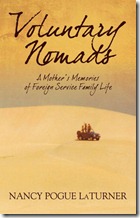
Voluntary Nomads, coverWith the first draft completed, I began a new adventure. On this journey, I learned what it takes to publish a book, and I discovered plenty about myself too. At the beginning of the trip, I couldn't have guessed that I would be able to handle the critical input of an editor, find a publisher, format a manuscript for both print and digital editions, turn color photos into black and white as well as crop and size them for both print and digital reproduction, or carry out the marketing of my final product.

I should have worn a Santa suit to launch my book. On that day, as I signed and distributed my gift of stories, I finally felt like the real thing. I recognized myself as a real writer at last and changed my identity forever.

Nancy Pogue LaTurner plays Santa to three grandsons when they visit her home in Albuquerque where she enjoys retirement with her husband, Fred. Nancy's current writing project is a suspense novel set in New Mexico. Learn more about her on her website and read my review of Voluntary Nomads on Amazon.

Write now: Write a story about your writing journey. If you’ve been writing for years, include some of the blocks you’ve faced and how you overcame them. If you are just beginning, write about your hopes and dreams, and how you will know you are a real writer. Explore elements underlying your belief that you are not yet a real writer. Regardless of your state of maturity as a writer, include your dreams for what you’d like to achieve with your writing.

Monday, November 26, 2012

What Does It Mean to Fit In?

puzzleAll my life I’ve wanted to fit in, or so I thought. Now I wonder. What is it that I wanted to fit into? Some might say their jeans, but so far, my jeans have fit fine. I wanted to fit in with others, to blend seamlessly with the group. To be an insider. To be like others. Suddenly I wonder: just what does that mean? What was I hoping to be like? And who were these people I wanted to fit in with?

Last month travel writer Annabel Candy published a blog post, 35 Ways I Don’t Fit In, and she challenged readers to make their own list and link back to her post. When I sat down to make my list I realized that any given item is far from unique. Each specific attribute will be shared by a multitude of others – like DNA, it’s the total combination of shared elements that makes me unique. In no particular order, I’ll list  35 of the countless elements that add up to my unique experience and self.

1. I love chili, the hotter the better – up to a point. Inspired by Elizabeth-Anne Kim, I’m working on a Kindle Short about my adventures as a Chilihead.

2. I spent my public school years in Los Alamos, moving there after the Manhattan Project chaos had settled down and Los Alamos was closer to being a “real” town.

3. I have visited all fifty states, and lived in eight of them.

4. I love working with Photoshop.

5. I’d rather be writing than nearly anything else – except traveling and playing with Photoshop.

6. I almost never use recipes when I cook.

7. One of my two earliest memories was sitting on the floor by my mother’s knee with a needle and thread and scrap of fabric. I knew I was only  making tangles, but that didn’t matter. I was sewing!

8. In 1961 I placed second at the state level in the New Mexico Make-It-Yourself-With-Wool contest.

9. I began violin lessons in fourth grade.

10. In high school I played string bass in the New Mexico All-State Orchestra.

11. My favorite afterschool activity in high school was drama club, known as the Olions. I always worked backstage.

12. I love to drive stick shift cars and still own one.

13. I have hiked the Milford Track and Tongariro Crossing in New Zealand.

14. I have walked across edges of Antarctic glaciers.

15. I can’t carry a tune by myself.

16. I love walking in the woods.

17. I do not enjoy gardening or yard work.

18. I do not like talking about myself!

19. I love solving puzzles.

20. I do things in binges, i.e. writing, playing computer games … even cleaning.

21. I used the kitchen clock as a calculator to keep score when my sister and I played tiddly winks as preschoolers.

22. I love taking pictures, but don’t give a fig about f-stops and all that jazz. That’s what Photoshop is for!

23. I have a great-grandmother and great-great-grandmother buried in Oakwood cemetery in Austin, Texas, right behind Ima Hogg, less than two miles from my daughter’s house.

24. I graduated from Boston University.

25. I was once a movie star’s houseguest at his beachfront home.

26. I was treated to a reed kayak ride on Lake Titicaca on my most recent birthday after dancing with village women.

27. I began using AppleWriter on our Apple ][+ computer right after Halloween in 1982 – 30 years ago!

28. I have six grandchildren living in three states.

29. I have made every type of clothing article from hats to shoes, lingerie to winter coats.

30. I was always the last one chosen for softball in grade school.

31. Many of my best friends live in my computer.

32. I’m a lifelong supporter of public libraries.

33. To my chagrin and amazement, I love ebooks!

34. While failure is not an option, giving up often is.

35. I quit wanting to fit in. I like my unique mix of me, and realize the joke was on me. When I quit trying, I fit in with most groups. 

Any life writer will recognize this list as thirty-five story ideas. You know lots of facts about me that you probably didn’t know before, but not the story behind the facts. I could easily cluster these ideas, combining them into perhaps a dozen or fifteen stories. That’s how a memoir is formed. Find your key ideas, cluster and arrange to fit a story arc, then let those fingers fly!

Write Now: Compile a list of 35 things that make you uniquely you, then write some of the stories. Post your list to your blog or Facebook, and please, link back! I’d love to hear a few of your items in a comment too.

Sunday, November 18, 2012

Dancing in the Rain

PotatoFarmingElizabeth-Anne Kim recently published two collections of life stories, DANCING IN THE RAIN (free Kindle download Thanksgiving Day through Sunday, Nov. 25, 2012) and WHAT MY MOTHER DIDN’T KNOW, as Kindle Shorts. These memoir pieces were largely unplanned. In this guest post, she explains how incidental writing can turn into something surprising.

If you can be an accidental life story writer, that's what I am. I didn't mean to publish independently either; it just sort of happened.

After nearly four years in Korea, my husband and I transitioned our family back to the United States in the spring of 2010.  I found myself in a new setting with two children who needed me close at hand. Traditional career options were not going to work. I decided to try writing. I had previously done a bit of writing work, and I felt pretty confident in my ability to transition back and forth between genres.

What I didn't feel comfortable with was my ability to stick to a deadline all by myself.

ADHD runs in my family, and I desperately need deadlines, lists, and accountability. Finding writing groups I could join with two little boys in tow was difficult. Finding writing groups that met consistently was even harder! Fortunately, I ran across a life writing group at a nearby library that met religiously on the second and fourth Wednesday of the month. Proud to have found a group that would give me a solid writing deadline, I told myself I could learn to write memoir.

I did learn. Sharon's book, The Heart and Craft of Lifestory Writing, has helped. I am writing a full-length memoir—but this isn't it. Once again, serendipity stepped in. In response to a county library initiative, our life story group concept was expanding to other libraries. I started facilitating a life writing group at my own local library, and I needed some stories that were more relevant to the general population. Those stories essentially boiled down to my stories as a child and my stories as a parent.

Until that point, I had only blogged about my children, who are bright, creative, active little boys who also happen to have some mental health issues. Reactions from the writing group and others in the community cemented two things for me. First, many parents are grappling with mental health issues in their children now. Secondly, while there are plenty of heartbreaking memoirs out there and lots of self-help books for children with ADHD and spectrum disorders, very few people are writing about the joy found in life with these children. And that was my intent—to connect with others who were determined to enjoy their sometimes rather difficult children.

I began with four solid stories. I thought about building up enough stories for a complete memoir, a feat which would require quite a bit of time and would have no guarantee of eventual publishing success. I thought of my community. Those of us struggling now need encouragement now, not a few years down the road.

That conviction in and of itself, however, probably wouldn't have pushed me to publish independently either.

I was convinced instead by a combination of an upcoming project in our life writing group that I would like to convert to book form (and would therefore need a book to practice on first!) combined with Will Bevis's Kindle Shorts. If you haven't read Will Bevis's work, please do! It's hilarious, and I never begrudge the $0.99 I spend on it. In fact, I appreciate the brevity of the pieces. I will finish his work (and laugh the whole time).

With the project looming over my head, I began investigating the Kindle Short and Kindle Direct Publishing (KDP). It requires no initial monetary investment by the writer, takes care of all the sales taxes and online sales, and offers free promotions. It merely requires that there be no other electronic formats of one's e-book out there while that e-book is enrolled in KDP. So essentially, you can publish and un-publish in KDP. It allows me to get stuff out there in a format to test the waters. If I decide that I want to expand this material, which I think I'm going to do, it allows me to incorporate it into something larger by taking it down at the end of my contract period and putting it in a different format. It also allows me to test my voice as well as give a preview. As I write that longer memoir, I'm thinking of taking the stories that don't fit and putting them into a Kindle Short to use as a promotional piece later on. KDP will NOT work for my group project, but it has really allowed me to enter publishing at the shallow end of the pool. I'm extremely grateful for that.

Like many authors, I'm a little overwhelmed at the promotional end of the publishing process, but I think that KDP offers the perfect place to start. I have no initial costs to pay back, so my mistakes in promotions are not disastrous to my bank account. Because I'm confident in my stories, I'm satisfied that putting them out there, in whatever small capacity, will eventually help build my career, and I fully expect that as I publish more, the books will sell each other.

Elizabeth-Anne Kim, mother, writer, editor, teacher, records her personal thoughts at Kim Kusli, her pedagogical reflections at Umm, Teacher?, and tips for life writers at Lives in Letters. She is also currently coordinating the Share a Pair of Stories initiative.

Write now: Write about something annoying and go on to find the joy in it. Write about your most recent annoyance and include thoughts on how your attitudes might seem when viewed from another perspective. Empathize with yourself and gain a big picture attitude. Then turn your frustrations into a story we can all laugh along with by walking us through the whole situation with a few well-placed asides.

Monday, November 12, 2012

Odds and Ends

Odds-and-endsEverybody has a junk drawer in the kitchen or somewhere, a drawer where you put the stuff you don’t know where else to put. Stuff you intend to sort and put away properly “someday.”

I have a folder like that in Documents – odds and ends of lifestory starts and sandpaper drafts. Bits and pieces of memory and story that beg for completion, but I haven’t had time, or lost the thread or … you know. Stories that made it past the Story Idea List stage, but not by much. Stories with beginnings, but no endings. I’ll bet you have a folder like that too.

Today, when the post I’d planned didn’t work out because the video I wanted to include doesn’t display right, I decided to peruse my junk file. To be honest, I have more than one such folder. I found an older one with files dating back about four computers. I haven’t looked in it for ages, and I found some real treasures.

Among them is a file I’d intended to use as the first chapter of a memoir about my mother. The folder date on that file is in 1999, and I have not worked on it since. Usually when I find a file that old, I instantly find at least a dozen ways to improve it based on the countless writing lessons I’ve learned in the interim. Not this time. It’s all there: description in all seven senses, emotion, reflection, dialogue, tension stretching several ways, bait on the opening hook… .

That story is the exception. I also found meaningless scribbles that I’ll probably delete. Someday. But maybe not. Maybe I’ll leave them there, and someday one of my kids will look through my hard drive and find these files and either spend several days reading through it all, or simply delete the entire file structure.

Maybe I’ll keep them all for awhile yet, because just as I look at the kitchen drawer you see in the photo above and remember where we got the chopsticks we’ll never use, or the countless trips to the bread store represented by the balls of string, and the sweater or dishrags I’'ll never crochet from it, and the fragrant bottles of wine that held all those corks and the friend we drank it with, or the good intentions of the friend who gave us the beeswax candle I’m “saving for someday”, and the market in Victoria Falls where I bought the giraffe salad servers from a destitute woman too proud to beg, I realize that drawer is full of my life. Parts of my brain and heart live in that drawer, and much larger parts live on my hard drive.

Yes, I’ll keep the story crumbs, the odds and ends, and I’ll move that chapter about Mother up onto the active list. I’ll make yet another folder and move all the odds and ends of Mother stories into it where I can easily find them. I may yet get that memoir done. But even if I don’t, I have a solid start.

Write now: look through your scrap folder and find an unfinished story that merits polish or finishing, then take it to the next step. If you don’t have such a collection yet, open your kitchen junk drawer and find a memory. Write about it.

Monday, November 5, 2012

Give the Gift of Story

book-giftIf you, like Santa, are making a list and checking it twice, here’s a gift idea for adult relatives: stick a copy of The Heart and Craft of Lifestory Writing in their stocking.

This gift is a way of urging them to record their stories for you and the future. While you’re at it, order a copy for yourself. While you may not be able to crank out the story of your entire life in the next six weeks, you can begin now with a single story or two. If you write two pages a week, you’ll have six hundred pages in two years.

Amazon has dozens of books explaining how to write lifestories, and all have merit. In fact, I encourage anyone who is serious about writing lifestory, autobiography or memoir to read several.  I also encourage them to begin with mine, which is the most comprehensive I’ve found.

In addition to the usual guidelines for writing stories, here’s a list of features that set The Heart and Craft of Lifestory Writing apart:

  • Start-to-finish instructions on planning writing projects, whether you want to write a simple story about a single incident or a complete history of your life.
  • Guidelines for finding your personal writing style, whether you are a spontaneous binge writer, or someone who likes an orderly, little-bit-at-a-time process.
  • Simple explanations of elements that bring stories to life like description, strong beginnings and endings, including personal reflection, and more.
  • Concise overview of grammar and punctuation. Everything the average writer needs is covered in a one place.
  • Layout guidelines with step-by-step instructions for using your computer to prepare attractive printed pages.
  • Self-publishing overview explains the basics of preparing finished volumes of stories or memoir for uploading to free Print-on-Demand (POD) publishing sites like Amazon’s CreateSpace.
  • Extensive list of writing prompts to trigger memories about any stage of life.

Please understand: this book is not intended to be read cover-to-cover, non-stop. It’s a user manual for the writing process. Read some, then write. Then read more. Repeat until your project is finished. Then read again and start another volume. It’s addictive!

Write now: click here and enter ordering information for several copies of  The Heart and Craft of Lifestory Writing! Then write notes for each recipient explaining that you’ll never be able to remember or tell their stories the way they do, and you hope they’ll write them down as a legacy of family history. Explain that it’s okay if they write these stories as a series of letters. The book will show them how to get started.

Monday, October 29, 2012

How I Realized that Poetry Alone Was Not Enough to Convey the Story in My Memoir

Guest Post by Madelyn Sharples

dust-jacket-cmyk.epsMadeline Sharples’ memoir began as a collection of poems, that she thought would suffice to record her memories of living with her son’s bipolar disorder and subsequent suicide. In this invited post she explains how she realized poetry alone would not suffice.

My memoir, Leaving the Hall Light On: a Mother’s Memoir of Living with Her Son’s Bipolar Disorder and Surviving His Suicide consists of a mix of prose, poetry, and photos. And if I could have put music into it I would have.

I originally dreamed about publishing a memoir in poems. I had a finished poetry manuscript early on and since poetry came out almost miraculously from my pen soon after my son died, I thought telling his and my story in poems would be most appropriate.

But I was soon convinced the poems could not stand-alone. My book would lack the details, characterization depth, and the thoughts and feelings of my husband Bob and surviving son Ben that were necessary in the telling of our whole family’s story. The poems provided the chapter themes and emotional impact, the prose provided the details and descriptions, and the photos helped to make the story seem more real.

Early on my son Ben introduced me to a former literary agent who asked to read the poetry manuscript. After her reading she suggested I use the order of the poems as a way to organize my book’s chapters. And that organization stayed mostly intact in the final book manuscript. This young woman also generously gave me writing prompts that helped me flesh out my story in prose. I worked with her in developing the first draft of my memoir for about a year.

As I began to introduce more prose into the manuscript, using my huge supply of journal entries, pieces I wrote in various writing classes, and my advisor’s wonderful writing prompts, I formed chapters each starting with a poem. Then I began to worry that interested agents would reject my book because of the poetry. That concern was not unfounded. As I looked for appropriate agents I found more and more who did not want to be involved in poetry books in any way. I even work-shopped the book and was advised by my instructor to take the poems out.

I also remembered the words of a good friend. She told me no one had the right to tell me that I had to take something out of my book if I, the author, felt it belonged in it. So, I kept the poems in although I didn’t mention their existence in my query letters. I thought I’d discuss the poetry later if it ever came up. Even then I was still waffling about leaving them in or taking them out.

Although I never found an agent to represent my book, I happily contracted with a small traditional press. My publisher asked me to revise my book in many ways, but her only suggestion about the poetry in the book was that I should add more. She resonated with my final decision to include poetry in my memoir.

Madeline-SharplesMadeline Sharples studied journalism in high school and college and wrote for the high school newspaper, but only started to fulfill her dream to work as a creative writer and journalist late in life. Her memoir, Leaving the Hall Light On: A Mother’s Memoir of Living with Her Son’s Bipolar Disorder and Surviving His Suicide, tells the steps she took in living with the loss of her oldest son, first and foremost that she chose to live and take care of herself as a woman, wife, mother, and writer. She hopes that her story will inspire others to find ways to survive their own tragic experiences.

Madeline’s mission since the death of her son is to raise awareness, educate, and erase the stigma of mental illness and suicide in hopes of saving lives. She and her husband of forty plus years live in Manhattan Beach, California, a small beach community south of Los Angeles. Her younger son Ben lives in Santa Monica, California with his wife Marissa. Click to visit Madeline’s blog, Choices, and on Red Room.com.

Read my Amazon.com review of Leaving the Hall Light On.

Write now: if you write poetry, find a poem or few and write a narrative version of the story they tell. Those like me, who lack the poetry gene or muse, can find a photo and do the same exercise.

Tuesday, October 23, 2012

You Can’t Trust Memory!

Abq-bkydI would have bet half the farm that this picture I drew was an accurate representation of my first backyard in Albuquerque. I would have lost half that farm.

I pulled out my 64 color box of fragrant Crayolas a dozen years ago and had a blast drawing a vivid memory of that backyard, calling on artistic skills little improved since I last sat on that swing. I remembered sitting inside a curtain of leaves on the pictured stump of one of the four trunks of that willow tree. A second stump, hidden in the picture behind the two intact trunks, was cut off somewhat higher, about shoulder level for me as I sat on the lower one. I drew the grass beneath the tree, and my sandbox back somewhat behind the tree to the left. The chicken house is in the back, along with the storage shed.

Sometime later I asked my father when the two trunks had been amputated. He had no idea what I was talking about. “That tree had four trunks,” he insisted. “We never cut any off.”

Abq-bkyd-photoHis report was a jolt, but the nail in my memory’s coffin came when I reviewed blurry photos from the first roll of film I took with my first camera when I was three. This one settled the matter in my mind and convinced me, I can’t trust my memory. Mother is sitting on something – I have no idea what – in what passed for my sandbox, and the tree clearly has four trunks. There is no grass under that tree!

Where the devil did that memory of sitting on the stump having a tea party with my doll come from? I have no idea.

A later photo shows that later I did have a proper sandbox with  wooden sides around it, and as I think about it, the sandbox never could have been back where I drew it. That area was over the septic tank, and I didn’t have to be told twice not to walk there – it could cave in!

In the larger scheme of things, it doesn’t matter a bit whether I sat on that stump or not, whether the yard had grass, or the state and position of my sandbox. I’ve enjoyed that stump scene pretty much forever. To me, that’s still the true memory, whatever the evidence shows. So how should I handle this schizzy memory?

When I wrote The Albuquerque Years, a memoir of my preschool years, I intended it as a family historical document. I wanted it to be as accurate as possible, so in the face of the evidence, I chose to simply ignore the faulty-but-cherished memory of the tree stumps. The memoir is written as a simple past tense narrative, tightly confined to those few years, so there was no way to discuss discrepant memories, and it didn’t fit with the rest of the content anyway.

If my purpose were more literary and the structure more sophisticated, I might include my original memory, mentioning how happy I felt sitting there looking at blue sky peeking through green willow leaves with the scent of roses and honeysuckle wafting my way on gently balmy breezes that caressed my skin. That’s a memory I return to now in meditative moments. The memory carries its own truth, and I would let it stand on its own, with no further explanation.

This trivial example applies equally well to more substantial situations. One aim of a memoir is to document changes and insights, so it’s entirely appropriate to include discussion of discoveries such as mine – but only if they fit within the framework and structure of the story.

Write now: write about a time you discovered you remembered something wrong. What implications did the discovery have? How did you handle it? How might you incorporate this discover in a larger story?

Preserve a Record of Life As It Was

Believe it or not, this post is not about politics. It’s about change. Regardless of your political position or beliefs, you’d have to be l...