It must be the season for memory triggers. Last night I wrote about having my own memory triggered by coming across the old fashioned key chain that reminded me of hopscotch.
This morning I found a link in my e-mail to Do You Remember These? a website featuring an old-time song by that name sung by The Statler Brothers. Do you remember that? The e-mail isn’t new. It’s been around for ages and quite likely you’ve already seen it, but the site is fun, the music great, and you probably will remember at least most of these. Click on over and see if any stories come to mind for you.
Memory triggers are everywhere. It’s a good idea to write them down on your story idea list when they come to mind so you won’t forget them, and to help you find things to write about when you are feeling stuck.
Write on,
Sharon Lippincott, aka Ritergal
Saturday, September 16, 2006

Friday, September 15, 2006
Hopscotch and Other Games
This afternoon I picked up an item from my junk drawer and noticed that it sports a metal bead chain with a clasp that holds the two end beads together. When I was young, these bead chains were used as key chains, and they were prized as hopscotch markers. I considered the chain for a minute, wondering if I should save it for one or the other of my younger granddaughters to use when she is old enough to play hopscotch in a few years.
Do girls today still play hopscotch? I wondered, thinking back to the endless hours I used to spend drawing hopscotch grids on sidewalks with whatever chalk I could find. I drew them at home to practice. I drew them at school during recess and before class for competitive play with friends.
 Curious about the state of things today, I checked the web and found several links to sites, like Streetplay Rulesheets, that explain the rules. In my day we drew a grid like the one in the picture here. There are many ways to draw them, as you’ll find with a quick search.
Quite surprisingly, from Wikipedia I learned that the game was originated by the Romans for soldiers, to improve their footwork. Maybe if boys today knew that, they’d be more likely to play!
Several of the websites I visited on this quest have rules for other games like Kick the Can, Red Rover, Simon Says, and so forth. What games did you play as a youngster, at school and in the neighborhood? Who did you play them with? Were you especially good at them? Have you taught any to your children or grandchildren?
If you want to share some of your old favorites but don’t quite remember how they went, do a web search, or go to the children’s room at your local library and ask the librarian to help you find a book with the rules. They’ll surely be there, along with pictures and diagrams.
Now, maybe I’ll call my older granddaughter and ask her about hopscotch. If she and her friends play this game, I might mail her the chain, and maybe I’ll put a couple of metal washers on it to give it more weight and heft. I used to be quite good at making markers that always landed on target.
Maybe I’ll also write a story or two about those games we used to play, and include the rules in the stories. Who knows? They might be a welcome diversion from Game Stations in another few years.
Have fun, and write on,
Sharon Lippincott, aka Ritergal
Do girls today still play hopscotch? I wondered, thinking back to the endless hours I used to spend drawing hopscotch grids on sidewalks with whatever chalk I could find. I drew them at home to practice. I drew them at school during recess and before class for competitive play with friends.
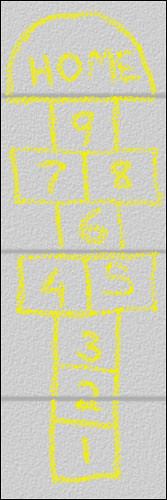 Curious about the state of things today, I checked the web and found several links to sites, like Streetplay Rulesheets, that explain the rules. In my day we drew a grid like the one in the picture here. There are many ways to draw them, as you’ll find with a quick search.
Quite surprisingly, from Wikipedia I learned that the game was originated by the Romans for soldiers, to improve their footwork. Maybe if boys today knew that, they’d be more likely to play!
Several of the websites I visited on this quest have rules for other games like Kick the Can, Red Rover, Simon Says, and so forth. What games did you play as a youngster, at school and in the neighborhood? Who did you play them with? Were you especially good at them? Have you taught any to your children or grandchildren?
If you want to share some of your old favorites but don’t quite remember how they went, do a web search, or go to the children’s room at your local library and ask the librarian to help you find a book with the rules. They’ll surely be there, along with pictures and diagrams.
Now, maybe I’ll call my older granddaughter and ask her about hopscotch. If she and her friends play this game, I might mail her the chain, and maybe I’ll put a couple of metal washers on it to give it more weight and heft. I used to be quite good at making markers that always landed on target.
Maybe I’ll also write a story or two about those games we used to play, and include the rules in the stories. Who knows? They might be a welcome diversion from Game Stations in another few years.
Have fun, and write on,
Sharon Lippincott, aka Ritergal
Tuesday, September 12, 2006
Moving Beyond Senseless Writing
Before I left on our recent trip I bought a new spiral notebook for the specific purpose of keeping a trip journal so I’d have the details for writing stories later. I managed to write a few lines about each port of call, but didn’t find the experience satisfying. I finally identified the root of the problem. I was writing about the easy stuff, which was mostly a list of things we saw and the status of the yet-to-be diagnosed minor knee injury I sustained as I was walking down the pier at our first port of call. I was writing “senselessly, leaving out my thoughts and reactions.
My failure to write about these perceptions was based on the fact that even though I’ve made strides in expanding my description skills, it still doesn’t come naturally. Much of the experience of being in these exotic places was pure sensation —rich wall colors, pungent fragrances, odd shapes pr exotic sounds. I also felt joy at seeing old edifices newly renovated and freshly painted, indicating prosperity and progress for formerly oppressed people and gratitude for the opportunity to be there. Joy, gratitude — how do you write about these sensory things?
Some people turn spontaneously to poetry for such expression. I envy people who are able to easily do this. It is not my gift. I’ll stick to narrative writing, but I’ll have to ponder the best way to go about it for awhile, chewing that mental cud I mentioned in my previous post. When I do write of these experiences, it will most likely be in the form of essays, not stories as such. When I do write about these experiences, I’ll draw upon the insights in an earlier post, Transcending the Trite.
Perhaps this is a good time to point out the difference between essays and stories. Stories involve action and/or interaction. Something happens. Stories have a plot. Essays are expressions of thoughts, ideas and insights. They may include a certain amount of action, but plot isn’t a critical element. Essays interject meaning into experiences. Both of these writing forms have a place in lifestory writing.
My conclusion is that for future trips I’ll take a tiny notebook that fits in a pocket where I can record thought fragments of a few words, tossing aside the idea of writing coherent narrative. I’ll also take along the small digital audio recorder I bought a few years ago with the intention of recording relatives telling stories. That hasn’t worked well, but I think it will work well for the purpose of describing smells, colors, and such sensory data.
Have you faced similar challenges when writing about sensory rich experiences from the past or the present? Let’s all give ourselves permission to move beyond senseless writing. Let’s scribble and write some thoughts that aren’t polished prose. Perhaps we’ll never share the result, but we’ll become more versatile writers for the trying. Let me know how it goes for you.
Write on,
Sharon Lippincott, aka Ritergal
My failure to write about these perceptions was based on the fact that even though I’ve made strides in expanding my description skills, it still doesn’t come naturally. Much of the experience of being in these exotic places was pure sensation —rich wall colors, pungent fragrances, odd shapes pr exotic sounds. I also felt joy at seeing old edifices newly renovated and freshly painted, indicating prosperity and progress for formerly oppressed people and gratitude for the opportunity to be there. Joy, gratitude — how do you write about these sensory things?
Some people turn spontaneously to poetry for such expression. I envy people who are able to easily do this. It is not my gift. I’ll stick to narrative writing, but I’ll have to ponder the best way to go about it for awhile, chewing that mental cud I mentioned in my previous post. When I do write of these experiences, it will most likely be in the form of essays, not stories as such. When I do write about these experiences, I’ll draw upon the insights in an earlier post, Transcending the Trite.
Perhaps this is a good time to point out the difference between essays and stories. Stories involve action and/or interaction. Something happens. Stories have a plot. Essays are expressions of thoughts, ideas and insights. They may include a certain amount of action, but plot isn’t a critical element. Essays interject meaning into experiences. Both of these writing forms have a place in lifestory writing.
My conclusion is that for future trips I’ll take a tiny notebook that fits in a pocket where I can record thought fragments of a few words, tossing aside the idea of writing coherent narrative. I’ll also take along the small digital audio recorder I bought a few years ago with the intention of recording relatives telling stories. That hasn’t worked well, but I think it will work well for the purpose of describing smells, colors, and such sensory data.
Have you faced similar challenges when writing about sensory rich experiences from the past or the present? Let’s all give ourselves permission to move beyond senseless writing. Let’s scribble and write some thoughts that aren’t polished prose. Perhaps we’ll never share the result, but we’ll become more versatile writers for the trying. Let me know how it goes for you.
Write on,
Sharon Lippincott, aka Ritergal
Friday, September 8, 2006
It's Good To Be Back
It’s good to be back! The extended space between posts here has accommodated nearly a month of new adventures. My husband and I flew out of JFK International, heading for Heathrow, on August 10, the day the news broke about the latest terrorism threat. Fortunately we were booked on Aer Lingus, which meant changing planes and entering the UK in Dublin, so we had none of the harrowing problems our friends flying directly into Heathrow from the USA experienced.
After a day of jetlag recovery in London, we proceeded to Dover and boarded the Celebrity Constellation for a two-week cruise around the Baltic, visiting Klaipeda, Lithuania; Helsinki, Finland; St. Petersburg, Russia; Tallinn, Estonia; Stockholm, Sweden; Rostok, Germany; Copenhagen, Denmark and Oslo, Norway. Just remembering the list makes my head swim!
As soon as we docked in Dover, we made a beeline for the bus back to London, then transferred to the metro line out to Heathrow for a flight to Shannon, Ireland, scrambling to make the tight transfer window. We then spent ten idyllic days exploring the Emerald Isle.
The result was a pair of vacations that were virtually the opposite of each other. The cruise was highly structured, luxurious, fast-paced, city oriented, and shared with friends. The Irish Adventure was planned on the fly. We knew only that we would concentrate our time in the southwest sector, experiencing it deeply, and that we did. We stayed in each place until we were ready to leave, hiked and explored ancient ruins and found our next B&B at the end of each day. Driving on Wild Irish Roads was an adventure in itself, and although we met dozens of delightful strangers, we were on our own for this part.
On the next-to-last day in Ireland, we visited the Bunratty Castle and Folk Center, and the sight of a huge five-prong red deer stag implacably in a pasture chewing his cud as he lay peacefully in a pasture blew me away. Now I think of that stag, and realize that I’ll be doing something similar with my trip memories. It’s the mental chewing and mulling that gives them shape, form and meaning and prepares them for sharing in a meaningful way.
There are many possible ways to write about the trip. We plan to set up a site (or maybe two) to share pictures and comments about them with family and friends. I’ll post a link to that when it happens. Eventually it will find its way into one or more personal lifestories. For this blog I’ll confine posts to insights about writing that occur to me as I reflect back, including only those trip details that are relevant as illustrations.
Again, it’s great to be home, back to blogging, writing and all the great things that everyday life brings along.
Write on,
Sharon Lippincott, aka Ritergal
After a day of jetlag recovery in London, we proceeded to Dover and boarded the Celebrity Constellation for a two-week cruise around the Baltic, visiting Klaipeda, Lithuania; Helsinki, Finland; St. Petersburg, Russia; Tallinn, Estonia; Stockholm, Sweden; Rostok, Germany; Copenhagen, Denmark and Oslo, Norway. Just remembering the list makes my head swim!
As soon as we docked in Dover, we made a beeline for the bus back to London, then transferred to the metro line out to Heathrow for a flight to Shannon, Ireland, scrambling to make the tight transfer window. We then spent ten idyllic days exploring the Emerald Isle.
The result was a pair of vacations that were virtually the opposite of each other. The cruise was highly structured, luxurious, fast-paced, city oriented, and shared with friends. The Irish Adventure was planned on the fly. We knew only that we would concentrate our time in the southwest sector, experiencing it deeply, and that we did. We stayed in each place until we were ready to leave, hiked and explored ancient ruins and found our next B&B at the end of each day. Driving on Wild Irish Roads was an adventure in itself, and although we met dozens of delightful strangers, we were on our own for this part.
On the next-to-last day in Ireland, we visited the Bunratty Castle and Folk Center, and the sight of a huge five-prong red deer stag implacably in a pasture chewing his cud as he lay peacefully in a pasture blew me away. Now I think of that stag, and realize that I’ll be doing something similar with my trip memories. It’s the mental chewing and mulling that gives them shape, form and meaning and prepares them for sharing in a meaningful way.
There are many possible ways to write about the trip. We plan to set up a site (or maybe two) to share pictures and comments about them with family and friends. I’ll post a link to that when it happens. Eventually it will find its way into one or more personal lifestories. For this blog I’ll confine posts to insights about writing that occur to me as I reflect back, including only those trip details that are relevant as illustrations.
Again, it’s great to be home, back to blogging, writing and all the great things that everyday life brings along.
Write on,
Sharon Lippincott, aka Ritergal
Monday, August 7, 2006
On Hiatus
Sometimes it seems that life gets in the way of writing. This is one of those times. The Heart and Craft of Lifestory Writing is going on vacation, and will resume in mid-September.
Stay tuned for stories of happenings during the hiatus. If you haven’t subscribed, now is a good time, so you’ll get a notice when I post again.
In the meanwhile,
Write on,
Sharon Lippincott, aka Ritergal
Stay tuned for stories of happenings during the hiatus. If you haven’t subscribed, now is a good time, so you’ll get a notice when I post again.
In the meanwhile,
Write on,
Sharon Lippincott, aka Ritergal
Saturday, August 5, 2006
Fresh Insight
One of the best ways to improve your writing is to read the work of fine writers. This reading can give you fresh insight into writing style, writing technique and a general philosophy of writing. I just finished reading Floor Sample, Julia Cameron’s hot new memoir and gained new insight in each of these areas. Julia is a novelist, playwright, songwriter and poet, and author of the best-seller, The Artist’s Way, the premier work on freeing the creative process in any mode. She is a fine writer indeed, and her story stirs my own creative juices.
In a comment on the inside cover, Sophy Burnham writes, “Courageous! An unflinching view of drugs, drunkenness, marriages, madness and the redemptive power of the creative spirit.”
When I finished reading the memoir, I thought of this comment. Yes, it is courageous and unflinching. She neither ducks issues like guilt, addictive denial, psychotic episodes, and flights of artistic inspiration, nor does she wallow in any of this. She records it, almost dispassionately. She’s entirely dispassionate about her successes, merely recording the fact of a book or script sale, without mention of the ecstasy she must have felt — or did she? I was left with the feeling that I’d peered through a porthole into one corner of her complex mind.
I mention this not as an indictment of the book. Her writing is lyrical, and I loved the book. It made me more keenly aware that the best efforts of the most talented authors result in a sketchy outline of actual experience. In every case, the story is finished with details and inferences supplied by the mind of the reader. No two readers will understand it the same way, because our interpretation of the story is colored by our own experience.
The interactive duality between reader and writer is both liberating and challenging. As a writer I realize that all I can do is to blaze a trail my readers will follow. The optimum result I hope for is to provide a lens for them to see their own world or work in a new way. Realizing that I don’t need to justify or explain my experiences or ideas, but merely present them as they are, is liberating. The challenge is to find a way to present them that’s fresh enough to inspire those new views.
This book was my first taste of Julia’s magic. It’s her most recent work, and having the story behind her earlier ones whets my appetite to work through The Artist’s Way, and perhaps one or more of her later works on creativity also.
I found this book, as I find nearly all my reading material, in the local library. Perhaps you’d like to take a library break this weekend and pick up a book or two to give you some fresh views and writing inspiration. You might even find one of Julia Cameron’s many titles on a shelf there.
Write on,
Sharon Lippincott, aka Ritergal
In a comment on the inside cover, Sophy Burnham writes, “Courageous! An unflinching view of drugs, drunkenness, marriages, madness and the redemptive power of the creative spirit.”
When I finished reading the memoir, I thought of this comment. Yes, it is courageous and unflinching. She neither ducks issues like guilt, addictive denial, psychotic episodes, and flights of artistic inspiration, nor does she wallow in any of this. She records it, almost dispassionately. She’s entirely dispassionate about her successes, merely recording the fact of a book or script sale, without mention of the ecstasy she must have felt — or did she? I was left with the feeling that I’d peered through a porthole into one corner of her complex mind.
I mention this not as an indictment of the book. Her writing is lyrical, and I loved the book. It made me more keenly aware that the best efforts of the most talented authors result in a sketchy outline of actual experience. In every case, the story is finished with details and inferences supplied by the mind of the reader. No two readers will understand it the same way, because our interpretation of the story is colored by our own experience.
The interactive duality between reader and writer is both liberating and challenging. As a writer I realize that all I can do is to blaze a trail my readers will follow. The optimum result I hope for is to provide a lens for them to see their own world or work in a new way. Realizing that I don’t need to justify or explain my experiences or ideas, but merely present them as they are, is liberating. The challenge is to find a way to present them that’s fresh enough to inspire those new views.
This book was my first taste of Julia’s magic. It’s her most recent work, and having the story behind her earlier ones whets my appetite to work through The Artist’s Way, and perhaps one or more of her later works on creativity also.
I found this book, as I find nearly all my reading material, in the local library. Perhaps you’d like to take a library break this weekend and pick up a book or two to give you some fresh views and writing inspiration. You might even find one of Julia Cameron’s many titles on a shelf there.
Write on,
Sharon Lippincott, aka Ritergal
Tuesday, August 1, 2006
A Major Brain Health Day
Today has been one of those major brain health days. A search on the term “brain health” brings up thousands of links like the Alzheimers Association site. This site explains how staying mentally active by engaging in stimulating activities like reading, writing and working crossword puzzles will keep your brain in good working order. In my humble opinion, untangling messes like malfunctioning links covers all those bases, and I spend enough time every day on such activities that my brain should remain sharp for at least 250 years.
I got started with today’s exercise first thing this morning when I discovered that the link to the audio file in last night’s post wasn’t working as it should. My search for a more reliable audio file parking site ate a sizeable chunk of the day, and led me through a succession of virtual junkyards.
In the process I discovered that there is an endless list of sites that are willing to host large files, at no charge, and most will hold them indefinitely. As you may expect, these sites are mostly supported by advertising. Many of similar to MySpace in promoting visibility and sharing among members. Any link to your uploaded file loads your member page with the player for the file. That page has links to all sort of other members, many of which are blatantly not family-friendly. That was an adventure.
Finally, I found FileDen, a low-key, tasteful site with a generous amount of space available at no cost, and far more available by subscription. You can upload any sort of file to their site, and link to it seamlessly from other sites. The audio file link opens in the standard QuickTime player rather than requiring you to download the file or look at trash. One of these months I'm going to venture into creating a short narrated photo-based movie with Microsoft's free PhotoStory 3 software. This will be a great place to store that for your viewing enjoyment.
You can also use this site to park files for friends and family to download. If you want to record a batch of stories, you can park them there and let people know where to go pick them up.
Lifestory writing itself is an excellent way to keep your brain healthy. The basic writing exercise is good, and so is the satisfaction of knowing you’ve produced a fine piece of work. Besides, it’s fun. If you take the next step of virtual wrestling as you master more technology and forge new paths in both cyberspace and your own gray matter, so much the better.
Write on,
Sharon Lippincott, aka Ritergal
I got started with today’s exercise first thing this morning when I discovered that the link to the audio file in last night’s post wasn’t working as it should. My search for a more reliable audio file parking site ate a sizeable chunk of the day, and led me through a succession of virtual junkyards.
In the process I discovered that there is an endless list of sites that are willing to host large files, at no charge, and most will hold them indefinitely. As you may expect, these sites are mostly supported by advertising. Many of similar to MySpace in promoting visibility and sharing among members. Any link to your uploaded file loads your member page with the player for the file. That page has links to all sort of other members, many of which are blatantly not family-friendly. That was an adventure.
Finally, I found FileDen, a low-key, tasteful site with a generous amount of space available at no cost, and far more available by subscription. You can upload any sort of file to their site, and link to it seamlessly from other sites. The audio file link opens in the standard QuickTime player rather than requiring you to download the file or look at trash. One of these months I'm going to venture into creating a short narrated photo-based movie with Microsoft's free PhotoStory 3 software. This will be a great place to store that for your viewing enjoyment.
You can also use this site to park files for friends and family to download. If you want to record a batch of stories, you can park them there and let people know where to go pick them up.
Lifestory writing itself is an excellent way to keep your brain healthy. The basic writing exercise is good, and so is the satisfaction of knowing you’ve produced a fine piece of work. Besides, it’s fun. If you take the next step of virtual wrestling as you master more technology and forge new paths in both cyberspace and your own gray matter, so much the better.
Write on,
Sharon Lippincott, aka Ritergal
Subscribe to:
Posts (Atom)
Preserve a Record of Life As It Was
Believe it or not, this post is not about politics. It’s about change. Regardless of your political position or beliefs, you’d have to be l...

-
Elizabeth-Anne Kim recently published two collections of life stories, DANCING IN THE RAIN ( free Kindle download Thanksgiving Day through...
-
One passage near the end of Stephanie Pearl-McFee’s memoir, Yarn Harlot: The Secret Life of a Knitter , struck me as a poignant reminder tha...
-
A few days ago in Transcending the Trite , I described ways of finding alternate words to keep your writing from sounding repetitious and st...

