Tuesday, July 18, 2006

Don't Be Deterred

Oh wow! To my horror I just learned that the link in my previous post to Pat Holt’s list of Ten Mistakes should have carried a warning:


I learned this from a friend who is on her maiden writing voyage. “After I read that list, I realized there are so many things to be careful about, I’m having trouble writing anything!” she balefully admitted.

The hair on the back of my neck went on full alert.

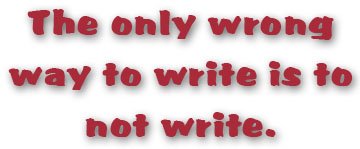
“Those rules are for editing, not writing drafts!” I told her. “Just write! Write anything. Just get words on paper!” I felt like standing on my chair and yelling, "Forget the rules!

She still sounded a little stuck and frozen so I made another suggestion: “Sit down with a tape recorder and tell a short story to the recorder. Then transcribe the tape.”

This idea appealed to her, and she promised to go home and give it a try. The idea behind this advice is that transferring her own words from audio to the written page will get her used to writing in a conversational tone. She agreed to put Pat’s list of rules out of mind for now. She’ll open her heart and let the words spill out. Then, maybe in a few weeks when she feels stronger, she’ll use that list to do a double-check on her edits before she circulates her stories to her intended audience.

If I caused you similar trepidation or reluctance, please accept my sincere apologies, and I have no doubt that Pat Holt would add her signature to mine. We don’t aim to discourage beginners. For better or for worse, we want everyone to write. Should you choose to take the next step and edit your work, then by all means, consult Pat’s list.

For now, keep this in mind:
Write on,

Sharon Lippincott, aka Ritergal

Sunday, July 16, 2006

Ten Mistake Writers Don't See

If you take your writing at all seriously, check out Pat Holt’s list of Ten Mistakes Writers Don't See

1. Repeats
2. Flat Writing
3. Empty Adverbs
4. Phony Dialogue
5. No-good Suffixes
6. The “To Be” Words
7. Lists
8. Show, Don’t Tell
9. Awkward Phrasing
10. Commas

The list doesn’t tell you how to structure your story flow to increase suspense, entertain readers, or bring tears to their eyes. It doesn’t tell you how to crop your story to focus it. But heeding the advice on it will help you bring your words to life and keep readers interested.

Pat earned her spurs as a writing critic as an editor at Houghton Mifflin and the San Francisco Book Company. Later she was book editor and critic at The San Francisco Chronicle. Currently she is an advocate for independent bookstores and consults on manuscript development. The lady knows the business, and she knows writing.

Write on,

Sharon Lippincott, aka Ritergal


Wednesday, July 12, 2006

Like Beads On a Necklace

How often do you write a life story that has more than one subject? What? It never occurred to you to consolidate topics? Welcome to the vast majority! Few people do. It’s natural to follow the ratio of one topic : one story. Not only is it natural, but when you read books on the subject, the planning chapters always have you make lists of story topics, and none of them (as far as I recall) discuss the option of doubling up.

There are several ways of doing this. One is nesting, where stories are imbedded, one within another, like a set of Russian nesting dolls. This technique requires that you return to complete each successive layer in reverse order to bring the overall story to closure.


Another way is to segue from one related story to the next, with a couple of lines of transition between.


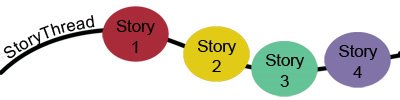
One of the most interesting is to string small stories together along an ongoing thread story.


Lori Jakiela uses this latter approach in Miss New York Has Everything, her recent memoir of growing up in Trafford, PA. In one chapter she uses the ongoing saga of a visit from her aunt, an alcoholic nun who is also a member of Narcotics Anonymous. She uses the occasion of the visit to string together ten shorter stories like beads on a necklace. Additional details of the aunt’s visit space the added stories like knots between pearls.

This book will surely become a classic for students of memoir and lifestory writing because it offers outstanding examples of story structure along with rollicking humor that begs to be read aloud to anyone within earshot. But perhaps its strongest feature is the tenderness and insight with which she describes her parents, two ordinary working class people who become extraordinary through the loving pen of their daughter.

Enjoy!

Write on,

Sharon Lippincott, aka Ritergal

Monday, July 10, 2006

Good Enough Is Good Enough

After two recent posts on finding the perfect words you may be feeling discouraged. I hear you thinking, “That’s so much work!” Indeed it is. I happen to enjoy editing and rewording. It’s one of my favorite sports — up to a point. Then, well, I get bored. I get tired. I get other ideas and want to move on. That happens sooner on some pieces than others.

Novelist Karen Hancock addressed this condition with a quote in her blog: “This is where I have to start applying that Tom Clancy quote about good enough being good enough, whereas perfect is a total pain and often not worth the trouble anyway.”

Well said, Karen. What more could I add?

Write on,

Sharon Lippincott, aka Ritergal

Saturday, July 8, 2006

The Write Brain Workout

A few days ago in Transcending the Trite, I described ways of finding alternate words to keep your writing from sounding repetitious and stale. This sort of word puzzle is an exceptionally good workout for your brain. It keeps your neurons healthy and actually builds new connections, helping to keep your mind young and flexible. Here’s another example to encourage you to try it yourself.

Let’s click over to Thesaurus.com to find a synonym for “master” to reduce redundancy in this sentence: “Cindy was a master of creativity and the announcement she wrote was a masterpiece.” Oh dear — that’s okay for a first draft, to get the idea down on paper, but all I’m saying here is that Cindy wrote a masterpiece. If I want to leave that descriptive phrase in, I need to change it so it adds value to the message to justify the added ink.

I find pro, expert, whiz, wizard and exemplar, among others, but they don’t quite fit. Champion is close, but my favorite is crackerjack — that’s my word. Not only will I avoid repetition, but that word more precisely fits my need anyway. Oops, hold on. Crackerjack works, but I need to fiddle a bit further. Cindy isn’t a crackerjack of creativity, she’s a crackerjack writer. Or a creative wizard.

Sometimes you need to switch more than a single word. You need to drill down to the core concept or meaning. I’m happy with either of these alternatives, and either one is more expressive than the knee jerk original choice.

Stephanie West Allen gives additional ways to increase your vocabulary and word power in her TrackKnacks posting 7 power vocabulary words, plus two vocabulary boosters.

I urge you to click over there to learn about Word.A.Day and Merriam-Webster’s Word of the Day along with all the ways that a great vocabulary can improve your life. Perhaps you’ll want to subscribe, as I’m doing. Thanks for the tip, Stephanie!

Now, how about giving your own neurons a workout by trying a few sentences in one of your stories to see what you can come up with?

Write on,

Sharon Lippincott, aka Ritergal

Thursday, July 6, 2006

The Day I Became Mortal


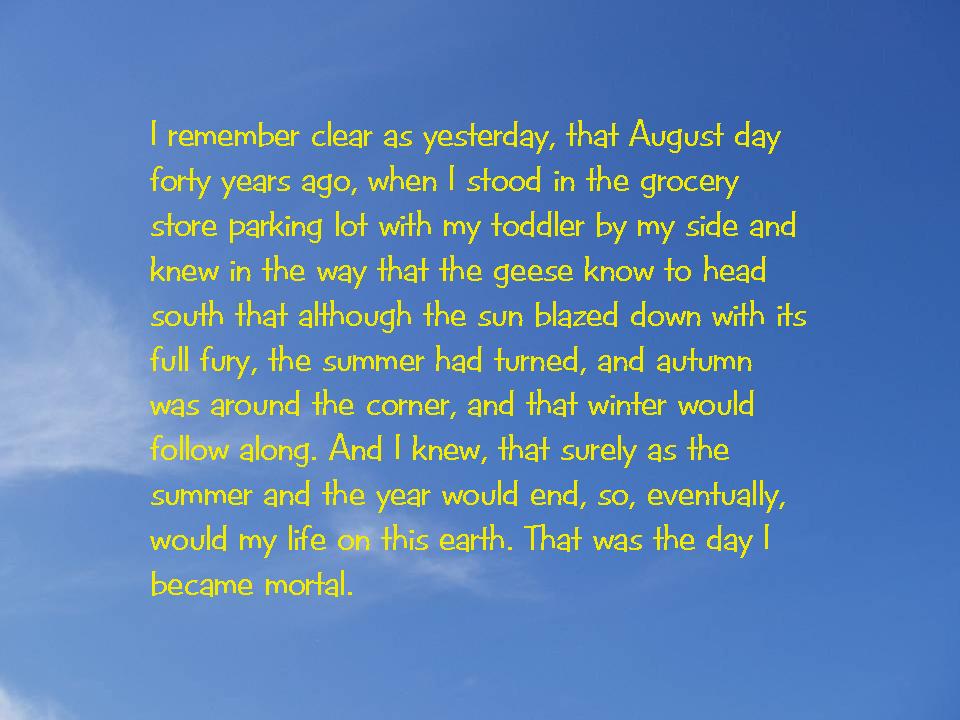
Some of our most profound stories are short, and they beg to be rendered graphically, as this one does.

This story is pared down to its essence. Further detail would distract from the knowingness of it. My memory is much richer:

I remember the sleeveless mini-dress I wore – a yellow coarse-weave fabric with a paisley pattern of pale golds and oranges, a wide collar and buttons down the front. I loved that dress, and wore it with my hippy sandals. I felt so cool in my hip short hairdo with the curls on top and sleek, smooth hair on the bottom. My sunglasses were huge.


I remember the smell of heat waves rising from asphalt and the fly buzzing lazily in the air. My bag of groceries weighed heavy and cold in my left arm and my tiny son’s little hand, as plump as his pudgy cheeks, warmed my other. He stood smiling in his navy chino boxer shorts, the madras plaid shirt matching the one I made his daddy, and his red Keds. The black vinyl top on our red Corvair Corsa convertible radiated heat like an oven.

I remember how intensely blue the sky was, how bright and hot the sun. Before then, summer seemed to go on forever, without any hint it would end. This day, as I looked at the sky, everything looked the same, and nothing was the same. Something fundamental had shifted. The balance had turned, in the season and in my soul. This moment was a milestone in my life, when I first truly knew that life is temporary.

How much does the story gain for you as a naïve reader with the addition of the extra memory? Some will like it better, some will prefer the spare version. Some will appreciate the artistic enhancement more than others.

This is a good time to reflect back to the concept of purpose. If my purpose is to portray the intensity of the moment and my insight, I'll go with the spare version. If my purpose is to portray a sense of the time, of life that summer, details matter.

Compare these two versions and consider how you might adapt your own stories. Obviously you won’t experiment with everything you write, but perhaps you have a milestone story of your own, a key insight moment, that you’d like to play with. Pare it down, dress it up. Different strokes for different folks, and different purposes.

Write on,

Sharon Lippincott, aka Ritergal

Saturday, July 1, 2006

Transcending the Trite

If you’re even a little bit serious about improving your writing, you know the value of replacing banal autopilot words with something more imaginative, something that will catch the reader’s eye rather than gliding past it like asphalt on the road. But how do you go about finding those fragrant figments of speech? It takes years to develop enough vocabulary flexibility to have a dozen options on the tip of your fingers for any given phrase.

This morning I began an e-mail to another writer. “I love your descriptions,” I wrote. Oh gag! I thought. Not about the descriptions, but about that trite phrase. I’m writing about lilting phrases that slide into my ear like the warble of a meadowlark, and all I can say is “I love your descriptions”? I tried again. “I admire your descriptions.” True, but not even close.

There was no need to flounder. Those of you reading this blog can do the same thing I did — click over to Thesaurus.com. I searched for alternatives to “admire” and came up with twenty-six lists containing hundreds of words, mostly overlapping. Treasure, cherish, commend, savor, applaud or esteem were improvements, but still lacking.

Rather than recasting the search with one of those words, I took another tack. I recast the sentence: “Your descriptions are music in my ears.” Mental melodies? Your lyrical lines…? How do I feel when I read her descriptions? I asked. What do they remind me of?

I won’t bore you with every thought in the train. I’ll skip to the final choice, only one of many satisfactory alternatives:  “Your lyrical lines of description evoke the happy tinkle of wind chimes. My heart smiles.” Okay. Maybe this is a bit overblown for most purposes, but it’s accurate! That is the way I respond. Her writing has that effect on me, and challenges me to respond in kind.

To me this is the difference between sending a birthday card from the Dollar Store versus handcrafting one on rice paper with embossed borders, a poem in hand-written calligraphy, and a few watercolor embellishments. Some occasions call for the quick-and-dirty card, and auto-pilot words are fine for most communications.

But not my stories! When I write for the delight of readers, they deserve my very best. I’m not great with calligraphy, poetry, rice paper or watercolor brushes. Word pictures are what I have to offer.

My challenge to you: Take one ordinary sentence from a story you’ve written, or one you’re working on, and see how far you can stretch it. Write from your heart to make it flower, make it growl, make it glow. Transcend the trite!

Write on,

Sharon Lippincott, aka Ritergal

Preserve a Record of Life As It Was

Believe it or not, this post is not about politics. It’s about change. Regardless of your political position or beliefs, you’d have to be l...